

On this page
Series questions in Class 11 and JEE Main practice rarely say which method to use: telescoping, the method of differences, or an arithmetico-geometric progression (AGP). An AI chatbot can help you choose, but only if you make it explain the choice and you test the answer yourself.
The test is simple. A partial sum is the total of the first k terms, S_k = a_1 + a_2 + ... + a_k, as defined in OpenStax Calculus Volume 2. You can always add three terms by hand. If the AI's formula disagrees with your S1, S2 or S3, the formula is wrong.
Which method fits: telescoping, differences or AGP?
Each method leaves a visible clue in the general term.
Telescoping: the term can be written as f(k) − f(k+1), often a fraction whose denominator is a product like k(k+1). OpenStax describes a telescoping series as one where most terms cancel in each partial sum, leaving only some of the first and last terms.
Method of differences: the terms are plain numbers with no obvious formula, but the gaps between them form an AP or a GP. Example: 1, 3, 7, 13, 21 has gaps 2, 4, 6, 8.
AGP: each term is an AP term times a GP term, like k/2^k or (2k − 1)x^k. You multiply the sum by the common ratio, subtract, and a GP is left over.
Our post on the telescoping method for tan inverse series shows the f(k) − f(k+1) step in detail.
What should you ask the AI?
Don't just ask for the answer. Ask for the reasoning. A script you can copy:
"Which method fits this series: telescoping, method of differences or AGP? Name the feature of the general term that tells you."
"Write the general term T_k before doing anything else."
"Give the formula for S_n, then show S_1, S_2 and S_3 from your formula."
"Don't simplify further until I confirm those three values."
How do you check the first few partial sums?
Three quick checks:
Add the first one, two and three terms by hand, as fractions, not decimals.
Put n = 1, 2, 3 into the AI's formula.
If all three match, try n = 4 for safety. If any one fails, stop and ask the AI to find its error.
Take the method of differences on 1 + 3 + 7 + 13 + ... The gaps 2, 4, 6 suggest T_n = n² − n + 1, which gives S_n = n(n² + 2)/3. Check it: n = 1 gives 1, n = 2 gives 4, n = 3 gives 11, and n = 4 gives 24. By hand: 1, 1 + 3 = 4, 4 + 7 = 11, 11 + 13 = 24. All four agree, so you can trust the formula.
What does a wrong AGP formula look like?
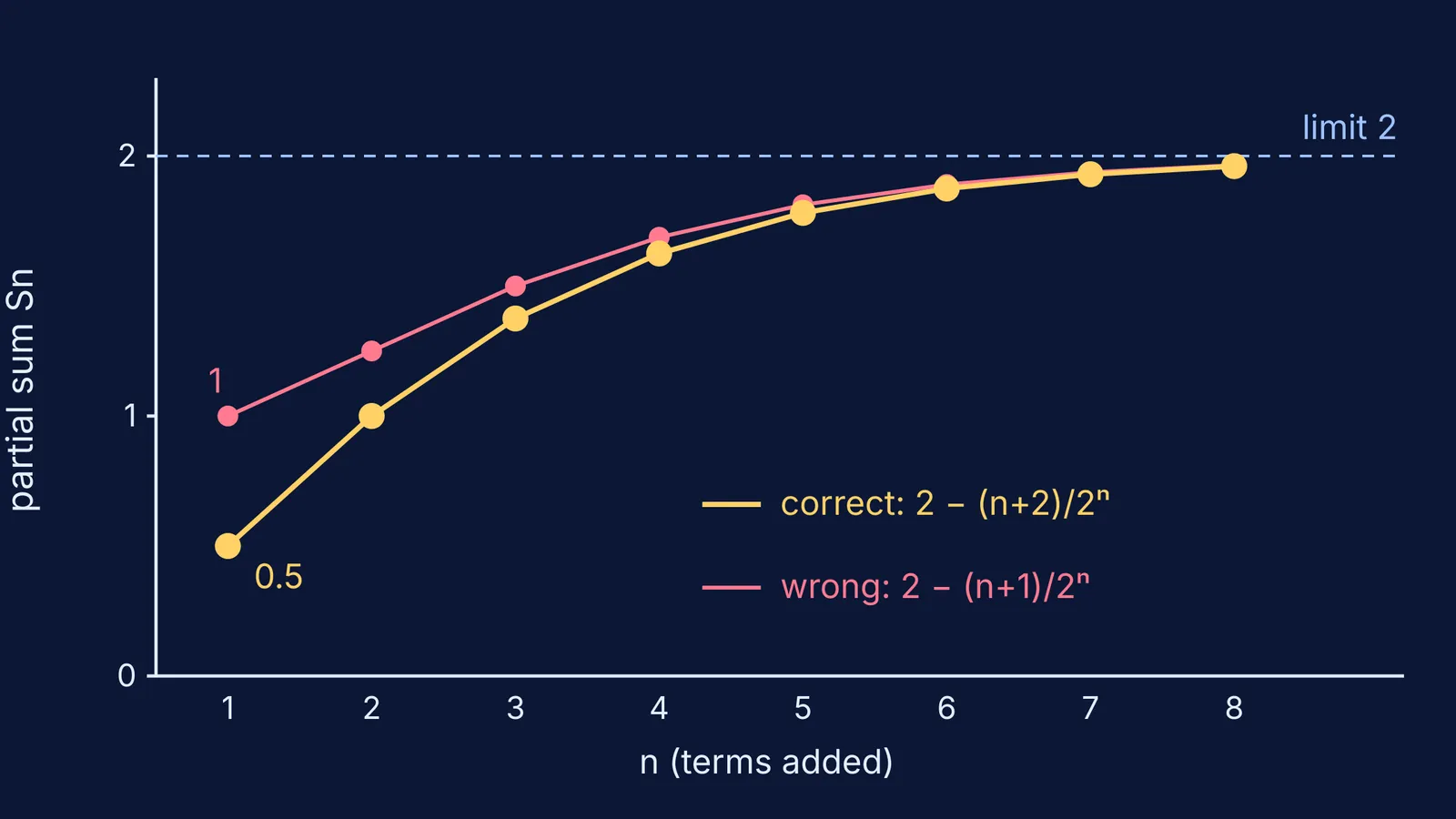
Suppose you ask for S_n = 1/2 + 2/4 + 3/8 + ... + n/2^n. This is an AGP: the numerators are an AP and the denominators are powers of 2. The correct result is S_n = 2 − (n + 2)/2^n.
Now suppose the AI writes 2 − (n + 1)/2^n, an easy off-by-one slip. Both formulas tend to 2 as n grows, so checking only the infinite sum would not catch it.
The partial sums do. By hand, S_1 = 1/2. The wrong formula gives 2 − 2/2 = 1. Caught at the very first term. The correct formula gives 2 − 3/2 = 1/2, then 1 for n = 2 (1/2 + 2/4 = 1), then 11/8 for n = 3 (1 + 3/8). The chart above plots both formulas: they never meet, but they head to the same limit. (For limits themselves, see checking an AI limit answer numerically.)
Why not just ask the AI to check itself?
Because that check is not reliable on its own. In Large Language Models Cannot Self-Correct Reasoning Yet, Huang and colleagues found that models struggle to correct their reasoning without outside feedback, and their performance sometimes got worse after self-correction. A separate study, GSM-Symbolic by Mirzadeh and colleagues, tested grade-school maths questions. Performance declined when only the numbers in a question were changed, and adding one clause that seemed relevant but played no part in the solution caused drops of up to 65%.
Your hand-added S1, S2 and S3 are that outside feedback. For other kinds of answers, substituting the answer back does the same job.
What if you keep choosing the wrong method?
Then you need the reasoning behind the choice, not more answers. The Fermi Problem Library has worked problems with a step-by-step solver that explains the reasoning rather than printing an answer. Fermi's AI tutor notices where you are stuck and decides whether to explain, ask or show.
Next time you meet a series, write down the method and its clue, add three terms, and only then open the chat.


