On this page
Area and volume questions in Class 8 look easy until the units disagree. A floor is given in metres, a tile in centimetres, and the answer has to come out in one of them. This is where an AI chatbot can give you a confident, neatly formatted, wrong answer. The fix is not to stop using AI. It is to check the step that often breaks: the unit conversion.
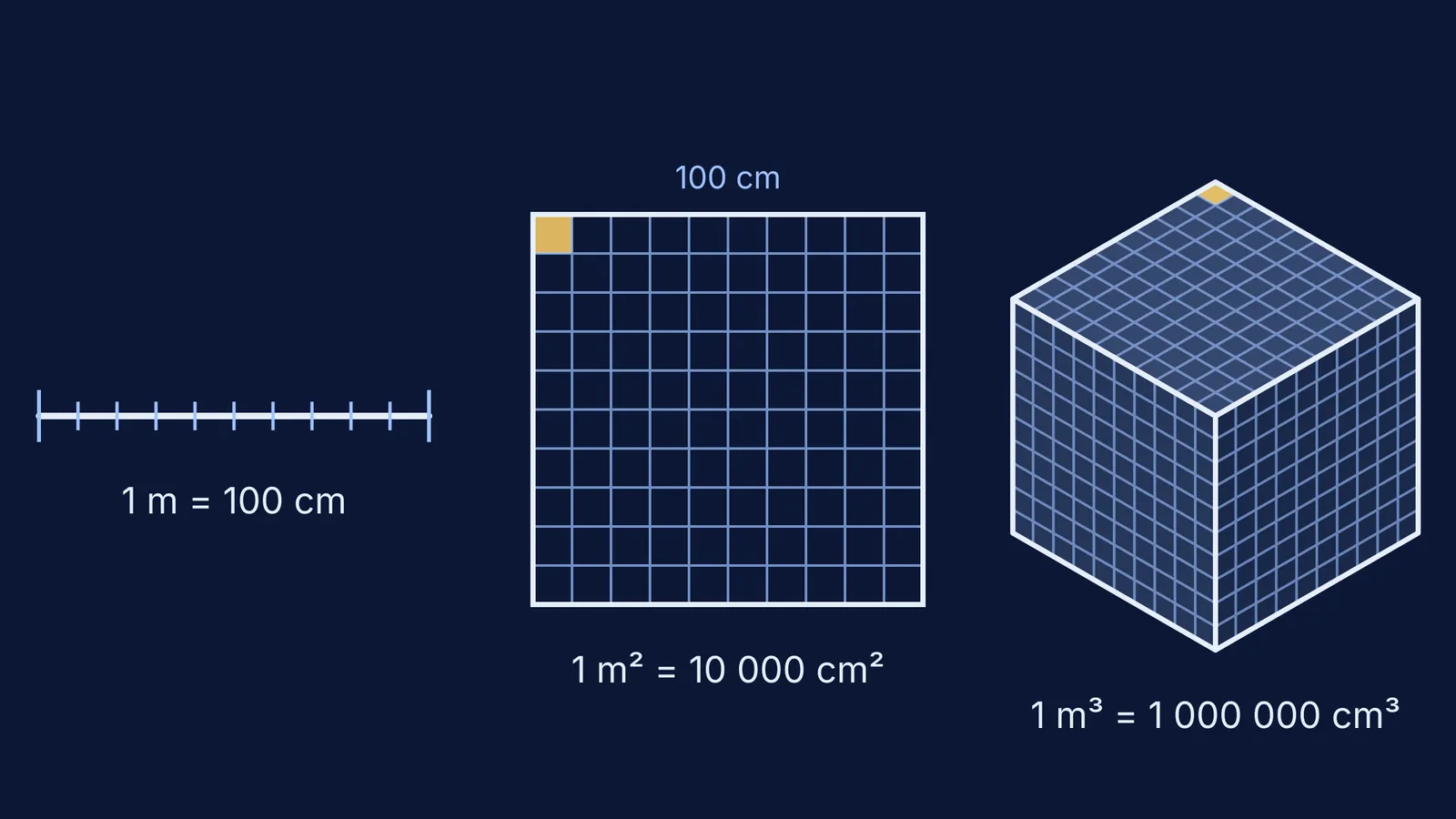
Why is 1 square metre 10,000 square cm, not 100?
Because area is length times length, so the length factor gets used twice. The US National Institute of Standards and Technology sets out the chain on its SI units of area page: 100 cm² make 1 square decimetre, and 100 square decimetres make 1 m². That gives 1 m² = 100 × 100 = 10,000 cm².
Volume uses the factor three times. NIST's SI units of volume page lists 1,000 cm³ = 1 cubic decimetre, which is 1 litre, and 1,000 litres = 1 m³, so 1 m³ = 1,000,000 cm³.
The rule to carry in your head:
Length: multiply by 100 to go from m to cm.
Area: multiply by 100² = 10,000.
Volume: multiply by 100³ = 1,000,000.
In NCERT's new Class 8 textbook, Ganita Prakash Part II (first edition December 2025), Chapter 7 'Area' goes deeper into the areas of triangles and quadrilaterals, and Chapter 4 explores 3D geometry. Whatever your school calls the topic, the units trap is the same. To see why the factor grows so fast, read our explainer on how a scale factor changes area and volume.
How do you use AI to check unit conversions in area questions?
Here is a typical question: a room floor is 4.5 m by 3.2 m. How many square tiles of side 40 cm are needed to cover it?
A common slip: floor area = 14.4 m², "converted" to 1,440 cm² by multiplying by 100 instead of the 10,000 in NIST's area conversion chain; tile area = 1,600 cm²; so 0.9 tiles. Less than one tile for a whole room should set off an alarm.
The checked version converts lengths first, before multiplying:
Floor: 450 cm × 320 cm = 144,000 cm².
Tile: 40 cm × 40 cm = 1,600 cm².
Tiles: 144,000 ÷ 1,600 = 90.
Cross-check the other way: 14.4 m² × 10,000 = 144,000 cm². Both routes agree, so you can trust 90.
What should you type to make the AI show its units?
Paste your question, then add this:
"Before solving, list every measurement with its unit. Convert all lengths to one unit and show it. When you convert an area or volume, write the factor as a power, like 100² or 100³. Then check the final answer with a size estimate."
If you have already solved it, ask the AI to check instead of solve: "Here is my working. Do not give the answer. Point to any line where the units don't match." That keeps the thinking with you, which is the idea behind using AI to understand mistakes, not get answers.
How do you check a volume answer in litres?
Question: a tank measures 1.2 m by 80 cm by 50 cm. How many litres does it hold?
Wrong route: 1.2 × 80 × 50 = 4,800, then call it litres. Metres and centimetres were mixed in one multiplication.
Checked route:
Lengths in cm: 120 × 80 × 50 = 480,000 cm³.
Litres: NIST's volume page gives 1,000 cm³ = 1 L, so 480,000 ÷ 1,000 = 480 L.
Cross-check in metres: 1.2 × 0.8 × 0.5 = 0.48 m³, and 1 m³ = 1,000 L, so 480 L.
Two routes, one answer. For more practice, see our walk-through on converting cubic centimetres to litres in tank problems.
A three-step check before you trust any answer
Same units? Every length in one unit before you multiply.
Right power? 100 for length, 100² for area, 100³ for volume, as in the NIST area and volume tables.
Sensible size? Work it a second way, or estimate. Less than one tile for a room, or a tank smaller than a cup, means go back.
If the same wrong method keeps showing up, the Fermi Problem Library has worked problems with a step-by-step solver that explains the reasoning rather than printing an answer. If you're not sure where the gap is, Fermi's AI tutor works out what you already know and builds a plan for the session, so you sit down to a clear next step.
Next time an AI hands you an area or volume answer, check the units before you copy it down.