

On this page
Field line diagrams are an easy place to lose marks: an arrow points the wrong way, two lines touch near a pole, or the lines inside a solenoid curve when they should run straight. You can catch most of these by describing your sketch to an AI and asking it to check each line against the textbook rules.
Describing a drawing does not replace drawing it. In a 2016 study in Cognitive Research, Eliza Bobek and Barbara Tversky found that middle-school students who created visual explanations of a bicycle pump and of chemical bonding learned more than those who wrote verbal explanations, and they linked this partly to the checks a drawing gives for completeness and coherence. Words add a second check: every arrow you name is a claim the AI can test.
What rules must Class 10 field line drawings follow?
All of these come from Chapter 12, Magnetic Effects of Electric Current, of the NCERT Class 10 Science textbook.
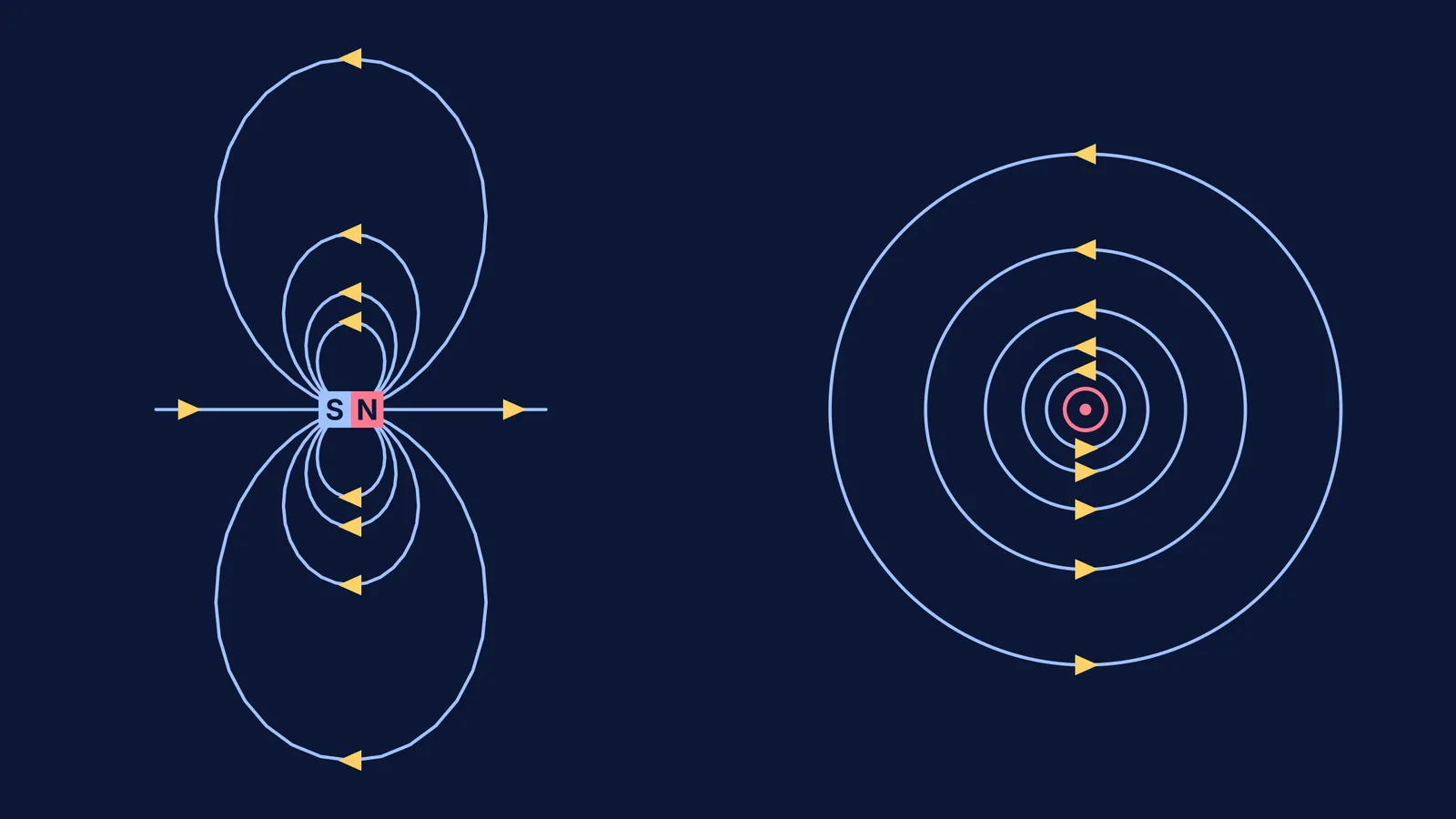
Bar magnet: outside the magnet, field lines emerge from the north pole and merge at the south pole; inside, they run from south to north, so every line is a closed curve.
Spacing: lines are crowded where the field is stronger, which is near the poles.
No crossing: no two field lines cross, because at a crossing a compass needle would have to point in two directions.
Straight wire: the lines are concentric circles around the wire, and the right-hand thumb rule gives their direction: thumb along the current, fingers curl the way the field goes.
Solenoid: outside, the pattern looks like a bar magnet's; inside, the lines are parallel straight lines, showing a uniform field.
Mixing them up with electric field lines? See how electric and magnetic field lines differ, which sets the two side by side.
How do you describe a field line sketch to an AI?
The AI cannot check what you leave out, so describe the sketch as if to a friend who must redraw it. Cover six things:
The object and how it lies, for example "bar magnet, horizontal, N on the right".
For a wire or solenoid, the current direction, for example "into the page" or "clockwise as seen from the left end".
Where each line starts and ends.
Which way the arrow points at named spots, such as inside the coil.
How the spacing changes from near to far.
Any place where two lines touch or meet.
Then paste this script, with your six points in the gap:
"I am a Class 10 student checking a magnetic field line diagram against NCERT rules. Here is my description: (my six points). Do not redraw it. List every place where an arrow points the wrong way, lines cross or touch, the lines inside a solenoid or magnet are wrong, or the spacing shows the wrong field strength, and name the rule each breaks. If my description is too vague to check, ask me a question instead of guessing."
The last line stops the AI filling gaps with what a correct diagram would show, which would hide your mistake.
What should the AI flag? A worked example
Here is a description of a solenoid sketch with three planted mistakes:
"Solenoid lying horizontally. Seen from the left end, the current goes clockwise. Outside, four lines leave the left end and curve round to the right end. Inside, three lines bunch together in the middle. At the right end, one outside line touches an inside line."
A good check flags all three:
Direction. Curl the fingers of your right hand clockwise as seen from the left end and your thumb points into the coil, towards the right. So the field inside runs left to right, the right end is the north pole, and the outside lines should leave the right end. The arrows are reversed. Our post on the clock rule for solenoid poles gives a second way to check this.
Inside shape. The lines inside should be straight, parallel and evenly spaced, because the field there is uniform.
Touching lines. Two field lines must never meet.
For a straight wire, "current into the page, evenly spaced circles, arrows anticlockwise" has two errors. The right-hand thumb rule gives clockwise circles, and the gaps should widen away from the wire, since the field weakens with distance and spacing shows strength.
Can you trust the AI's answer?
Treat each flag as a claim to check, not a verdict. For every problem the AI names, find the matching rule in the NCERT chapter; if the AI and the textbook disagree, go with the textbook and your teacher. Then redraw the diagram from your corrected description. The same habit works for optics, as in how an AI tutor checks a ray diagram description.
If the solenoid's field is still hard to picture, the Fermi Simulation Lab has interactive simulations for ideas that are easier to see than to read. And if you keep making the same mistake, Fermi's AI tutor works out what you already know, draws the figure and checks your understanding as it goes.


