

On this page
Many students can draw the curved arrows for nucleophilic addition. Fewer can say why each one goes where it does, and that "why" is what a question tests when it swaps ethanal for propanone or adds a benzene ring. An AI can help, but only if you make it explain every arrow. Copying a finished mechanism won't teach you that.
Why do aldehydes react faster than ketones in nucleophilic addition?
The NCERT Class 12 chemistry chapter on aldehydes, ketones and carboxylic acids gives two reasons, steric and electronic.
Steric: a ketone has two relatively large groups on the carbonyl carbon, an aldehyde only one, so the nucleophile has a harder path in.
Electronic: alkyl groups push electron density towards the carbonyl carbon, so two of them make it less electrophilic than one does.
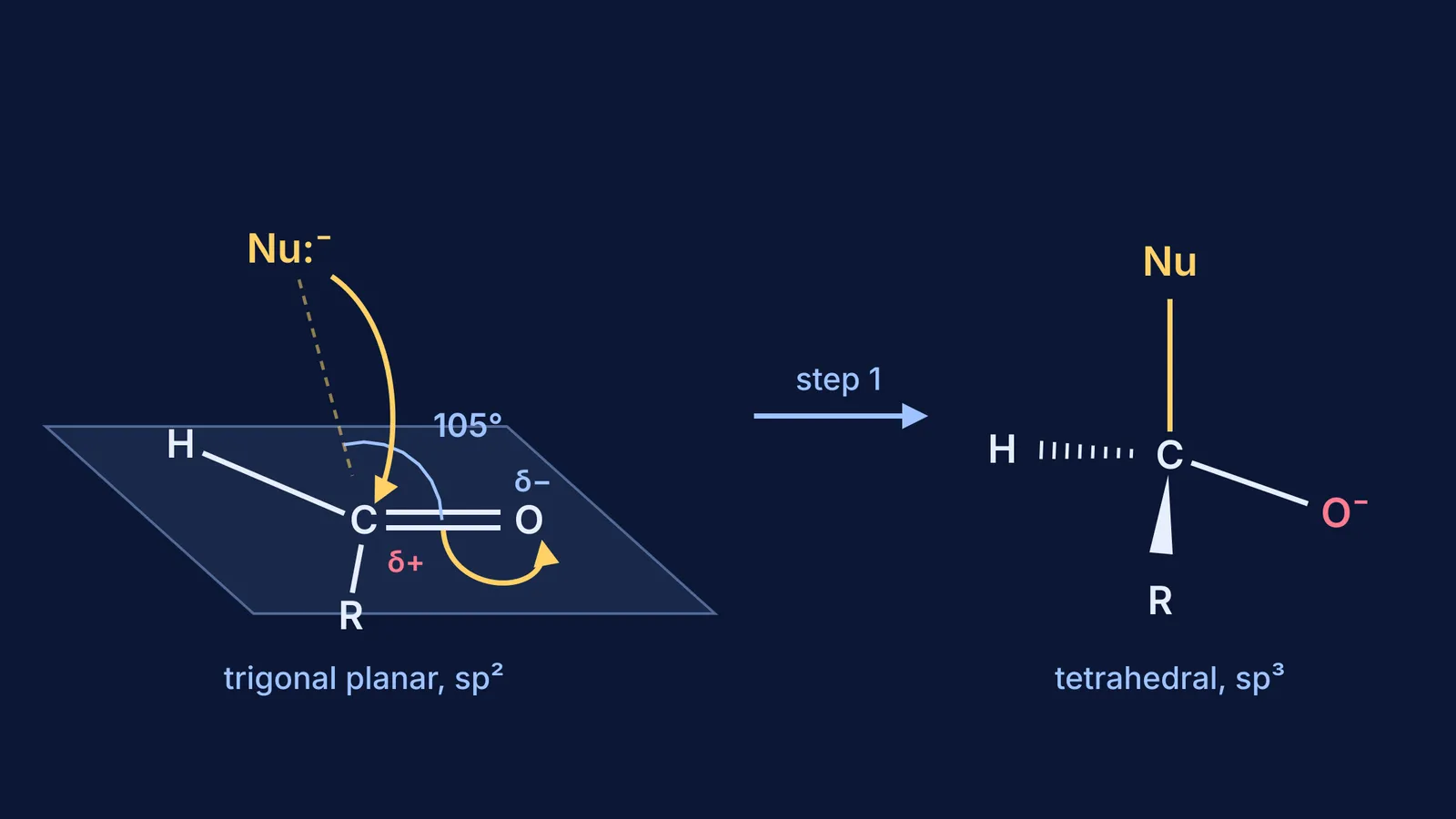
The OpenStax Organic Chemistry text/19%3A_Aldehydes_and_Ketones-_Nucleophilic_Addition_Reactions/19.04%3A_Nucleophilic_Addition_Reactions_of_Aldehydes_and_Ketones) adds the geometry: the nucleophile approaches the carbonyl carbon at an angle of about 105°, opposite the oxygen, and that carbon changes from sp2 to sp3 as it becomes a tetrahedral intermediate.
The same pattern shows up strongly in hydration. At equilibrium in water, formaldehyde is 99.9% gem diol, while acetone is only about 0.1% gem diol/19%3A_Aldehydes_and_Ketones-_Nucleophilic_Addition_Reactions/19.05%3A_Nucleophilic_Addition_of_Water-_Hydration). NCERT gives a similar case: sodium hydrogensulphite addition lies largely to the right for most aldehydes and to the left for most ketones, for steric reasons.
What does "justify each arrow" actually mean?
A curved arrow claims that a specific pair of electrons moves from one place to another. To justify it, you answer three questions:
Where do the electrons start? (A lone pair or a bond, never a positive charge.)
Where do they end up? (A new bond, or a lone pair on an atom.)
Why does that atom want them, and why can the starting atom let them go?
This matters because a mechanism can look right and still be nonsense. In a study of graduate-level organic chemistry students, Gautam Bhattacharyya and George Bodner examined how students wrote mechanisms for two- to four-step reactions that lacked the usual cues, and discussed the limits of their strategies. The paper's title sums up the trap: "It gets me to the product". An arrow drawn only because it leads to the known answer explains nothing.
Worked example: HCN adding to ethanal, arrow by arrow
NCERT notes that this reaction is very slow with pure HCN, so it is catalysed by base, because cyanide ion is the stronger nucleophile. Each arrow, justified:
Arrows 0 (making the nucleophile): a lone pair on OH⁻ takes the H of H–CN, and the H–C bond pair moves onto carbon, leaving CN⁻. Why: HCN itself is a weak nucleophile; the anion has a lone pair it can spare.
Arrow 1: the lone pair on cyanide's carbon goes to the carbonyl carbon. Why: that carbon is δ+, because oxygen pulls the C=O electrons towards itself.
Arrow 2: at the same time, the C=O π bond moves onto oxygen. Why: carbon cannot hold five bonds, and electronegative oxygen can carry the negative charge. Carbon goes from sp2 (planar) to sp3 (tetrahedral). NCERT's figure labels this attack the slow step.
Arrow 3: a lone pair on the alkoxide O⁻ picks up a proton in the fast second step, giving the cyanohydrin, 2-hydroxypropanenitrile.
Now change ethanal to propanone. The arrows don't change, but the justification for arrow 1 gets weaker: two methyl groups crowd the carbon and lower its δ+. That one sentence is the whole aldehyde-versus-ketone answer.
What prompt should you give the AI?
Paste this, then fill in your reaction:
"Explain the mechanism of [HCN + propanone, base-catalysed]. Number every curved arrow. For each arrow, tell me where the electrons start, where they end, and why the receiving atom wants them. Do not skip proton transfers. Then tell me which arrow would be harder for a ketone than an aldehyde, and why."
Then turn it around and make the AI check you. Write your own arrows in words ("lone pair on C of CN⁻ to carbonyl C") and ask it to find the first arrow you cannot justify. We have a fuller checklist for this in our guide to checking AI-drawn mechanism arrows.
Where does this lead next?
The same carbonyl carbon drives nucleophilic acyl substitution in esters and acid chlorides, where the tetrahedral intermediate kicks out a leaving group instead of picking up a proton. The C=O pull also explains why alpha hydrogens in carbonyl compounds are acidic.
If you keep losing marks on the method rather than the final product, the Fermi Problem Library has worked problems with a step-by-step solver that explains the reasoning rather than printing an answer. Fermi's AI tutor decides whether to explain, ask or show, and checks understanding as it goes, which suits arrow-by-arrow practice.


