

On this page
Nucleophilic acyl substitution is the defining reaction of carboxylic acid derivatives. Whether you are dealing with an acid chloride, an anhydride, an ester, or an amide, they all react with nucleophiles through the same fundamental pathway.
Unlike the one-step S_N2 reactions of alkyl halides, substitution at a carbonyl carbon is a two-step dance. The reaction does not push the leaving group out directly. Instead, it pauses at a temporary, high-energy structure before completing the swap.
What is the nucleophilic acyl substitution mechanism?
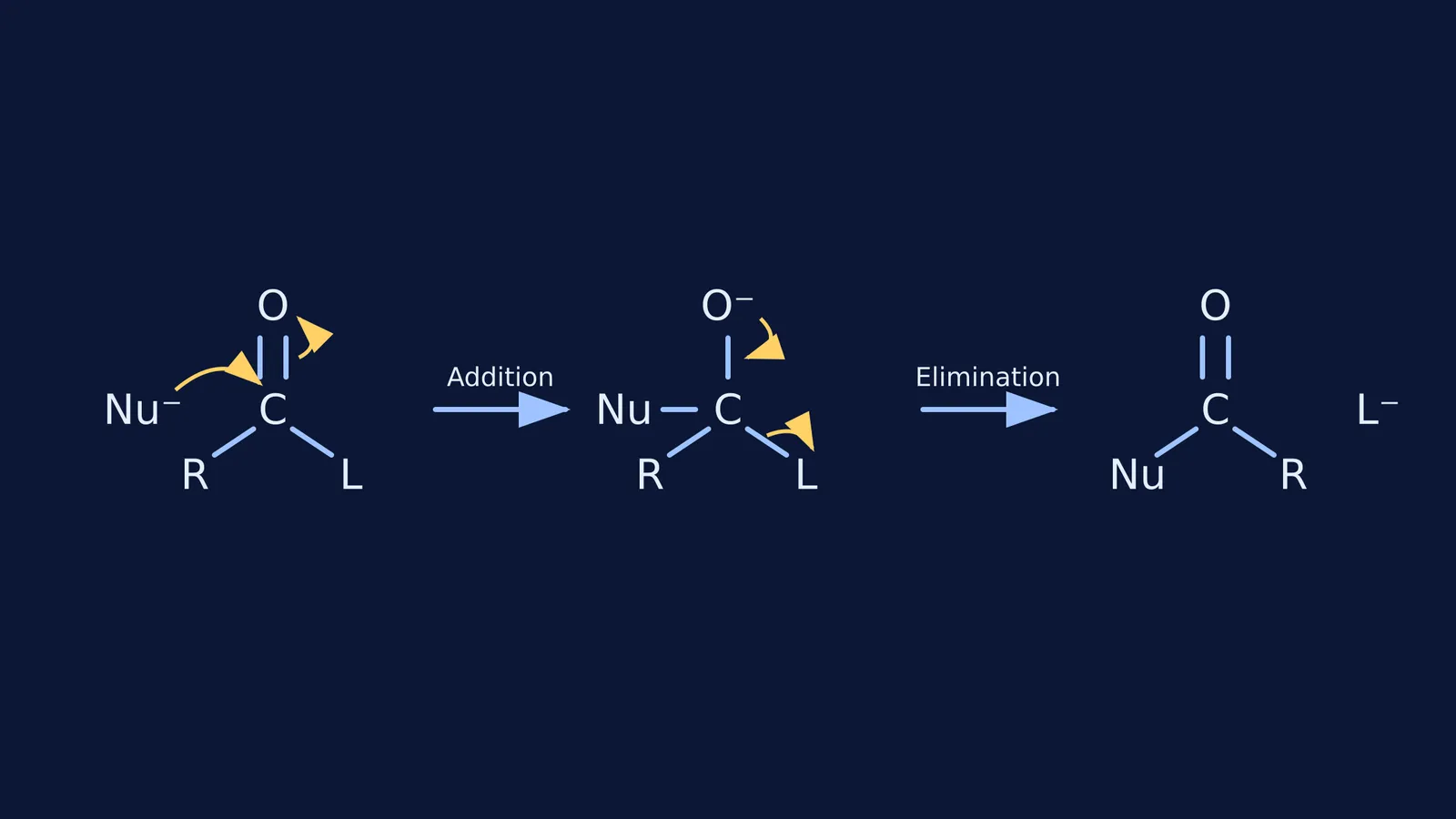
The mechanism consists of two distinct steps: addition and elimination.
In the first step, a nucleophile attacks the electrophilic carbonyl carbon. The carbon-oxygen pi bond breaks, and the electron pair shifts completely onto the oxygen atom. This forms a negatively charged alkoxide ion. The nucleophilic acyl substitution mechanism occurs in two steps: addition to form a tetrahedral alkoxide intermediate, and elimination of the leaving group (Source/21%3A_Carboxylic_Acid_Derivatives-_Nucleophilic_Acyl_Substitution_Reactions/21.02%3A_Nucleophilic_Acyl_Substitution_Reactions)).
In the second step, the intermediate collapses. The lone pair on the negatively charged oxygen swings back down to reform the carbon-oxygen double bond. To make room, the carbon must eject one of its substituents. It expels the best leaving group, which takes its bonding electrons with it, restoring the stable carbonyl group.
Why does a tetrahedral intermediate form?
The intermediate is the physical bridge between the reactant and the product. When the nucleophile attacks the flat, trigonal planar carbonyl group, the carbon atom must make room for a fourth bond. During the first step, the nucleophile's attack forms a tetrahedral alkoxide intermediate (Source/21%3A_Carboxylic_Acid_Derivatives-_Nucleophilic_Acyl_Substitution_Reactions/21.02%3A_Nucleophilic_Acyl_Substitution_Reactions)).
This tetrahedral intermediate is unstable because the oxygen carries a full negative charge without the resonance stabilization of a pi bond. It exists only briefly before the driving force to recreate the strong carbon-oxygen double bond forces a group out.
If you find it hard to picture how electron pairs shift between these states, the Fermi Concept Library has every concept in physics, chemistry, biology, mathematics and computing, each with its own lesson and its place in the map.
Which carboxylic acid derivatives are most reactive?
The speed of the reaction depends heavily on how easily the leaving group departs when the intermediate collapses. The better the leaving group can stabilize a negative charge, the faster the elimination step runs.
The reactivity of carboxylic acid derivatives follows the order: acid chlorides are the most reactive, followed by anhydrides, esters, and amides (Source/21%3A_Carboxylic_Acid_Derivatives-_Nucleophilic_Acyl_Substitution_Reactions/21.02%3A_Nucleophilic_Acyl_Substitution_Reactions)).
Acid chlorides: The chloride ion (Cl⁻) is an excellent leaving group because it is a very weak base. This makes acid chlorides highly reactive, even with weak nucleophiles like water.
Acid anhydrides: The leaving group is a carboxylate ion (RCOO⁻), which is stabilized by resonance. They are slightly less reactive than acid chlorides.
Esters: The alkoxide ion (RO⁻) is a strong base and a poor leaving group. Esters require a strong nucleophile or an acid or base catalyst to react.
Amides: The amide ion (NH₂⁻) is an exceptionally strong base and a terrible leaving group. Amides are highly unreactive and typically require harsh heating with strong acids or bases to force a substitution.
This hierarchy is known as the thermodynamic downhill rule. You can easily convert a more reactive derivative into a less reactive one, but going the other way requires special reagents.
How do you predict the product of an acyl substitution?
When faced with a reaction between an acyl derivative and a nucleophile, you can determine the outcome using a simple checklist:
Identify the nucleophile: Find the electron-rich species (it will have a lone pair and often a negative charge).
Identify the leaving group: Look at the group attached to the carbonyl carbon (such as Cl, OCOR, OR, or NH₂).
Compare their basicity: Will the new nucleophile be a weaker base than the original leaving group? If so, the reaction is thermodynamically favourable.
Draw the swap: Replace the leaving group with the nucleophile.
For example, when exploring the Fischer esterification: mechanism and how to push the equilibrium, an alcohol replaces the -OH group of a carboxylic acid under acidic conditions. Similarly, the reduction of acid chlorides to aldehydes relies on this reactivity ladder, as seen in the Rosenmund, Stephen and Etard reactions: three routes to aldehydes.
If you are working through synthesis pathways and get stuck, the Fermi Problem Library has worked problems with a step-by-step solver that explains the reasoning rather than printing an answer. Mastering the tetrahedral intermediate will make predicting these reactions second nature.


