On this page
An AI's one-word hybridisation answer is only as good as the lone-pair count behind it, and that count is easy to skip silently. The fix: work out the steric number yourself, then make the AI show its count.
What is the steric number, and how does it give hybridisation?
The steric number of a central atom is the number of atoms bonded to it plus the number of lone pairs on it (VSEPR theory, Wikipedia). The same article notes that a double or triple bond counts as one bonding group, so you count bonded atoms, not bonds.
The NCERT Class 11 chapter on chemical bonding and molecular structure gives the matching electron-pair arrangements: 2 pairs are linear, 3 trigonal planar, 4 tetrahedral, 5 trigonal bipyramidal and 6 octahedral (Table 4.6). The same chapter links these arrangements to sp, sp², sp³, sp³d (trigonal bipyramidal) and sp³d² (octahedral) hybridisation. So your check is a lookup:
Steric number 2: sp
Steric number 3: sp²
Steric number 4: sp³
Steric number 5: sp³d
Steric number 6: sp³d²
If the AI's hybridisation does not match your steric number, one of you has miscounted the lone pairs.
How do you count lone pairs on the central atom?
For a central atom joined to fluorine, chlorine or hydrogen by single bonds, use this:
Write the valence electrons of the central atom (its group number minus 10 for groups 13 to 18).
Subtract one electron for each single bond it forms.
For an ion, add one electron per negative charge and subtract one per positive charge.
Halve what is left. That is the number of lone pairs.
NCERT describes water exactly this way: four sp³ orbitals, two holding bond pairs and two holding lone pairs (NCERT Class 11 Chemistry, Unit 4).
What is the hybridisation of SF4, ClF3 and XeF4?
All three appear in NCERT's Table 4.7, which lists bond pairs, lone pairs and shape for molecules whose central atom has lone pairs (NCERT Class 11 Chemistry, Unit 4). Here is the count for each.
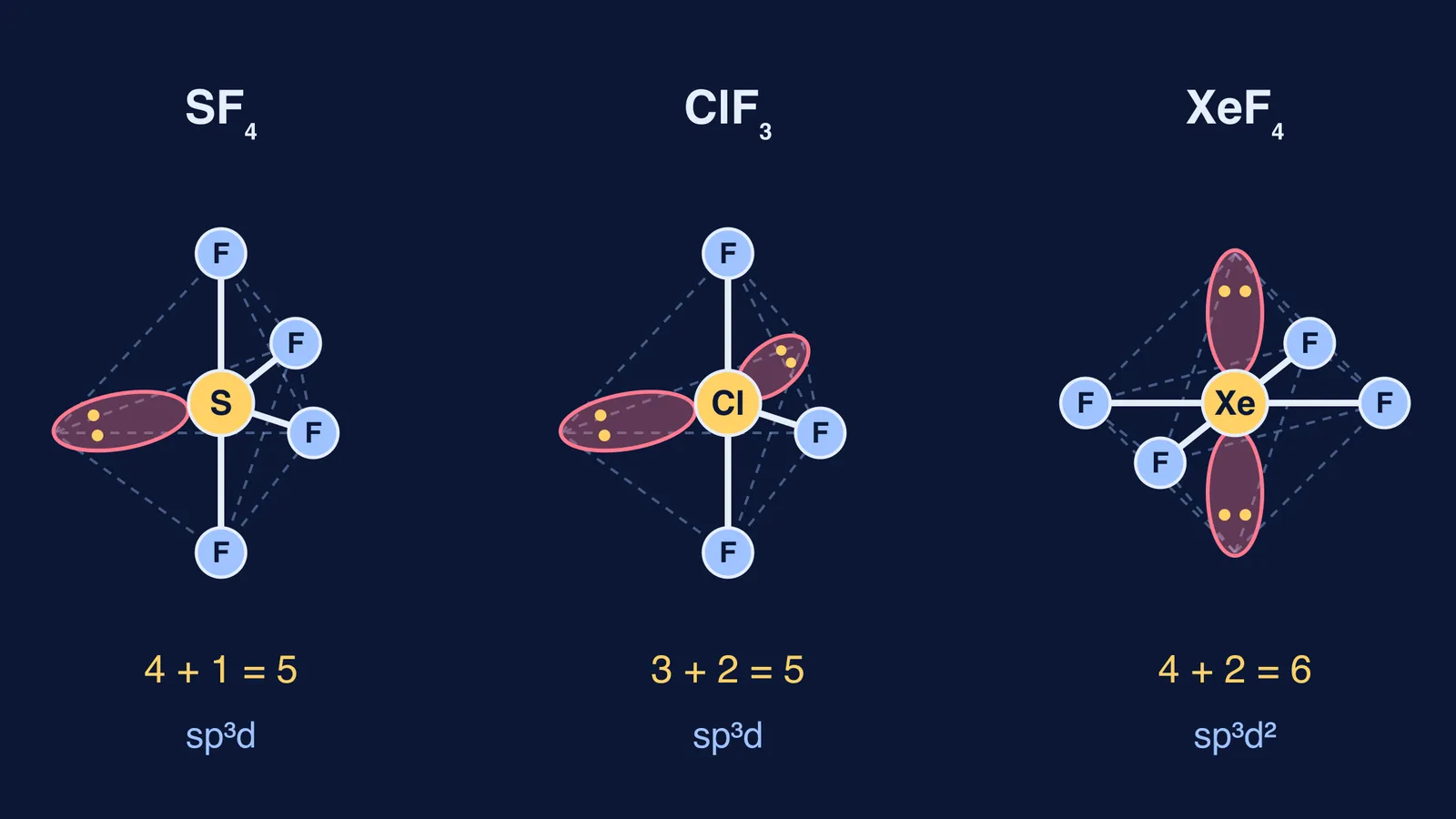
SF4. Sulfur has 6 valence electrons and forms 4 S–F bonds, leaving 2 electrons, which is 1 lone pair. Steric number 4 + 1 = 5, so sp³d. NCERT lists 4 bond pairs, 1 lone pair and a see-saw shape.
ClF3. Chlorine has 7 valence electrons and forms 3 bonds, leaving 4 electrons, which is 2 lone pairs. Steric number 3 + 2 = 5, so sp³d. NCERT lists a T-shape.
XeF4. Xenon has 8 valence electrons and forms 4 bonds, leaving 4 electrons, which is 2 lone pairs. Steric number 4 + 2 = 6, so sp³d². NCERT lists a square planar shape.
Notice that hybridisation and shape are different answers. XeF4 is sp³d² with an octahedral electron-pair arrangement, but the molecule itself is square planar because two corners hold lone pairs. If an AI calls XeF4 "sp³, tetrahedral" or SF4 "sp³, tetrahedral", it has counted four fluorines and ignored the lone pairs.
Where the lone pairs sit matters too. NCERT's Table 4.8 explains that in SF4 the lone pair is equatorial, because an axial lone pair would meet three bond pairs at 90° and an equatorial one only two. In ClF3 both lone pairs are equatorial, which leaves the T. For more on how lone pairs squeeze angles, see why water is bent and how lone pairs shape bond angles. If you prefer a formula, our post on the hybridisation shortcut formula, tested on SF4 and XeF4 reaches the same numbers by another route.
What prompt makes the AI show its lone pairs?
Do your own count first, then paste this:
"For [molecule], do not name the hybridisation yet. Step 1: name the central atom and its valence electrons. Step 2: list each bond pair. Step 3: show the lone-pair arithmetic. Step 4: give the steric number. Step 5: only then give the hybridisation, the electron-pair arrangement and the molecular shape, and say whether each lone pair is axial or equatorial."
Compare step by step, not just the last line, and if step 3 differs from yours, ask it to redo that step only. If two chats give two answers, the lone-pair line is where they split; we explain why AI gives different answers to the same question separately.
The Fermi Problem Library has worked problems with a step-by-step solver that explains the reasoning rather than printing an answer, so you can see each count before the label. If the gap is the idea of a lone pair itself, the Fermi Concept Library gives each chemistry concept its own lesson.
Try it now: count BrF5 yourself (NCERT's Table 4.7 lists 5 bond pairs and 1 lone pair), then run the prompt and see whether the AI lands on sp³d².