

On this page
Hybridisation questions come down to one count: how many electron pairs sit around the central atom. The shortcut formula does that count in one line. Here is why it works, four species checked against NCERT, and where it fails.
What is the shortcut formula for hybridisation?
The formula is H = ½(V + M − C + A), as written in study notes such as this Unacademy note on hybridisation. The letters mean:
V: valence electrons of the central atom (N 5, S 6, Xe 8)
M: monovalent atoms bonded to it (H, F, Cl, Br, I)
C: the charge, if the species is a cation
A: the charge, if the species is an anion
Read the answer as: 2 is sp, 3 is sp², 4 is sp³, 5 is sp³d, 6 is sp³d².
The NCERT Class 11 textbook states that a molecule's shape depends on the number of valence shell electron pairs, bonded or non-bonded, around the central atom (NCERT Chemistry Part 1, Unit 4). H is that number. Subtract the atoms bonded to the centre to get the lone pairs.
Why does the formula work?
It is bookkeeping. Each monovalent atom brings one electron to pair with one of the central atom's, so the electrons around the centre total V + M. Each unit of positive charge removes an electron; each unit of negative charge adds one. Halve the total to get pairs.
Divalent atoms such as oxygen are left out of M on purpose. A double-bonded oxygen uses two of the central atom's electrons, which the formula counts as one pair: the sigma bond, the part that sets the geometry. NCERT says the same in VSEPR terms: a multiple bond is treated as if it were a single electron pair (NCERT Unit 4).
Worked examples: SF4, XeF4, NH4+ and SO4 2-
All four shapes below are checked against the tables in NCERT Unit 4.
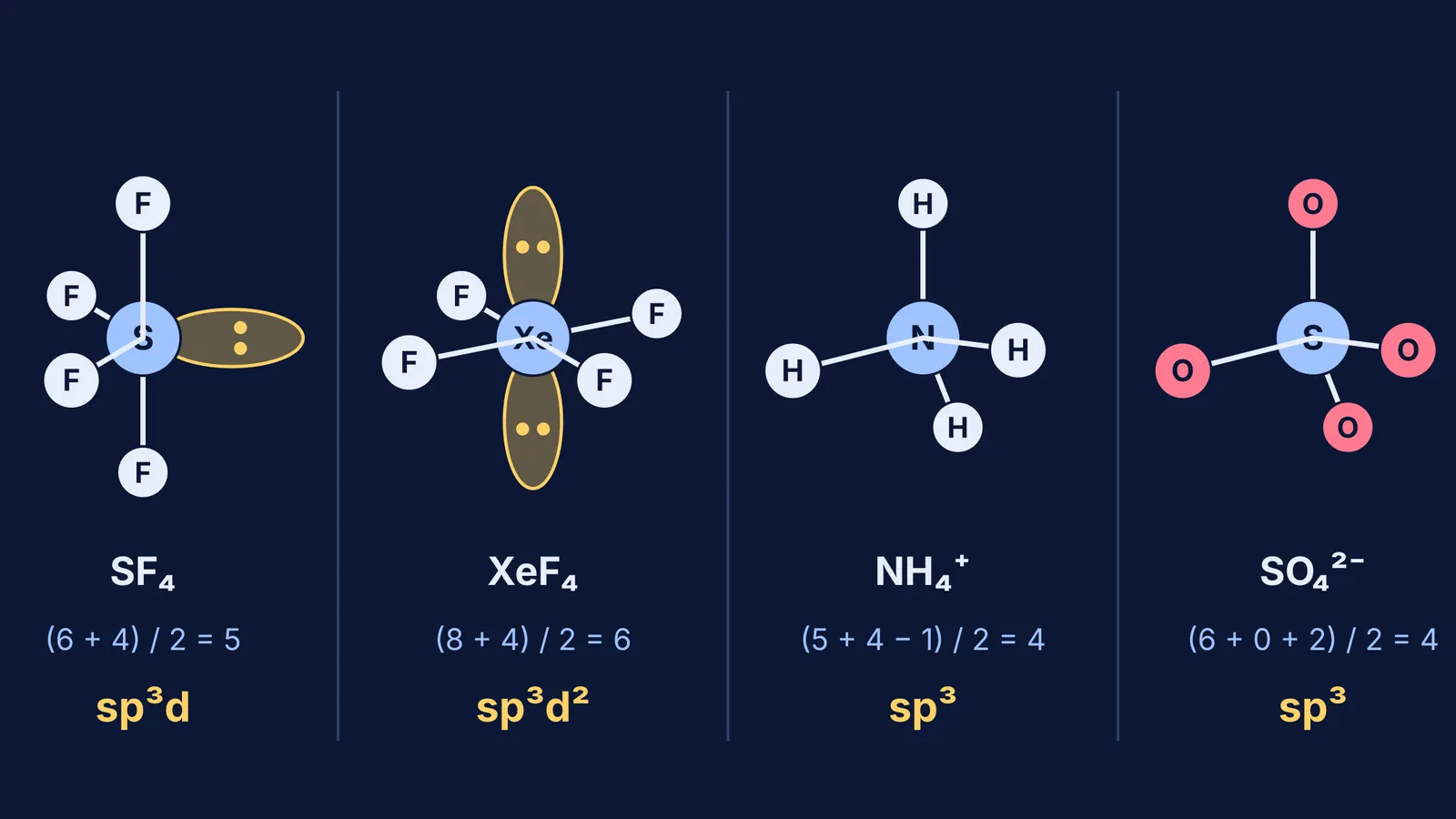
SF4: sulphur has 6 valence electrons and four fluorines, with no charge. H = (6 + 4)/2 = 5, so sp³d. Five pairs, four bonded, leaves one lone pair. NCERT Table 4.7 lists SF4 as AB4E: trigonal bipyramidal arrangement, see-saw shape. Table 4.8 explains that the lone pair sits in an equatorial position, where it meets fewer 90° repulsions.
XeF4: xenon has 8 valence electrons and four fluorines. H = (8 + 4)/2 = 6, so sp³d². Six pairs, four bonded, leaves two lone pairs. NCERT Table 4.7 lists XeF4 as AB4E2: octahedral arrangement, square planar shape, with the lone pairs above and below the plane.
NH4+: nitrogen has 5 valence electrons, four hydrogens and a cation charge of 1. H = (5 + 4 − 1)/2 = 4, so sp³ with no lone pairs. NCERT Table 4.6 lists NH4+ beside CH4 as tetrahedral. For why one coordinate bond ends up like the other three, read why all four N–H bonds in ammonium are identical.
SO4 2-: sulphur has 6 valence electrons. Oxygen is divalent, so M = 0, and the anion charge is 2. H = (6 + 0 + 2)/2 = 4, so sp³ with no lone pairs. Sulphate is indeed four equivalent oxygens arranged tetrahedrally around sulphur (Sulfate, Wikipedia).
When does the hybridisation shortcut fail?
Counting oxygen in M. Put the four oxygens of sulphate into M and you get (6 + 4 + 2)/2 = 6, a wrong sp³d². Only monovalent atoms count.
Half-number answers. A result like 2.5 means an unpaired electron. Draw the Lewis structure instead of rounding.
Transition-metal complexes. NCERT lists [Ni(CN)4]2- and [PtCl4]2- as dsp² square planar (NCERT Unit 4). The formula cannot produce dsp².
Carbon in organic molecules. Count sigma bonds and lone pairs atom by atom. Our post on 3D shapes and bond angles in sp, sp² and sp³ hybridisation shows what each count looks like.
The model itself. Quantum-chemistry calculations suggest d orbitals contribute little to bonding in main-group molecules such as SF6 (Hypervalent molecule, Wikipedia). Write sp³d in your exam, but underneath it is a pair count, the idea behind how Ronald Gillespie and Ronald Nyholm built VSEPR theory.
How should you practise the shortcut before an exam?
Learn V for common central atoms: B 3, C 4, N and P 5, O and S 6, halogens 7, Xe 8.
Work five species a day, checking each against Tables 4.6 and 4.7 in NCERT Unit 4.
Write three things each time: H, lone pairs, shape.
Mix in traps: an oxoanion, a cation, an interhalogen such as ClF3.
If you get H right but name the wrong shape, practise in the Fermi Problem Library, where the step-by-step solver explains the reasoning rather than printing an answer. If VSEPR itself feels shaky, the Fermi Concept Library gives it its own lesson.
Start with ClF3 tonight: you should get 5, two lone pairs and a T-shape, as in NCERT Table 4.7.


