On this page
Three of your ten exponent answers don't match the back of the book. Asking an AI for the right answers will not teach you much. Pasting your working and asking it to find the line where a law was misapplied will.
Which laws of exponents does Class 8 use?
The NCERT Class 8 chapter Exponents and Powers (2024-25 reprint) states these laws for non-zero integers a and b, and integers m and n:
aᵐ × aⁿ = aᵐ⁺ⁿ
aᵐ ÷ aⁿ = aᵐ⁻ⁿ
(aᵐ)ⁿ = aᵐⁿ
aᵐ × bᵐ = (ab)ᵐ
aᵐ ÷ bᵐ = (a/b)ᵐ
a⁰ = 1
a⁻ᵐ = 1/aᵐ
Every law has a condition hiding in it. The first three need the same base. The fourth and fifth need the same exponent. None of them is about addition. Most slips in this chapter come from using a law when its condition is not met:
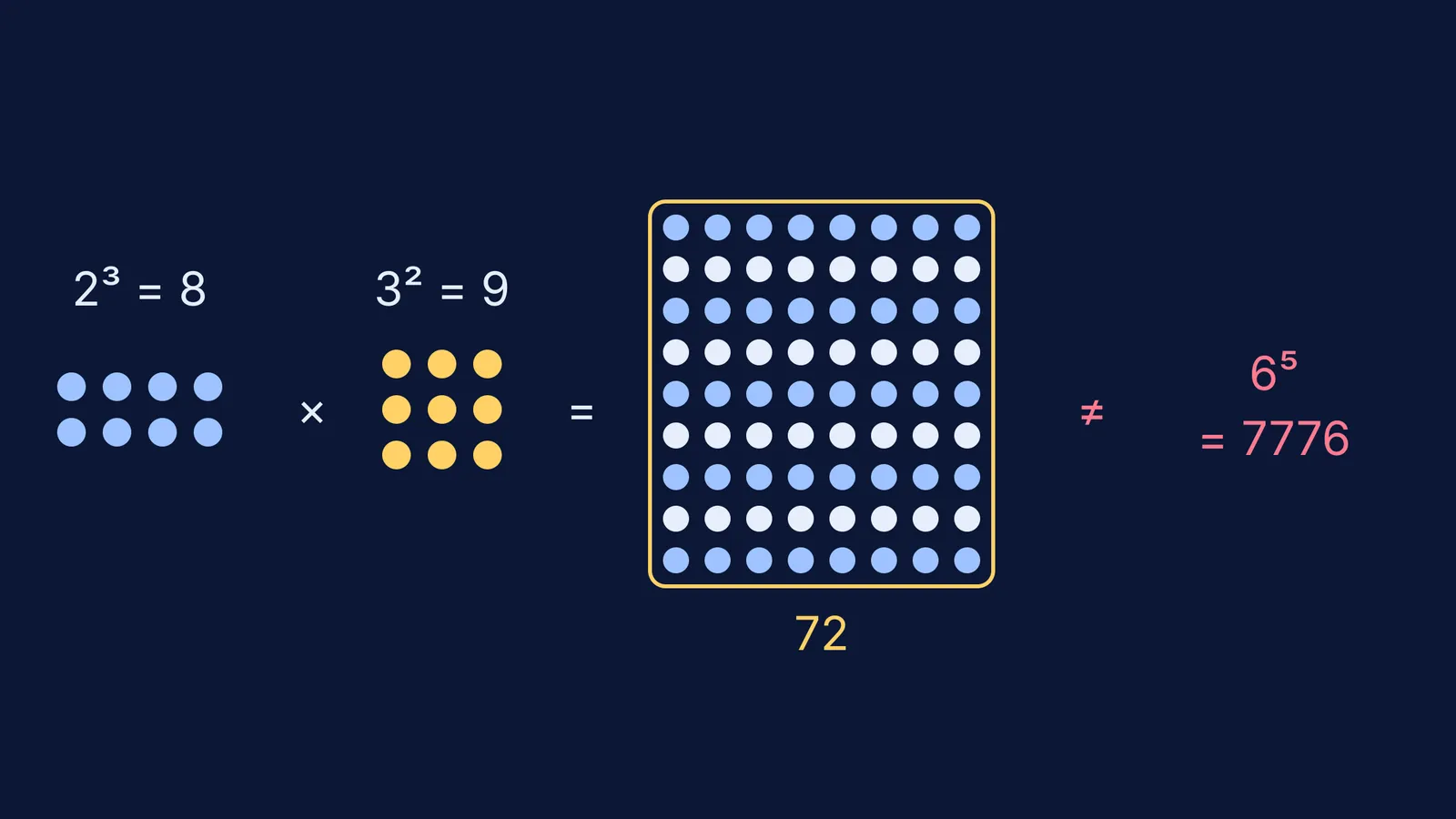
2³ × 3² written as 6⁵. The bases differ and so do the exponents, so no law applies. The real value is 8 × 9 = 72, while 6⁵ is 7776.
2³ + 2² written as 2⁵. The laws cover multiplication, not addition: 2³ + 2² is 12, and 2⁵ is 32.
(2³)² written as 2⁵. A power of a power multiplies the exponents, giving 2⁶.
2⁵ ÷ 2⁻⁶ written as 2⁻¹. Subtracting a negative exponent adds it, so the NCERT chapter gets 2¹¹.
3⁻² written as −9. A negative exponent means a reciprocal: 3⁻² = 1/9.
For the reciprocal rule with fractions, see our explainer on simplifying fractions with negative exponents.
Why ask AI to find the mistake instead of solving it?
Finding and fixing errors is itself a way to learn. Researchers call these erroneous examples: step-by-step solutions with one or more errors for students to find and fix, as defined by Bruce McLaren, Deanne Adams and Richard Mayer in a 2015 study in the International Journal of Artificial Intelligence in Education.
In that study, 390 middle-school students learned decimals with a web-based program, either by finding, explaining and fixing errors or by solving the same problems and explaining their solutions. The groups did not differ on a test right after the lessons, but the find-and-fix group did significantly better on a delayed test a week later, repeating the pattern of an earlier study with 208 students. The problem-solving group liked their version more: what students like does not always lead to the best learning.
Your own working is a ready-made erroneous example. Try each question yourself first; our guide on how long to try a problem before asking AI helps you decide when to paste.
How do you ask AI to check your exponent working?
Type out every line of your working, including the question. A bare answer gives the AI nothing to check.
Number each line.
Paste this prompt above it: "I'm in Class 8 and this is my working on laws of exponents. Don't give me the final answer. Go line by line and name the law I used on each line. Check its condition: same base, same exponent, or multiplication rather than addition. Stop at the first line where a law was misapplied, tell me the line number, and ask me one question that helps me spot the error myself."
Fix that line yourself, redo the rest, and paste the new version.
Check the final answer with small numbers or against the answer key.
Worked example: where did this go wrong?
Here is a question from the NCERT chapter, simplify (2⁵ ÷ 2⁸)⁵ × 2⁻⁵, with a student's working:
(2⁵ ÷ 2⁸)⁵ × 2⁻⁵ = (2⁻³)⁵ × 2⁻⁵
= 2² × 2⁻⁵
= 2⁻³
A good reply says line 1 is correct: the base is the same, so the exponents subtract to −3. Line 2 is where the law broke. The student added 5 to −3, but (aᵐ)ⁿ = aᵐⁿ says multiply, so (2⁻³)⁵ = 2⁻¹⁵. Then comes a question, such as: "In (2³)², how many 2s are being multiplied?" Once the student sees it is six, they can finish: 2⁻¹⁵ × 2⁻⁵ = 2⁻²⁰ = 1/2²⁰, the answer the chapter gives.
What if the AI gets it wrong?
AI chatbots can slip on arithmetic or call a correct line wrong. Check that the law it names is in your textbook and that small numbers agree. If they disagree, trust the numbers and ask your teacher.
A general chatbot may still hand you the full solution even when told not to. Fermi's AI tutor is built to teach rather than answer: it notices where a student is stuck and decides whether to explain, ask or show. For more practice, the Fermi Problem Library has worked problems with a step-by-step solver that explains the reasoning rather than printing an answer.
Parents can read our guide to how Class 6 to 8 students should use an AI tutor safely.
Next time an answer doesn't match, paste the working, not just the question.