On this page
You type a reaction into a chatbot, ask "SN1 or SN2?" and get a confident one-word answer. That answer is only useful if you can see why. The fix is simple: make the AI argue each of the three factors on its own, then check its reasoning against examples NCERT has already solved for you.
Can AI tell whether a reaction is SN1 or SN2?
It can, but not reliably enough to trust blind. In ChemBench, a 2025 study in Nature Chemistry, researchers tested large language models on more than 2,700 chemistry question-answer pairs. The best models beat the best human chemists in the study on average, yet the authors found that the models "struggle with some basic tasks and provide overconfident predictions."
Overconfidence is the real danger for a student. A model that says "SN2" in the same calm tone whether it is right or wrong gives you no signal. If you have watched a chatbot happily accept your mistake, our piece on why AI agrees with your wrong answer explains the pattern.
What decides whether a reaction is SN1 or SN2?
Three factors, and they can pull in opposite directions.
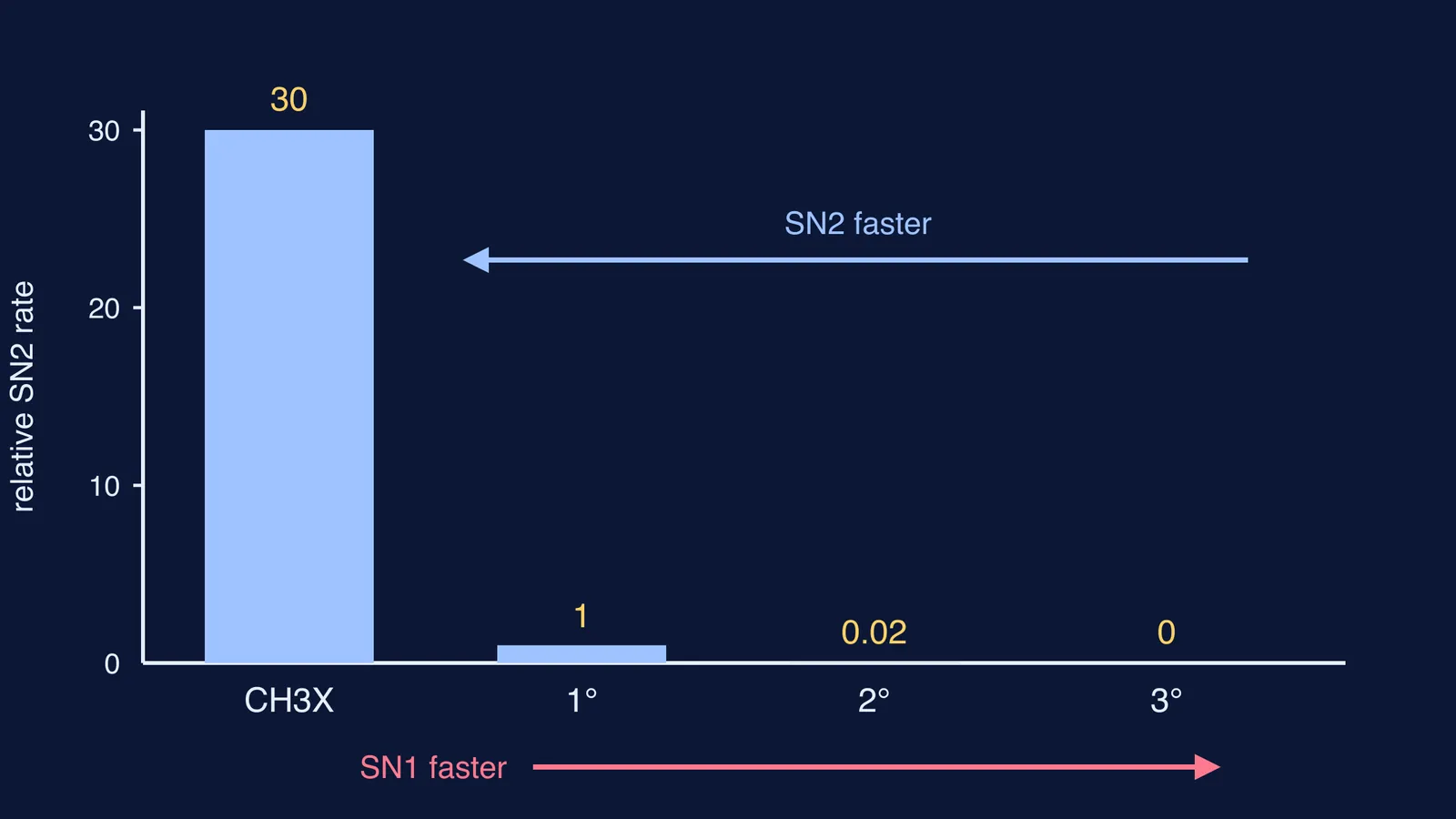
Substrate. The NCERT Class 12 chapter Haloalkanes and Haloarenes gives SN2 reactivity as CH3X > primary > secondary > tertiary, and SN1 reactivity in the reverse order.
Nucleophile. A strong nucleophile favours SN2, while a weak one, as in solvolysis by water or an alcohol, favours SN1, according to Organic Chemistry I by Xin Liu on LibreTexts/07%3A_Nucleophilic_Substitution_Reactions/7.05%3A_SN1_vs_SN2).
Solvent. NCERT notes that SN1 reactions are generally carried out in polar protic solvents such as water, alcohol and acetic acid; the same LibreTexts page says polar aprotic solvents such as acetone, DMSO and DMF favour SN2.
The substrate effect is large. In NCERT's Fig. 6.3, the relative SN2 rate is 30 for a methyl halide, 1 for ethyl, 0.02 for isopropyl and 0 for tert-butyl (NCERT Unit 6). The reason is crowding: bulky groups block the nucleophile's approach, while NCERT says tertiary halides undergo SN1 very fast because tertiary carbocations are highly stable.
Solvent matters a lot too. LibreTexts/07%3A_Nucleophilic_Substitution_Reactions/7.05%3A_SN1_vs_SN2) reports that CH3I reacting with chloride ion runs about 1,200,000 times faster in DMF than in methanol, because methanol wraps the anion in hydrogen bonds.
One thing that does not choose the mechanism: the leaving group. NCERT says that for a given alkyl group the order R-I > R-Br > R-Cl >> R-F holds in both mechanisms, so on its own it does not point to one mechanism over the other.
How do you ask AI whether a reaction is SN1 or SN2?
Paste your reaction, then send these prompts one at a time, waiting for each answer:
"Don't name the mechanism yet. Classify the substrate as methyl, primary, secondary, tertiary, allylic or benzylic, and say which mechanism that alone favours."
"Now only the nucleophile: strong or weak, charged or neutral? Which mechanism does that alone favour?"
"Now only the solvent: polar protic or polar aprotic? Which mechanism does that alone favour?"
"Combine the three. If they disagree, tell me which factor wins here and why."
"Name the NCERT Class 12 rule each step depends on, so I can find it in the chapter."
Does the AI agree with NCERT Example 6.7?
Test the AI on a question whose answer you already hold. NCERT Example 6.7 asks for the order of reactivity of the four isomeric bromobutanes. Its solution, in the same chapter, is:
SN1: CH3CH2CH2CH2Br < (CH3)2CHCH2Br < CH3CH2CH(Br)CH3 < (CH3)3CBr
SN2: the exact reverse
Run the five prompts on each compound, then check:
It puts 2-bromo-2-methylpropane fastest in SN1 because its tertiary carbocation is the most stable.
It ranks 1-bromo-2-methylpropane above 1-bromobutane in SN1. NCERT's reason is the greater electron-donating inductive effect of the (CH3)2CH- group.
It justifies the SN2 order with steric hindrance, not carbocation stability.
Then watch for red flags. The AI calls a tertiary halide with hydroxide SN2. It treats iodide versus chloride as the deciding factor, when NCERT Example 6.6 uses the better leaving group only to say which compound reacts faster by SN2. It skips the solvent, or cannot say which factor won.
What should you do when the AI and NCERT disagree?
For your board answer, write NCERT's reasoning. Then use the disagreement as practice: tell the AI which step contradicts the textbook and ask it to find its own error.
To revise the rules themselves, read our explainers on SN1 and SN2 reactions of haloalkanes and on how polar protic and aprotic solvents steer SN1 and SN2.
If your marks keep slipping because you pick the wrong method, the Fermi Problem Library has worked problems with a step-by-step solver that explains the reasoning rather than printing an answer. Fermi's AI tutor teaches rather than answers: it notices where you are stuck and decides whether to explain, ask or show.
Tonight, pick one reaction from your exercise set and make the AI earn its answer, one factor at a time.