

On this page
The embryo sac is one of the most counted structures in Class 12 biology, and one of the easiest to miscount. Ask an AI how many cells it has and you may hear “eight”, because the model counted nuclei. Here is how to make an AI count both properly, explain double fertilisation, and then check every number against your NCERT figures.
How many cells and nuclei are in the embryo sac?
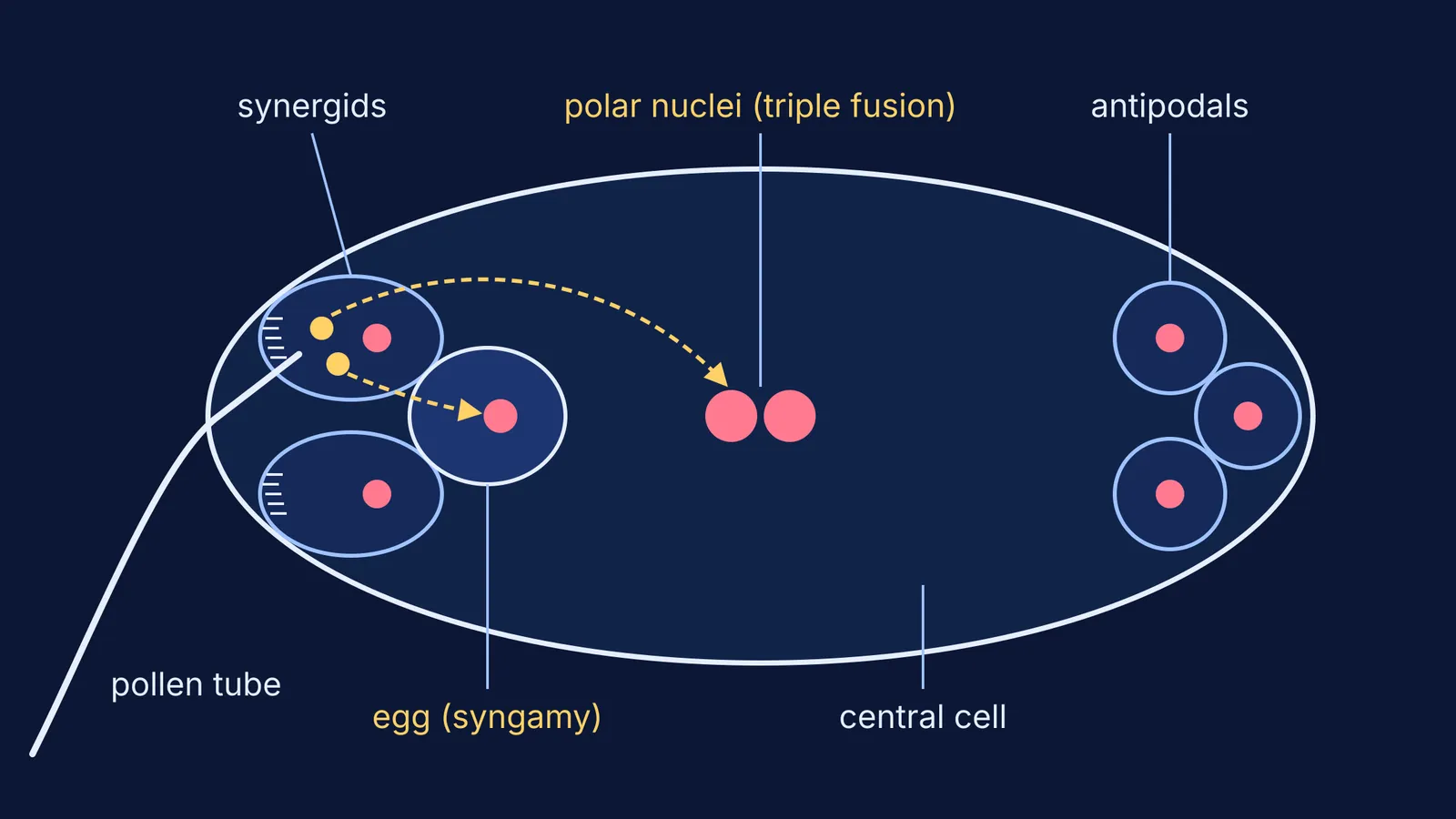
NCERT's Class 12 Biology chapter on sexual reproduction in flowering plants states that a typical angiosperm embryo sac, at maturity, is 8-nucleate but 7-celled. The count follows from how it forms. The nucleus of the functional megaspore divides by mitosis three times in a row, giving the 2-nucleate, 4-nucleate and 8-nucleate stages. These divisions are strictly free nuclear: cell walls are laid down only after the 8-nucleate stage.
Then walls form around six of the eight nuclei. The other two, the polar nuclei, sit together in one large central cell. So the count by position is:
Micropylar end: the egg apparatus, two synergids and one egg cell (3 cells, 3 nuclei)
Middle: one central cell with two polar nuclei (1 cell, 2 nuclei)
Chalazal end: three antipodals (3 cells, 3 nuclei)
That adds up to 7 cells and 8 nuclei.
What is double fertilisation, explained with the same count?
The same NCERT chapter says the pollen tube enters one of the synergids through the filiform apparatus and releases two male gametes there. Researchers have tested the synergids' role directly. In a 2001 study in *Science*, Higashiyama and colleagues destroyed single cells with a laser and found that the two synergids attract the pollen tube, and that one synergid alone was enough to send the signal.
Once the gametes are inside, two fusions happen, each using nuclei you have just counted:
Syngamy: one male gamete fuses with the egg nucleus, giving a diploid (2n) zygote, which becomes the embryo.
Triple fusion: the other male gamete fuses with the two polar nuclei. Three haploid nuclei give the triploid (3n) primary endosperm nucleus (PEN).
NCERT calls the two fusions together double fertilisation, “an event unique to flowering plants”. The central cell then becomes the primary endosperm cell (PEC) and develops into the endosperm. For where the two male gametes come from, see how pollen is shed at the 2-celled or 3-celled stage. For what happens to the PEN next, read why tender coconut water is free-nuclear endosperm.
How do you ask an AI to count it properly?
Don't ask for the answer. Ask the AI to build it one step at a time, so a wrong step shows. You can paste this:
“Start from the functional megaspore. Show the nucleus count after each mitotic division, and say when cell walls form.”
“List every cell in the mature embryo sac from the micropylar end to the chalazal end, with the number of nuclei in each.”
“Total the cells and the nuclei separately, and explain why the totals differ.”
“Trace both male gametes. Which nuclei does each fuse with, and what is the ploidy of each product?”
“Ask me two questions to check I understood. Don't give the answers until I reply.”
Step 5 matters most, because a good tutor checks understanding as it goes. Fermi's AI tutor works that way: it holds a line of reasoning across a session, notices where you are stuck, and can draw the figure while it explains.
How do you check the AI's answer against NCERT's figure?
An AI can sound sure and still be wrong, and it may even make up page numbers (here is why AI tutors invent NCERT page numbers). So check against the book itself. In the 2026-27 reprint of NCERT Class 12 Biology, this topic is in Chapter 1: Figure 1.8(c) shows the mature embryo sac and Figure 1.13(a) the fertilised one. If your copy numbers them differently, find them by caption.
Check Figure 1.8(c) with a pencil:
Count the cells: 3 at the micropylar end, 1 central, 3 at the chalazal end, so 7.
Count the nuclei: 8, with the two polar nuclei in the central cell.
Find the filiform apparatus. It belongs to the synergids, not the egg.
On Figure 1.13(a), find the zygote marked 2n, the PEN marked 3n, and the degenerating synergids and antipodals.
Then look for the usual AI slips:
“8 cells” (it counted nuclei)
“the polar nuclei are triploid” (each is haploid; the PEN they help form is triploid)
“the pollen tube enters the egg” (NCERT says it enters a synergid)
treating PEN and PEC as the same (one is a nucleus, the other a cell)
If the AI and the figure disagree, trust the figure and tell the AI what it got wrong; explaining the mistake is good revision. If one idea keeps slipping, the Fermi Concept Library gives each biology concept its own lesson. Then close the book and recount the figure from memory.


