

On this page
When you crack open a tender green coconut, the clear, sweet liquid inside is not fruit juice or simple sap. Botanically, that water is a living, multinucleated nutritive tissue known as free-nuclear endosperm. Surrounding this liquid is the firm white meat—the cellular endosperm kernel. Together, they demonstrate how flowering plants sustain an embryo until it germinates.
What makes tender coconut water a free-nuclear endosperm?
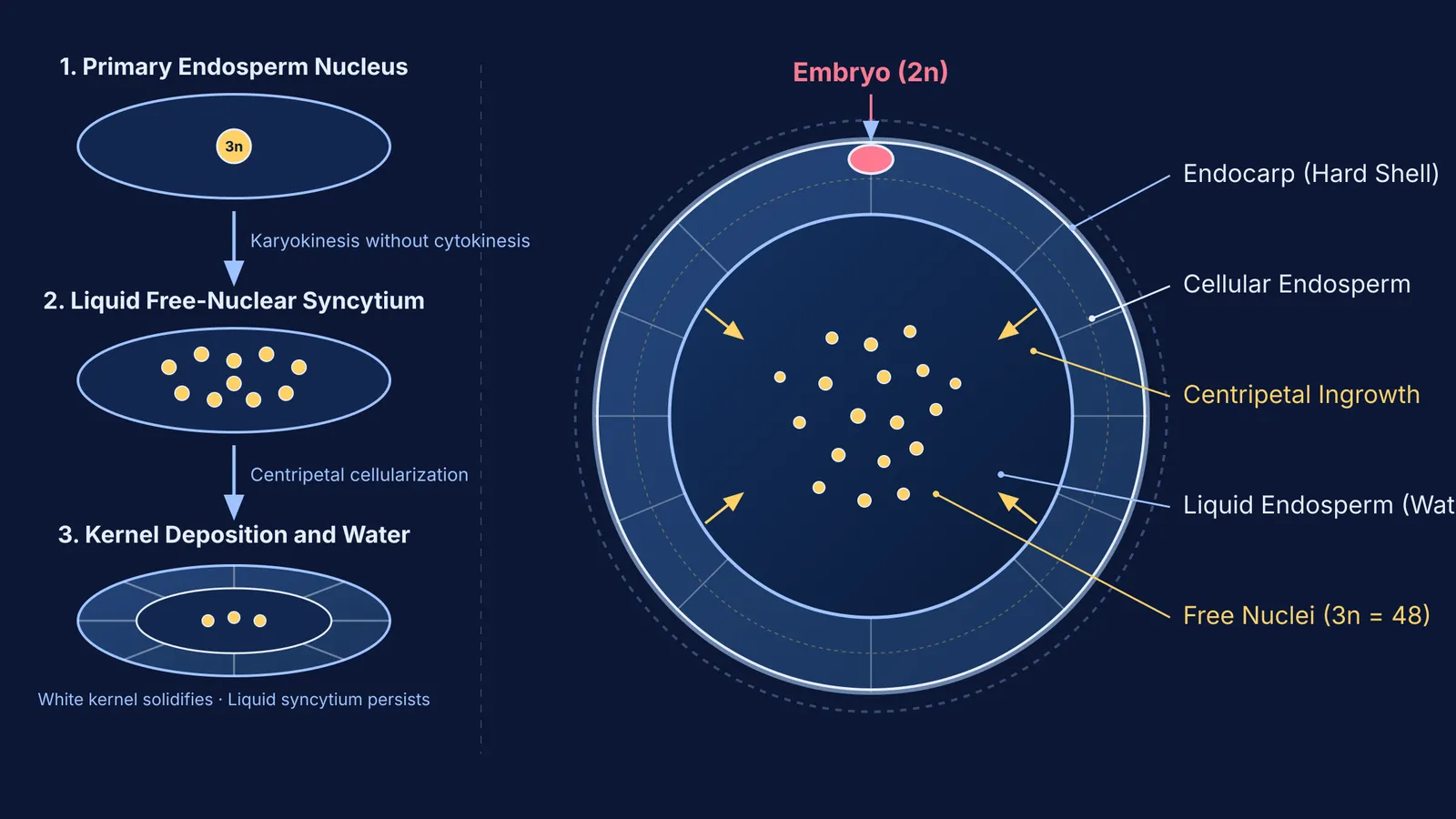
The process begins with double fertilisation. Inside the ovule, one sperm nucleus fuses with the egg to form a diploid zygote (2n), while the second fuses with two polar nuclei to create the triploid (3n) primary endosperm nucleus (PEN).
In the coconut (*Cocos nucifera*), endosperm follows the nuclear developmental pathway. Immediately after triple fusion, the PEN undergoes rapid mitotic divisions. Crucially, these karyokinetic nuclear divisions take place without immediate cytokinesis (cell wall deposition).
This uncoupling creates a multinucleated liquid cytoplasm, or syncytium, filling the central vacuole of the embryo sac. As Jean W. H. Yong and colleagues review in Molecules, coconut water is of cytoplasmic origin, functioning as a fluid reservoir rich in free nuclei, phytohormones, sugars, and amino acids.
Cytological research in the Annals of Botany by A. Abraham and P. M. Mathew showed that these suspended free nuclei possess a triploid complement of 48 chromosomes (3n = 48 in tall palms). They also noted that older liquid endosperm undergoes C-mitotic divisions, generating higher endopolyploid nuclei with 96 (6n) and 192 (12n) chromosomes.
How does the liquid endosperm turn into the solid cellular kernel?
In an immature nut, the endosperm is entirely fluid. As the coconut matures, cytokinesis sets in.
Abraham and Mathew recorded in the Annals of Botany that cellular development becomes visible when the nut reaches approximately 6 months of age. Cell wall deposition begins at the periphery against the inner shell wall (endothelium) and moves centripetally—inward toward the center. Free nuclei settle along the margins, where walls enclose them into individual cells.
As Odd-Arne Olsen explains in the Annual Review of Plant Physiology and Plant Molecular Biology, nuclear endosperm cellularization relies on radial microtubule systems radiating from nuclear envelopes to organize cytoplasmic domains before cell plates form.
Unlike cereals where cellularization fills the entire cavity, the coconut stops halfway. The outer region solidifies into the edible white kernel rich in lipids, while the interior preserves the liquid syncytium.
Why does endosperm development precede the division of the embryo?
Under the microscope, the primary endosperm nucleus divides well before the diploid zygote begins cleavage. This sequence guarantees that a reliable food reserve exists before the embryo expends energy on cellular differentiation.
Beyond basic nutrients, liquid endosperm supplies essential regulatory signals. In Science, J. van Overbeek, Marie E. Conklin, and Albert F. Blakeslee showed that coconut milk contains potent growth factors—later identified as cytokinins—essential for cultivating young embryos.
When studying how double fertilisation coordinates tissue development during sexual reproduction in flowering plants, the Fermi Concept Library covers every concept in physics, chemistry, biology, mathematics and computing, each with its own lesson and its place in the map.
How do you solve endosperm and ploidy questions in NEET?
As documented in classical cytological studies in the Annals of Botany, tracing chromosome complements across reproductive stages requires distinguishing somatic from gametic tissues.
Use this three-step framework:
Find the haploid count (n): Somatic tissues (roots, leaves, nucellus, integuments) are diploid (2n). Divide their chromosome count by 2 to get n.
Trace tissue origin: Cells of the embryo sac formed during megasporogenesis (egg, synergids, antipodals) are haploid (n). The embryo is diploid (2n). Angiosperm endosperm—both the liquid water and the cellular kernel—is triploid (3n).
Classify the seed: Albuminous seeds (coconut, maize, castor) retain endosperm at maturity; non-albuminous seeds (pea, gram) consume it completely.
Consider this worked problem: A plant species has 24 chromosomes in its root cells. What are the chromosome counts in its leaf cells, egg cell, and cellular endosperm?
Leaf cells: Somatic and diploid, so 2n = 24 chromosomes.
Egg cell: Haploid female gamete, so n = 12 chromosomes.
Endosperm: Formed by triple fusion (one sperm nucleus of n = 12 plus two polar nuclei totaling 2n = 24), giving a triploid count of 3n = 36 chromosomes.
This dual fusion follows the mechanism uncovered when Sergei Nawaschin discovered double fertilisation in lilies. For step-by-step practice on genetics and ploidy calculations, the Fermi Problem Library provides worked problems with a step-by-step solver that explains the reasoning rather than printing an answer.


