On this page
Writing a formula by criss-cross takes a minute to learn, but the small slips take practice to shake off. They tend to repeat: AlOH3 instead of Al(OH)3, Mg2O2 left undivided, FeO when the question said ferric. An AI chatbot can set the questions and do the marking. Your job is the writing, on paper, before it sees anything.
What are the rules for writing chemical formulae with valency?
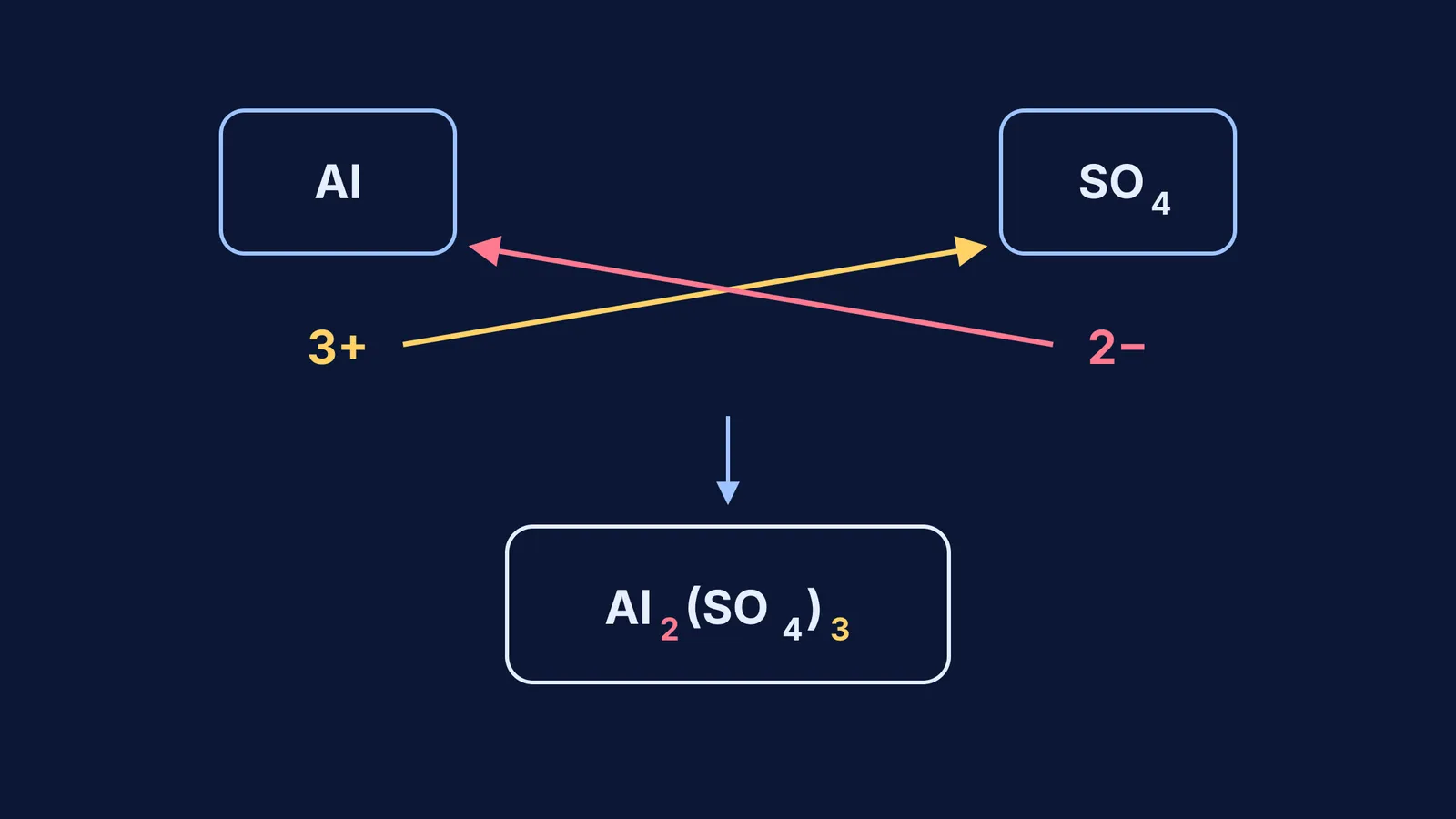
NCERT's 2026 Class 9 science textbook, Exploration, covers this in section 9.5 of Chapter 9, Atomic Foundations of Matter. For an ionic compound, the chapter gives four steps:
Write the symbol of the cation first, then the anion.
Write the charges under the symbols, not as superscripts.
Cross over the charge numbers only, so each becomes the other ion's subscript.
Divide the subscripts by any common factor, because a formula gives the simplest ratio.
Three more details cost marks. A subscript of 1 is not written. Brackets go around a polyatomic ion when there are two or more of it, which is why aluminium hydroxide is Al(OH)3, not AlOH3. And the charges are not shown in the final formula. Its Table 9.1 lists the valencies you need, from sodium (1) and aluminium (3) to sulfate (2) and ammonium (1).
New to the method? Start with our walk-through of writing chemical formulae with valency and the criss-cross method.
How do you use AI to practise writing chemical formulae?
Use the AI as a question setter and a marker, never as the answer sheet. In a study by Henry Roediger and Jeffrey Karpicke, students who took recall tests remembered much more 2 days and 1 week later than students who restudied the same number of times, even though restudying made students feel more confident (Psychological Science, 2006). Writing a formula from memory before you see it is a similar kind of practice.
Step 1, ask for a set. "I am in Class 9. Give me 10 compounds to write formulae for, using only these ions: [type the ions from Table 9.1]. Include at least two with polyatomic ions that need brackets and two where the subscripts must be divided by a common factor. Do not give the formulae."
Step 2, write them yourself. On paper, book closed.
Step 3, ask for marking. "Here are my answers. Mark each one right or wrong. For each wrong one, tell me which step I broke: wrong valency, not crossed, not divided by a common factor, missing brackets, or charges left in. Do not show the correct formula yet. Let me try again first."
Step 4, redo and repeat. Fix the wrong ones, then ask: "Give me five new compounds that test the mistakes I made."
What does good AI feedback on a wrong formula look like?
Say you wrote these six:
Calcium chloride: CaCl2
Aluminium hydroxide: AlOH3
Magnesium oxide: Mg2O2
Sodium carbonate: Na2CO3
Ferric oxide: FeO
Ammonium sulfate: (NH4)2SO4
Numbers 1, 4 and 6 are right. A useful reply names the broken step for each of the others:
AlOH3: the crossing is right (Al 3, OH 1), but three of a polyatomic ion need brackets: Al(OH)3.
Mg2O2: crossing 2 and 2 is fine, but both subscripts share a factor of 2. Divide to get MgO.
FeO: ferric means iron with valency 3, not 2. Crossing Fe 3 with O 2 gives Fe2O3.
A reply that only says the answer is Fe2O3 teaches you less. A review of feedback research by John Hattie and Helen Timperley found that feedback is among the major influences on learning, but that its effect depends on the type of feedback and how it is given (Review of Educational Research, 2007). Ask for the step you can fix.
Can practising with AI make you worse at chemistry?
It can, if the AI does the thinking. In a field experiment with nearly a thousand high school maths students, access to a plain GPT-4 chat raised grades by 48% while students had it, but once it was taken away their grades were 17% lower than those of students who never had it (Bastani and colleagues, PNAS, 2025). A tutor version with learning safeguards largely avoided that harm. The prompts above are your own guardrails: no formulae from the AI until you have written yours. For more, see our guide to using AI to understand mistakes rather than collect answers.
What if the same formula mistake keeps coming back?
A repeated mistake is often a concept gap, not carelessness. The Fermi Concept Library has a lesson for every concept in chemistry, each with its place in the map. And Fermi's AI tutor notices where you are stuck and decides whether to explain, ask or show, rather than handing over the formula.
Once formulae feel easy, use the same routine for asking AI to check your oxidation number assignments.