

On this page
You can use an AI chatbot to check the electron configurations of ions like Fe³⁺ and Cu²⁺, but only if you write them yourself first and ask it to check your method. The rule most students trip on is simple to state: when a first-row transition metal forms a positive ion, it loses its 4s electrons before any 3d electrons.
Why do 4s electrons leave before 3d?
You fill 4s before 3d when you build up the neutral atom, so it feels natural to empty them in reverse. Measured ground states say otherwise: NIST's atomic data lists neutral iron as 3d⁶4s² and singly ionised iron (Fe⁺) as 3d⁶4s, so the first electron to leave comes from 4s (NIST iron data). Copper behaves the same way: neutral Cu is 3d¹⁰4s¹ and Cu⁺ is 3d¹⁰, with the 4s electron gone (NIST copper data).
Table 4.2 in the NCERT Class 12 chapter on the d- and f-block elements lists M²⁺ configurations for the whole first transition series and M³⁺ configurations from scandium to nickel, and none of them has a 4s electron (NCERT Chemistry Part I, Unit 4, Table 4.2). Filling order is not removal order.
What are the correct configurations of Fe3+ and Cu2+?
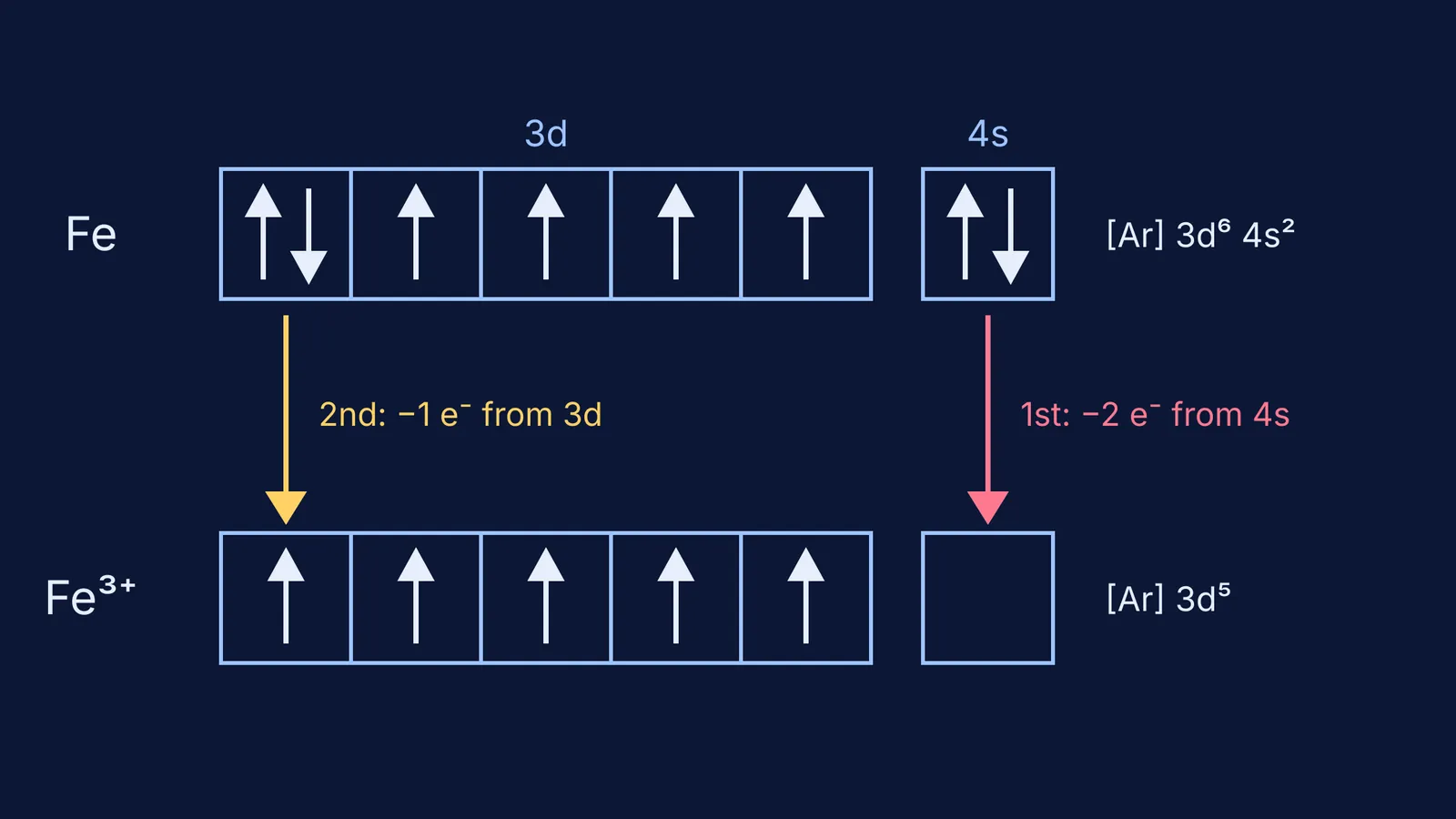
Work in three steps: write the neutral atom, remove electrons from 4s, then take any remaining charge from 3d. All the configurations below match NCERT Table 4.2 (NCERT Unit 4).
Iron, Z = 26
Neutral Fe: [Ar] 3d⁶ 4s².
Fe²⁺: remove both 4s electrons, giving [Ar] 3d⁶.
Fe³⁺: remove one more, now from 3d, giving [Ar] 3d⁵.
Copper, Z = 29
Neutral Cu: [Ar] 3d¹⁰ 4s¹, not 3d⁹ 4s². NCERT points to chromium and copper as the 3d-series cases where half-filled and completely filled d subshells, which are relatively more stable, change the expected configuration.
Cu⁺: remove the single 4s electron, giving [Ar] 3d¹⁰.
Cu²⁺: remove one 3d electron, giving [Ar] 3d⁹.
The same method gives Cr³⁺ as [Ar] 3d³ (from 3d⁵4s¹) and Mn²⁺ as [Ar] 3d⁵ (from 3d⁵4s²).
How do you ask an AI to check your electron configurations?
Do the work on paper first. If you ask a chatbot "what is the configuration of Fe³⁺?", you get an answer to copy and learn nothing about your own method. Before you paste, mark how sure you are of each line; our post on rating your confidence before checking answers with AI explains why that habit helps.
Then paste your working with a prompt like this:
"Below are my electron configurations for Fe, Fe²⁺, Fe³⁺, Cu, Cu⁺, Cu²⁺, Cr³⁺ and Mn²⁺, with each step. Do not give me the answers. For each ion, tell me: (1) whether my neutral-atom configuration is correct, (2) which subshell I removed electrons from and whether that order is correct, (3) how many unpaired electrons the ion has. If a line is wrong, quote it and ask me one question that helps me find the error."
A tutor that asks rather than tells makes you do the fixing. That is how Fermi's AI tutor is meant to work: it holds a line of reasoning across a session, notices where you are stuck and decides whether to explain, ask or show.
If oxidation states trip you up, fix those first. Our guide on how to check oxidation numbers in compounds with AI uses the same method.
How do you know the AI's check is right?
Chatbots can state the rule correctly and still slip on a specific ion. Run these four checks yourself, using the NCERT d-block chapter as your reference (NCERT Unit 4).
Count electrons. The total must equal Z minus the charge. Fe³⁺ has 26 − 3 = 23 electrons: 18 for [Ar] plus 5 in 3d.
Look for an empty 4s. None of the M²⁺ or M³⁺ ions in NCERT Table 4.2 has a 4s electron. If the AI accepts Fe³⁺ as 3d³ 4s², it is wrong.
Check the magnetic moment. NCERT gives the spin-only formula μ = √(n(n+2)) BM, where n is the number of unpaired electrons. Fe³⁺ (3d⁵) has 5 unpaired electrons, so μ = √35 ≈ 5.92 BM, the same value NCERT calculates for Mn²⁺ (3d⁵). Cu²⁺ (3d⁹) has 1, so μ = 1.73 BM, and NCERT Table 4.7 lists observed values of 1.8 to 2.2 BM for Cu²⁺. Our guide to counting unpaired electrons with Hund's rule walks through the box diagrams.
Check the colour. NCERT Table 4.8 lists aquated Cu²⁺ (3d⁹) as blue and Zn²⁺ (3d¹⁰) as colourless; in that table only the 3d⁰ and 3d¹⁰ ions are colourless. If the AI gives a coloured ion a 3d¹⁰ configuration, look again.
Try it tonight with a few ions you have not memorised, such as V³⁺, Co²⁺ and Ni²⁺, and keep a list of every line the AI flagged. When the same slip shows up twice, read the lesson on that idea in the Fermi Concept Library, which covers every concept in physics, chemistry, biology, mathematics and computing.


