On this page
Domain and range questions look short but are easy to get half right: you write "x ≤ 3" and forget the other end, or give the range of the expression under the root instead of the function. AI can catch these slips, but only if you do the work first and ask it to test your answer, not replace it.
What are the domain and range of a function?
The domain of a function is the set of input values it accepts, and the range is the set of output values it can produce. The OpenStax Precalculus 2e textbook pictures the domain as a "holding area" for a function machine's raw materials and the range as the holding area for its products.
For square roots, the same textbook gives a one-line rule: set the radicand (the expression under the root) greater than or equal to zero and solve for x, because you cannot take the square root of a negative real number. The root sign also means the non-negative root, so its output is never negative. For the wider picture, see our guide to domain, range and composite functions for JEE.
How do you find the domain and range of √(9 − x²)?
Take f(x) = √(9 − x²). Work it on paper before you open any chat window.
Domain: the radicand must be non-negative, so 9 − x² ≥ 0, which means x² ≤ 9.
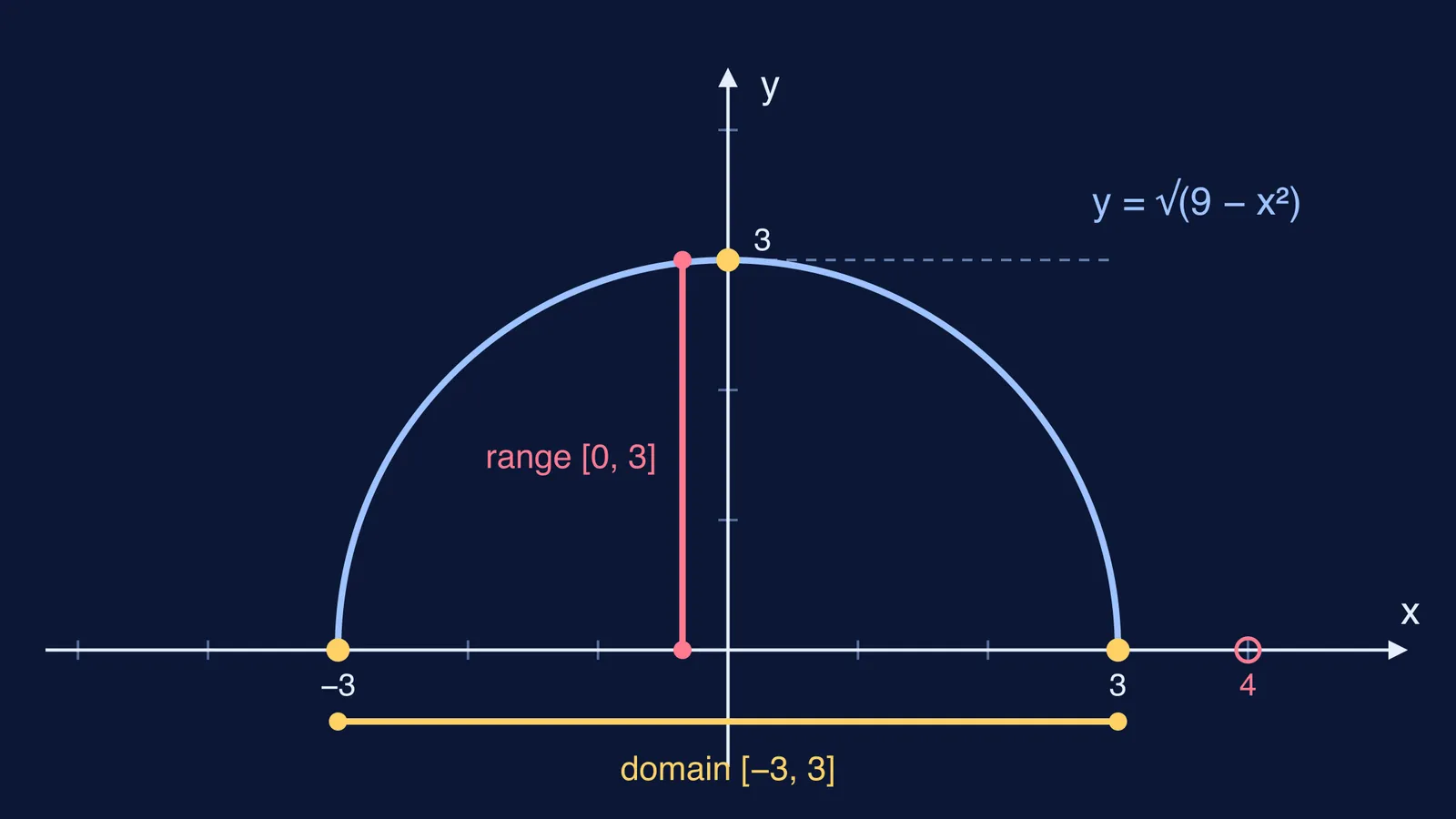
Solve carefully: x² ≤ 9 gives −3 ≤ x ≤ 3, not just x ≤ 3. The domain is [−3, 3].
Range: inside the domain, 9 − x² is largest at x = 0 (value 9) and smallest at x = ±3 (value 0).
Take the root of those extremes: √0 = 0 and √9 = 3. The range is [0, 3].
Three wrong answers to watch for:
Domain x ≤ 3, from treating x² ≤ 9 like a linear inequality.
Range [0, 9], which is the range of the radicand, not of f.
Range [−3, 3], copied from the domain.
For a root over a fraction, where the denominator adds its own restriction, see domain of a square root over a linear function, step by step.
Why should you find the answer before asking AI?
The order matters. In a field experiment published in PNAS in 2025, Hamsa Bastani and colleagues gave nearly a thousand high school maths students access to GPT-4 tutors. Students using a plain ChatGPT-style interface got 48% higher grades on practice problems, but once access was taken away they scored 17% lower than students who never had it. The authors found that students used the tool as a "crutch", and that a version with prompts designed to safeguard learning largely mitigated the harm.
How can AI check your domain and range?
Paste your working and ask for tests, not answers. A prompt to copy:
"Here is my working for the domain and range of f(x) = √(9 − x²). Do not solve it for me. First, evaluate f at x = −3, 0, 3, 3.1 and −4, and say which values are defined. Second, graph y = √(9 − x²) for x from −5 to 5, or describe the shape exactly. Third, tell me whether my domain [−3, 3] and range [0, 3] match those results, and if not, point to the step where my working goes wrong."
Here is what a correct check should show, so you can judge the AI's reply:
f(−3) = 0 and f(3) = 0: both ends of the domain are included, so square brackets are right.
f(0) = 3: the highest output, the top of the range.
f(3.1) = √(−0.61) and f(−4) = √(−7): not real numbers, so these lie outside the domain.
The graph is the upper half of a circle of radius 3 centred at the origin, spanning x from −3 to 3 and y from 0 to 3.
What if the AI disagrees with your answer?
Do not switch your answer straight away, and do not trust easy agreement either. Plug the disputed boundary value into the function yourself. If f(3.1) involves the root of a negative number, 3.1 is outside the domain whatever the chat says. If the AI simply agrees with everything you wrote, give it a deliberately wrong range such as [0, 9] and see if it notices. Our post on why AI agrees with your wrong answer explains how to run that test.
If the slip is in method, such as solving x² ≤ 9 as x ≤ 3, the Fermi Problem Library has worked problems with a step-by-step solver that explains the reasoning rather than printing an answer. And if you keep getting stuck on the same step, Fermi's AI tutor notices where you are stuck and decides whether to explain, ask or show, writing on a board and drawing the figure as it goes.
Try the method on your next three domain and range questions: commit to an answer, test the boundaries, then look at the graph.