

On this page
When students encounter functions combining roots and fractions in school examinations or competitive tests like JEE Main, domain problems often become unexpected stumbling blocks. The natural domain of a real function is the set of all real inputs for which the formula produces a real output. According to the senior secondary curriculum from the Central Board of Secondary Education, working with real functions requires avoiding two fundamental algebraic violations: taking an even root of a negative quantity and dividing by zero.
In practice, this means avoiding negative expressions inside square roots and zero in denominators. While each rule seems simple in isolation, mistakes occur when both appear together in algebraic fractions. Reviewing foundational set mappings in functions for JEE domain and range provides helpful background before tackling compound constraints.
What rules determine the domain of a square root over a linear function?
Consider a function where the square root sits only in the numerator:
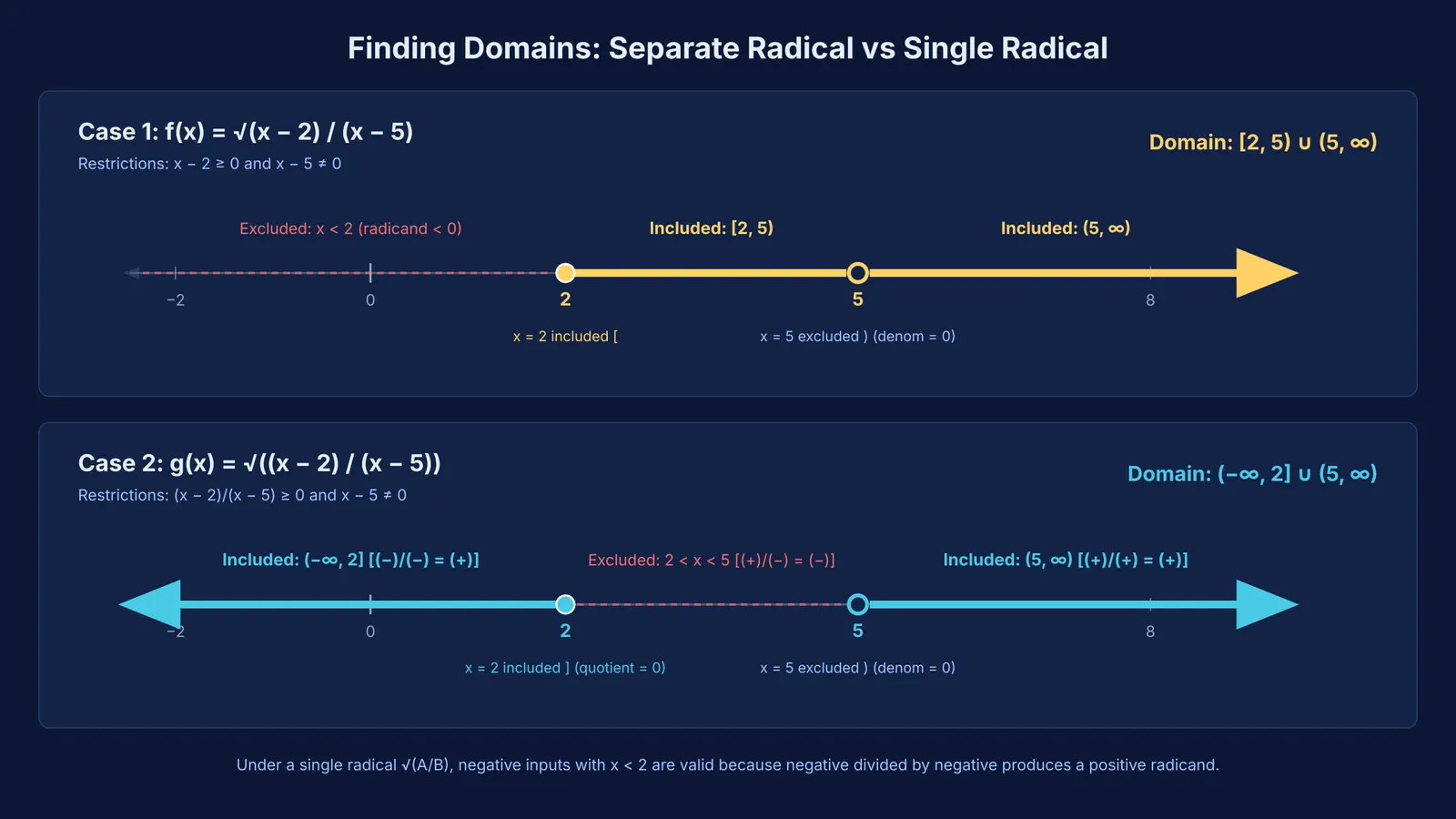
f(x) = √(x − 2) / (x − 5)
As outlined in OpenStax Precalculus, determining the natural domain requires finding the intersection of all independent algebraic restrictions. For this expression, two conditions must hold simultaneously:
Radicand condition: The expression inside the radical must be non-negative: x − 2 ≥ 0, which gives x ≥ 2. In interval notation, this is [2, ∞).
Denominator condition: The denominator cannot be zero: x − 5 ≠ 0, which gives x ≠ 5.
To determine the domain of the function, take the intersection of these two solution sets:
Domain = [2, ∞) ∩ {x ∈ ℝ : x ≠ 5} = [2, 5) ∪ (5, ∞)
Evaluating the endpoints illustrates why the boundary brackets differ:
At x = 2, the numerator is √(2 − 2) = 0 and the denominator is 2 − 5 = −3. Because 0 / (−3) = 0 is a well-defined real number, x = 2 is included with a closed bracket `[`.
At x = 5, the denominator is 5 − 5 = 0, causing division by zero. Thus, x = 5 must be excluded with an open parenthesis `)`.
What happens when the whole fraction is under the root?
A subtle shift in notation creates a very different problem. Consider:
g(x) = √((x − 2) / (x − 5))
Here, the entire rational fraction sits under a single radical. Following real function rules documented in Mathematics LibreTexts/01%3A_Functions/1.02%3A_Domain_and_Range), the entire radicand must be non-negative while the denominator remains non-zero:
(x − 2) / (x − 5) ≥ 0 and x − 5 ≠ 0
A frequent mistake is assuming both x − 2 ≥ 0 and x − 5 > 0 must hold. In reality, a quotient of two real numbers is positive when both the numerator and the denominator share the same sign—whether both are positive or both are negative.
The partition numbers x = 2 and x = 5 divide the real number line into three intervals:
Interval 1 (x < 2): At test point x = 0, the quotient (−2) / (−5) = 2/5 is positive. Because the quotient is positive, its square root is real. Thus, all x < 2 are included.
Interval 2 (2 < x < 5): At test point x = 3, the quotient 1 / (−2) = −1/2 is negative. The square root of a negative number is not real, so this interval is excluded.
Interval 3 (x > 5): At test point x = 6, the quotient 4 / 1 = 4 is positive, making this interval valid.
Testing the boundaries shows x = 2 gives √0 = 0 (valid, closed bracket), while x = 5 makes the denominator zero (undefined, open parenthesis). The complete domain is:
Domain = (−∞, 2] ∪ (5, ∞)
In g(x), numbers like x = −10 belong to the domain because (−12) / (−15) = 4/5 > 0. In f(x), x = −10 was excluded immediately. You can practice this interval sign analysis in the wavy curve method for rational inequalities.
How do you build a sign chart step by step?
When handling higher-degree expressions or multiple linear factors under a radical, a systematic sign chart prevents errors. Educational guidelines in OpenStax Precalculus highlight a four-step method:
Identify partition points: Set each factor in both numerator and denominator to zero to find boundary points.
Form test intervals: Arrange these points in increasing order on the real line.
Test interval signs: Choose a test value in each interval to find the sign (+ or −) of each factor and calculate the overall quotient sign.
Set endpoints: Include numerator zeros with brackets `[` or `]` for non-strict inequalities (≥ 0). Always exclude denominator zeros with parentheses `(` or `)`.
Reviewing basic inequality properties in linear inequalities in Class 11 helps ensure boundary expressions are simplified accurately.
How can you avoid common exam traps with domains?
Before finalizing your answer, verify these common pitfalls:
Never cancel common factors before finding the domain. If a factor appears in both numerator and denominator, its zero must be excluded even if canceled algebraically.
Check endpoints by substituting them into the original expression rather than relying on memory.
Distinguish between a root of a quotient and a quotient of roots: √(A / B) allows both A and B to be negative, whereas √A / B requires A ≥ 0 and B ≠ 0.
When practicing challenging domain and range problems, the Fermi Problem Library provides worked problems with a step-by-step solver that explains the reasoning rather than printing an answer. If you want to review foundational function properties across mathematics, explore the Fermi Concept Library, which covers every concept in physics, chemistry, biology, mathematics and computing, each with its own lesson and its place in the map. If you are stuck on algebraic inequalities, Fermi's AI tutor can work out what you already know and build a plan for the session, guiding you through each sign chart step by step.


