On this page
A wormhole is a shortcut that Einstein's equations permit and nature has never shown us. The full answer has three parts: what the maths allows, what it would cost, and what astronomers have looked for.
What is a wormhole in general relativity?
In general relativity, gravity is the curving of space and time by mass and energy, and a wormhole is a solution of Einstein's equations in which that curving forms a tunnel joining two distant regions.
The first such geometry came from Albert Einstein and Nathan Rosen, in their 1935 Physical Review paper The Particle Problem in the General Theory of Relativity. Physicists still use "Einstein-Rosen bridge" almost interchangeably with "wormhole", as Astronomy magazine's history of wormholes notes.
The word "wormhole" came 22 years later. In a 1957 Annals of Physics paper90049-0), Charles Misner and John Wheeler described a handle in the shape of space as "what physicists might perhaps be excused for more vividly terming a 'wormhole'". Wheeler also named something else: read how John Wheeler came to name the black hole.
Worked example: how wide is the throat?
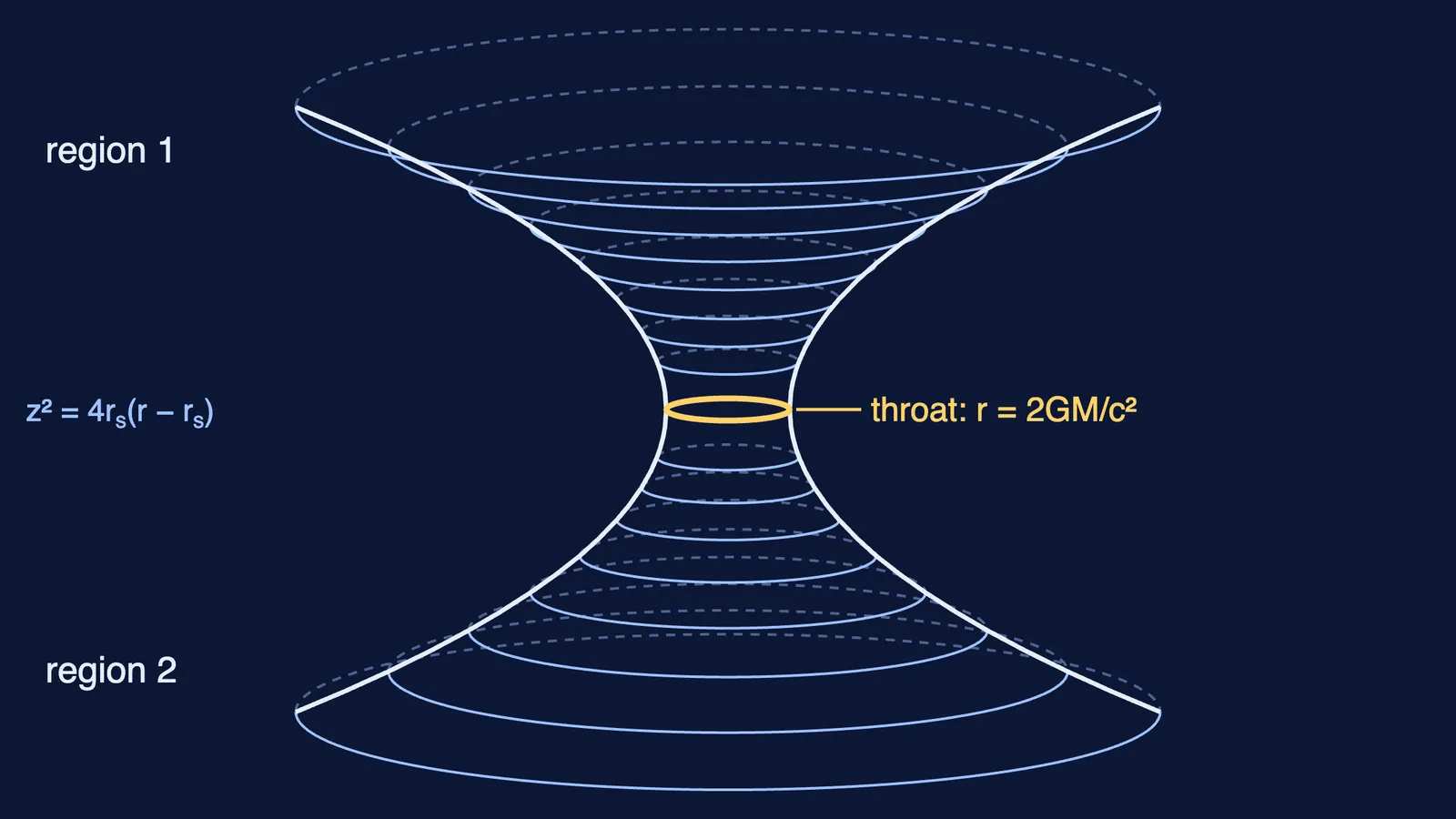
The picture above shows one slice of the Einstein-Rosen geometry: two funnels meeting at a throat, whose radius is the Schwarzschild radius, r = 2GM/c², the same radius as a black hole's event horizon.
JEE gravitation gets you there: set the escape speed √(2GM/R) equal to c and solve for R. (That shortcut lands on the right formula by coincidence; general relativity derives it properly.)
Put in numbers. The Sun's GM is 1.32712 × 10²⁰ m³/s² (NASA Sun fact sheet) and c is exactly 299,792,458 m/s (NIST).
Multiply: 2 × 1.32712 × 10²⁰ = 2.654 × 10²⁰ m³/s².
Square c: about 8.988 × 10¹⁶ m²/s².
Divide: r ≈ 2,950 m, about 3 km.
The same sum with Earth's GM of 3.986 × 10¹⁴ m³/s² from the same NASA sheet gives about 9 mm. A star's whole mass would have to sit inside 3 km before this geometry appears; why collapse like that happens is the subject of Penrose's singularity theorem.
If escape speed still feels shaky, the Fermi Concept Library gives every physics concept its own lesson, and the Fermi Simulation Lab has interactive simulations for ideas easier to see than to read.
Can you travel through an Einstein-Rosen bridge?
No. A paper by Peter Collas and David Klein, Embeddings and time evolution of the Schwarzschild wormhole, calls the Einstein-Rosen bridge a "nontraversable wormhole" and shows its throat pinching off over time.
What would it take to hold a wormhole open?
In 1988 Michael Morris and Kip Thorne asked what material a wormhole people could cross would need. Their American Journal of Physics paper says the throat must have no horizon, and the material there must carry a radial tension of about (pressure at the centre of the most massive neutron stars) × (20 km)² / (circumference of the throat)².
Try it: a throat 20 km round needs the pressure at a heavy neutron star's centre, a 2 km throat 100 times that, a 200 km throat one hundredth.
The harder demand is the second one in the same paper: that tension must exceed the material's mass-energy density, ρc². No known material does this, and such material would violate the "energy conditions" behind key theorems of general relativity. They added that it cannot be firmly ruled out.
The nearest real candidate is the Casimir effect, an attraction between metal surfaces very close together in a vacuum, which Steve Lamoreaux measured at gaps of 0.6 to 6 micrometres in 1997. It is often cited as laboratory negative energy, but Remo Garattini's analysis of Casimir wormholes concludes that such a wormhole is traversable "only in principle but not in practice".
Why has no wormhole been observed?
A wormhole would bend light, so astronomers look for lensing. In 1995 John Cramer and colleagues proposed that a negative-mass wormhole mouth would brighten background stars in a distinctive way.
In 2013 Ryuichi Takahashi and Hideki Asada used the Sloan Digital Sky Survey quasar lens search, which found no multiple images lensed by such objects among about 50,000 distant quasars. That sets an upper limit on how common one type, the Ellis wormhole, can be for throat radii of 10 to 10,000 parsecs.
Wormholes may be very rare, too small to spot, or, as Astronomy magazine puts it, forbidden by deeper physics we have not yet found. Extreme gravity itself is real and can be photographed: see how the first black hole image was taken.
How do you check a "wormhole found" headline?
Ask four questions before you share it:
Is it an object in the sky, or a calculation, simulation or analogy?
What holds the throat open? If negative energy or exotic matter never comes up, ask how it escapes the Morris-Thorne condition.
Is there a signal, such as lensing, that ordinary stars or black holes cannot explain?
Is there a peer-reviewed paper with a DOI whose abstract says what the headline says?
Seen a wormhole in a film? Try the throat sum and tension formula on it.