On this page
In about 1792 a Scottish engineer working in Cornwall started heating coal in a closed vessel and burning the gas that came off. Within fifteen years that gas was lighting a whole cotton mill in Manchester, and soon after, gas lamps lit the streets of London. The engineer was William Murdoch, and the numbers he left behind are still worth checking.
Who was William Murdoch?
William Murdoch was born on 21 August 1754 in Ayrshire, Scotland, and died on 15 November 1839, according to the Dictionary of National Biography. He joined Boulton & Watt, James Watt's steam-engine firm, in 1777, and in about 1779 was sent to Cornwall to look after its mine pumping engines (DNB). If you have read how James Watt's separate condenser cut wasted heat, Murdoch was one of the people keeping those engines running.
Did Murdoch really light his house with gas in 1792?
The DNB says that "about 1792, while residing at Redruth, he commenced making experiments on the illuminating properties of gases produced by distilling coal, wood, peat". Murdoch's own 1808 paper to the Royal Society dates his Redruth experiments to "nearly sixteen years" earlier (the paper's text).
The house is where the story gets softer. Wikipedia's biography calls his Redruth home the first house lit by gas. But the DNB says 1792 "is much too early" as the date gas lighting began: Murdoch's mother-in-law told the firm's agent in Cornwall that the gas "was never set fire to" at the house "at a greater distance than the length of a gun-barrel fixed to the retort" (DNB).
The firmer facts come later. Murdoch's paper says he moved to the Soho Foundry in 1798 (the DNB doubts the year). At Soho, gas was used "to a small extent" in the illuminations for the peace of Amiens in March 1802, and in 1803 part of the foundry was regularly lit by gas (DNB).
How did coal gas lighting work?
Coal gas is a flammable fuel made by heating coal strongly without air, supplied to users through pipes (Wikipedia: coal gas). It contained carbon monoxide, which made it highly toxic (same article). The coke left behind could be sold (Murdoch, 1808).
At the mill, Murdoch distilled cannel coal from Wigan in large iron retorts, washed and stored the gas in gasometers, and piped it to two kinds of burner: Argands, like an Argand oil lamp, and three-jet cockspurs (Murdoch, 1808).
Was gas cheaper than candles? Check Murdoch's numbers
Murdoch's 1808 paper reports on the Philips and Lee cotton mill in Manchester, lit by apparatus made at Soho (Murdoch, 1808). On 1 January 1806 he wrote to Boulton & Watt that "fifty lamps of the different kinds" were lit that night (DNB). In the winter of 1807-08, when he wrote the paper, the mill had 271 Argands and 633 cockspurs, which he said gave about the light of 2,500 mould candles (Murdoch, 1808).
Check his sums from the same paper:
Light. Each Argand gave the light of 4 candles, each cockspur 2.25. So 271 × 4 = 1,084 and 633 × 2.25 = 1,424.25, about 2,508 candles: "a little more than" 2,500, as he says.
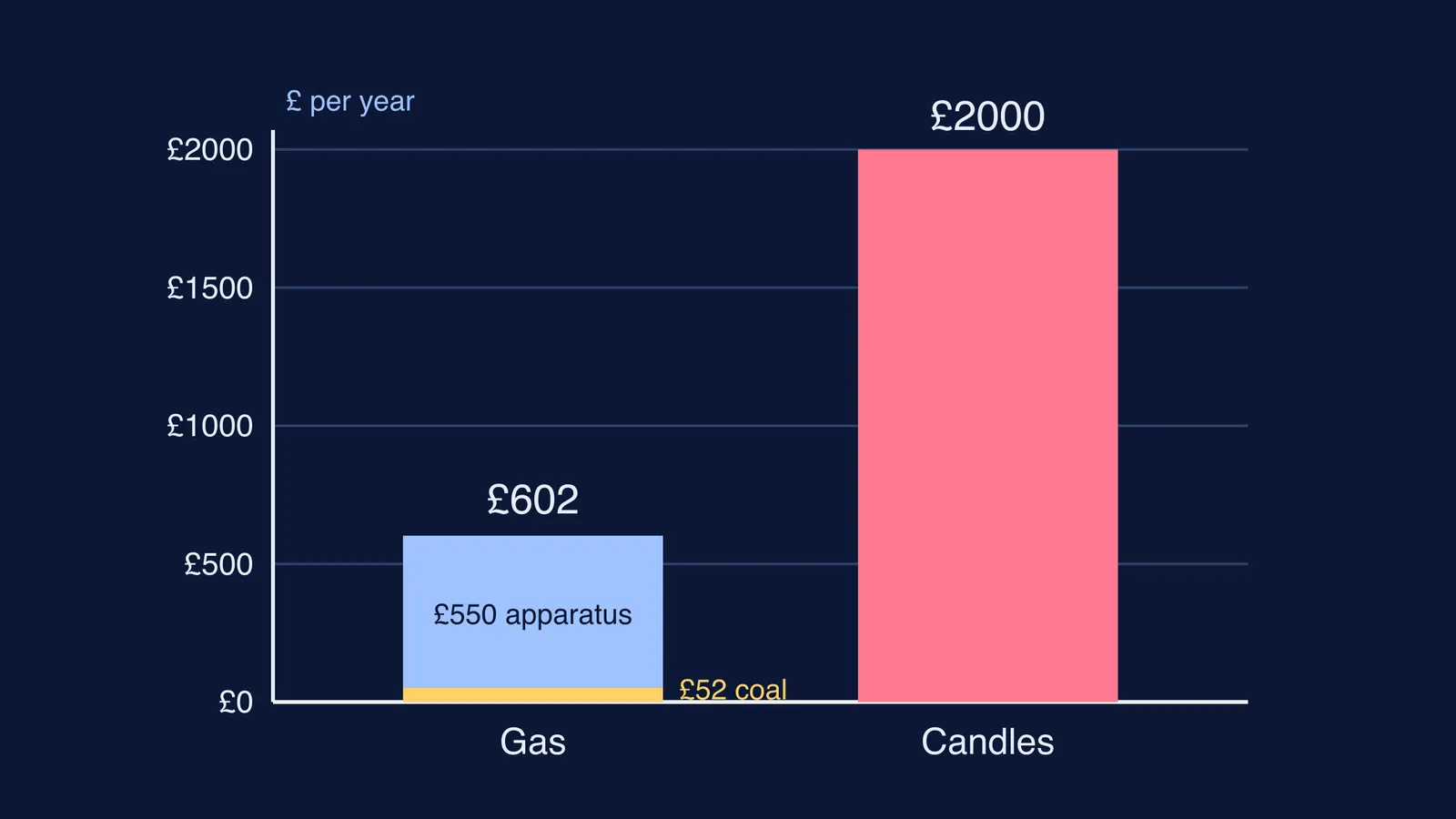
Fuel. 110 tons of cannel coal cost £125 and 40 tons of ordinary coal to heat the retorts £20, so £145. The 70 tons of coke left over were worth £93, leaving £52 a year.
Everything else. Interest on the capital plus wear and tear came to about £550, so gas cost about £602 a year, his "about £600". Candles giving the same light would cost about £2,000.
The surprise is in step 3: £550 of the £602, about 91%, is the apparatus, not the coal. At three hours a day instead of two, Murdoch put gas at no more than £650 against £3,000 for candles (Murdoch, 1808). Our reading: gas was cheap to run but costly to set up, so it paid best where many lights burned long hours in one place.
If unit-by-unit sums like this trip you up in fuel numericals, the Fermi Problem Library has worked problems with a step-by-step solver that explains the reasoning rather than printing an answer. For the modern version, see how to calculate the calorific value of a fuel.
When did gas street lighting come to London?
Frederick Winsor gave the first public display of gas lighting in 1807, with street lamps on Pall Mall for King George III's birthday (London Museum). The Gas Light and Coke Company was founded in London in 1812, and Westminster Bridge was lit by gas street lamps at the end of 1813 (London Museum). By the 1820s London had around 50,000 gas lamps connected by 300 miles of pipes (London Museum).
Murdoch never made money from gas lighting because he did not obtain a patent for it, which left the field open to others, Winsor among them (Wikipedia).
How can you check a "first" in science history?
Before you quote a famous date:
Find what the person wrote themselves.
Separate what they did (began experiments) from what is retold (lit his house in 1792).
Redo their numbers; Murdoch's add up.