On this page
In 1856 a schoolteacher in Nashville, Tennessee, published an essay on a question that had puzzled scientists: why do the winds of the middle latitudes blow from the west? William Ferrel's answer put Earth's rotation at the centre of the whole wind system. The middle band of circulation in each hemisphere, between the Hadley cell and the polar cell, now carries his name.
Who was William Ferrel?
Ferrel was born on 29 January 1817 in Pennsylvania and had only two winters of schooling in a one-room schoolhouse, according to his MacTutor biography. Around 1850, while teaching in Liberty, Missouri, he found a copy of Newton's Principia that someone had ordered and never collected. In 1854 he set up his own school in Nashville. Two years later he published his essay on the winds in the Nashville Journal, and MacTutor says that with this paper "he became the chief founder of the subject of geophysical fluid dynamics."
You can read the full 1856 essay, An essay on the winds and the currents of the ocean, on Wikisource.
What did Hadley's theory get wrong?
The standard account came from George Hadley's 1735 paper, Concerning the cause of the general trade-winds. Hadley showed that Earth's rotation turns the trade winds, but he pictured just one cell from the equator to the pole, as the Encyclopedia of the Environment explains.
Ferrel pointed out that a single cell gives the wrong pressure pattern: "The barometer also should stand highest at the poles where the air is coldest and most dense, and gradually fall as it is brought nearer the equator. But both of these, as we have shown, are contrary to observation." Instead, pressure was highest near latitude 28°, with calm belts there and a low barometer near the polar circles. Ferrel also engaged with Matthew Fontaine Maury's Physical Geography of the Sea; we told Maury's story in how Maury's wind charts cut sailing times.
How does the Coriolis effect create the westerlies?
The Met Office puts it in one line: Earth's rotation causes the Coriolis effect, which deflects moving air to the right in the northern hemisphere and to the left in the southern hemisphere.
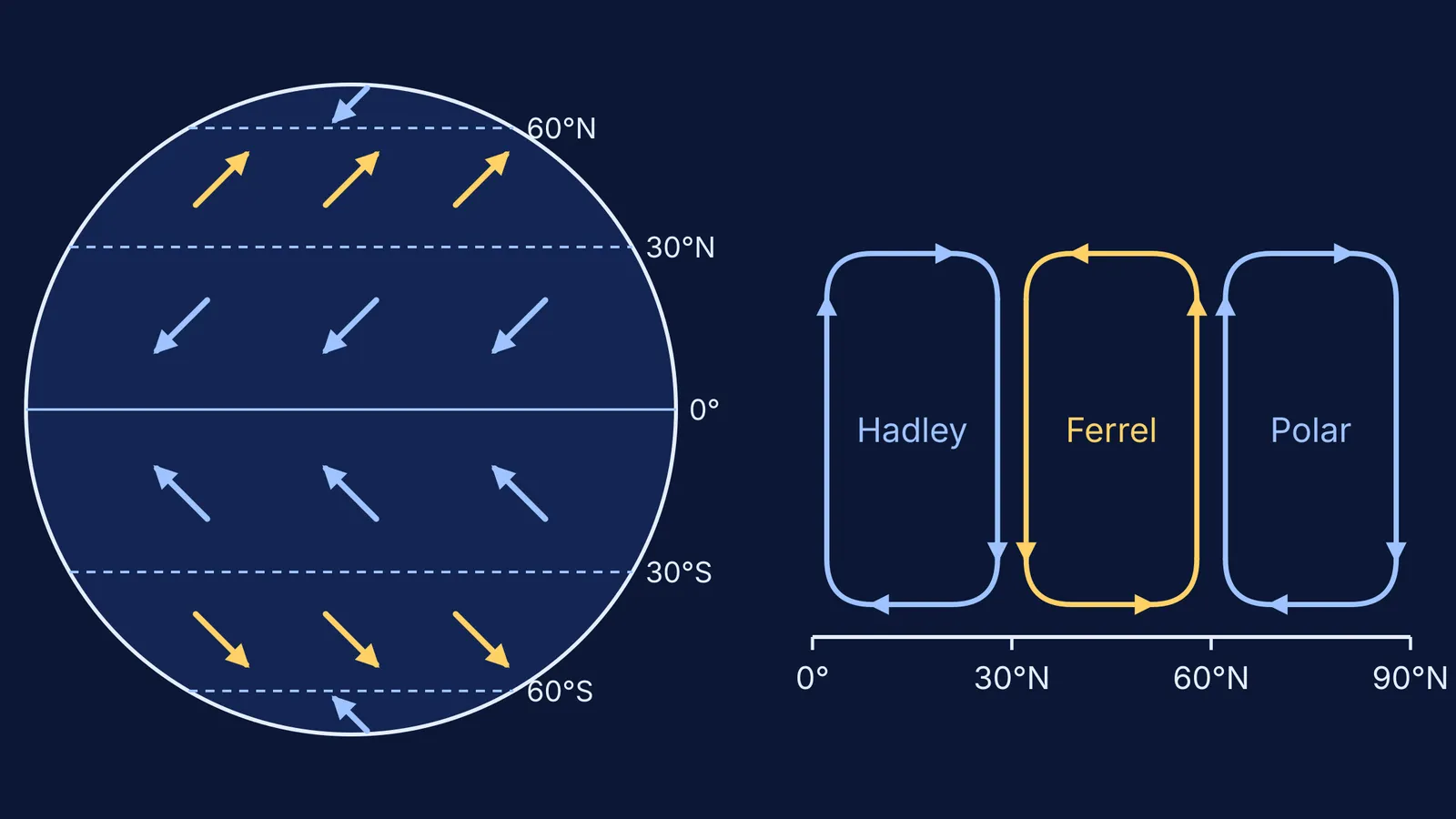
Ferrel argued that this deflection piles air up around latitude 28°. From that high-pressure belt, surface air flows two ways. Air heading for the equator becomes the trade winds. Air heading for the pole, "combined with the rotatory motion of the Earth, produces the southwest winds in the northern hemisphere, and northwest winds in the southern hemisphere, called passage-winds," he wrote in the 1856 essay. His passage-winds are what we now call the westerlies.
In an 1858 paper he stated what became Ferrel's law: a body moving in any direction is deflected to the right in the northern hemisphere and to the left in the southern (MacTutor). To see the same turning on a playground, read our post on a ball rolled across a rotating merry-go-round.
How do you work out a wind's direction step by step?
Start the air at the subtropical high near 30°N.
Pressure pushes it poleward, so it heads north.
In the northern hemisphere the Coriolis effect turns it right, towards the east. It now moves north-east.
Name it by where it comes from: air moving north-east arrives from the south-west, so it is a south-westerly.
Repeat for 30°S. The air moves south and is turned left, which is again east, so it arrives from the north-west. That matches Ferrel's "northwest winds in the southern hemisphere."
If the turning is still hard to picture, the Fermi Simulation Lab has interactive simulations for ideas that are easier to see than to read, and the Fermi Concept Library has a lesson for each concept behind it.
What is the Ferrel cell today?
Modern science kept three cells but changed why the middle one runs. Tapio Schneider's review The general circulation of the atmosphere (Annual Review of Earth and Planetary Sciences, 2006) defines the Ferrel cell as a "thermally indirect midlatitude circulation cell." In plain words, heating alone would not drive it: air sinks near 30° and rises near 60°, where it is colder.
The same review says the Hadley cell extends only to about 30° latitude, and that large-scale eddies, cyclones and anticyclones with length scales of order 1000 km, are essential for carrying heat and momentum. It concludes that each hemisphere has three cells, "at least two of which are due to eddy fluxes." So the Ferrel cell is best seen as the average effect of mid-latitude weather systems, not an engine of its own.
The Met Office places the Ferrel cell between 30–40° and 60–70° latitude and says it acts like a gear between the Hadley and polar cells.
Does the three-cell model explain India's winds?
It gives the background pattern, not the whole story. Ferrel noted in his essay that continents and mountain ranges bend the ideal belts, and over South Asia the monsoon reshapes them every year, as we explain in what causes the Indian monsoon winds. Learn the three cells first, then learn where land breaks them.