

On this page
Biology chapters on digestion lean on two words that one man chose within weeks of each other: enzyme and trypsin. That man was Wilhelm Kühne, a physiologist working in Heidelberg in the 1870s. Here is what he did and how to use the story to remember protein digestion.
Who was Wilhelm Kühne?
Wilhelm Friedrich Kühne was born in Hamburg on 28 March 1837 and died in Heidelberg on 10 June 1900, according to the Dictionary of Scientific Biography entry on Encyclopedia.com. He studied at Göttingen under the chemist Friedrich Wöhler, learned the pancreatic fistula technique from Claude Bernard in Paris, took the physiology chair in Amsterdam in 1868 and succeeded Hermann von Helmholtz at Heidelberg in 1871, staying until 1899. He also studied nerve endings and the retina, but his lasting gift to students is vocabulary.
Why did Kühne coin the word enzyme?
In the 1870s, scientists sorted digestive agents into two kinds of "ferment". Organised ferments were living things, like yeast. Unformed ferments were substances, like the pepsin of the stomach, that worked with no living cell in sight.
On 4 February and 6 March 1876, Kühne read two papers to the Heidelberg Natural History and Medicine Society, which were printed in the society's proceedings in 1877, as chemist Gregory Girolami sets out in the Bulletin for the History of Chemistry (2024). In Girolami's translation, Kühne proposed "to call the unformed or unorganized ferments, whose action can take place without the presence of organisms and outside them, as enzymes".
The word comes from the Greek énzymos, meaning "in yeast" or "leavened", the same source notes. It replaced "ferment" only gradually.
Kühne's line between living and non-living ferments did not last. Eduard Buchner won the 1907 Nobel Prize in Chemistry "for his biochemical researches and his discovery of cell-free fermentation", showing that even yeast's work could be done without living cells. So Kühne's word ended up covering both kinds.
Was trypsin discovered in 1876 or 1877?
Both dates appear in books, and both have a reason. Kühne announced trypsin in one of those 1876 talks, titled "On Trypsin (Enzyme of the Pancreas)", and the printed version is dated 1877, according to Girolami's paper. Kühne wrote that he chose the name trypsin for the pancreas enzyme that digests egg white "because it also causes cleavage of albuminous bodies", meaning proteins.
The origin of the name is a small puzzle. The Oxford English Dictionary links it to the Greek trîpsis, "rubbing". Girolami argues for thrýpto, "I break in pieces", which matches Kühne's own reason. Kühne's own procedure, he notes, was to rub fresh pancreas with glass powder and alcohol.
How does trypsin digest protein in your body?
The pancreas makes trypsin in an inactive form, trypsinogen, so it does not digest the gland that makes it. In the small intestine, an enzyme on the gut lining called enteropeptidase (also called enterokinase) cuts trypsinogen at one bond to switch it on, and the new trypsin then activates chymotrypsinogen and other protein-splitting precursors, according to the UniProt entry for human enteropeptidase.
Trypsin itself prefers to cut a protein chain just after arginine (R) or lysine (K), as recorded in the UniProt entry for human trypsin-1. Textbooks usually add one exception: the cut is slowed or blocked when the next residue is proline, though large-scale mass-spectrometry data, summarised in Wikipedia's trypsin article, suggest it still happens.
If the difference between the pancreas's two jobs is fuzzy, our post on why the pancreas is both an endocrine and an exocrine gland sorts it out, and why your stomach does not digest itself covers the protection story one organ earlier.
Worked example: where would trypsin cut insulin?
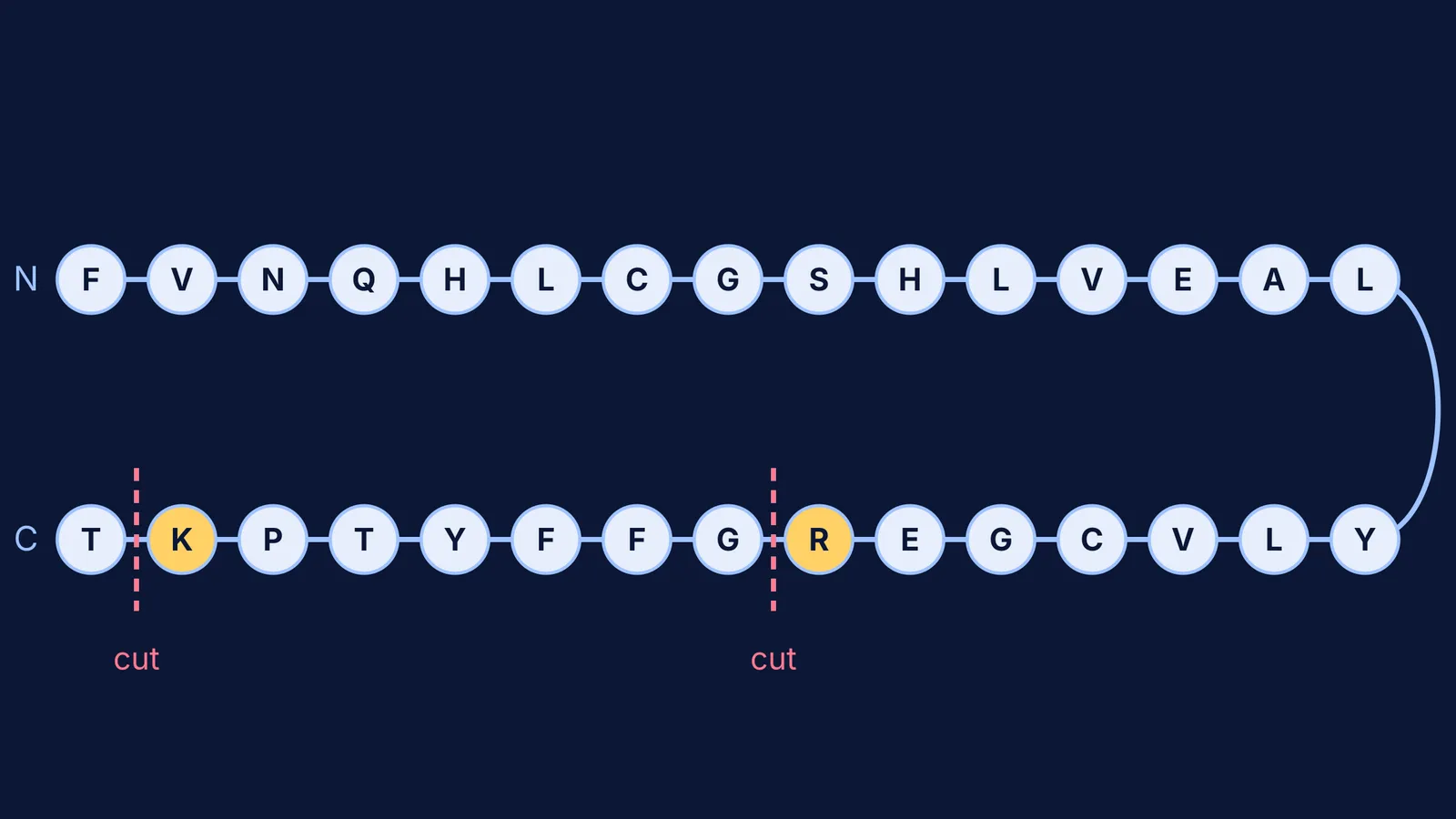
Take the insulin B chain, 30 amino acids long. Its sequence, from the UniProt entry for human insulin, is FVNQHLCGSHLVEALYLVCGERGFFYTPKT.
Find every R and K. There is an R at position 22 and a K at position 29.
Check the next residue. R22 is followed by G and K29 by T, so neither is blocked by proline. The P at position 28 comes before K, so it does not matter.
Cut after each one. You get three pieces: residues 1-22, 23-29 and 30 alone.
How can you remember all this for an exam?
Use the story as a hook, then test the science:
Say the cascade aloud in order: trypsinogen, enteropeptidase, trypsin, then the other precursors.
Write one sequence of your own and mark the cuts before checking.
Link it to the earlier history: Theodor Schwann's discovery of pepsin gives you the stomach half of protein digestion.
If words like zymogen, protease or catalyst still feel loose, the Fermi Concept Library has a lesson for every concept in biology and chemistry, each placed on a map of related ideas, so you can see where enzymes fit.
Kühne gave the field its words. Using them precisely is now your part of the job.


