

On this page
For centuries, the process of digestion remained a mystery. Some scientists believed it was a purely mechanical grinding of food, while others thought it was a type of spontaneous fermentation or decay. By the early 19th century, researchers knew that gastric juice contained acid, but they suspected that acid alone could not account for how completely food broke down in the stomach. (This interest in the stomach was fueled in part by earlier medical cases, such as William Beaumont's observations of digestion inside a living stomach.)
In 1836, a young physiologist named Theodor Schwann set out to solve this puzzle. His work would lead to the discovery of pepsin, a find that forever changed how we understand the body's chemistry.
What was the puzzle of digestion before 1836?
Before Schwann's experiments, digestion was difficult to explain. In 1824, the English chemist William Prout had discovered that the stomachs of animals secrete hydrochloric acid. While the acid clearly played a role, it was not strong enough on its own to dissolve meat or egg whites at the speed seen in a living stomach.
Working as an assistant to the renowned physiologist Johannes Müller in Berlin, Schwann began to look for the missing factor. He suspected there was another active agent at work alongside the acid.
How did Theodor Schwann discover pepsin?
Schwann approached the problem by trying to recreate digestion outside the body. He prepared a water-soluble extract from the lining of an animal's stomach and mixed it with hydrochloric acid.
When he added egg-white albumin (a protein) to this mixture, he found that it was digested much more rapidly than it was by acid alone. Furthermore, the extract retained its digestive power even when he neutralized the acid, filtered it, and diluted it. This proved that a specific, non-acidic chemical agent was responsible for breaking down the food, making it the first enzyme ever prepared from animal tissue.
Schwann correctly identified this substance as a physiological catalyst. At the time, the word "enzyme" did not yet exist, so he described it as a "peculiar specific substance" that drove the chemical breakdown of food without being consumed in the process. It would be nearly a century before James Sumner proved that enzymes are proteins.
Why did he name it pepsin?
Schwann coined the name "pepsin" for his newly discovered substance. He took the name from the Greek word *pepsis*, which means "digestion."
His choice of name reflected the enzyme's core function. By proving that digestion was a controlled chemical reaction driven by specific agents like pepsin, he helped dispel the old myths of mechanical grinding or random fermentation.
Schwann's work on pepsin was published in 1836 in the journal *Archiv für Anatomie, Physiologie und wissenschaftliche Medicin*.
How does the stomach digest proteins?
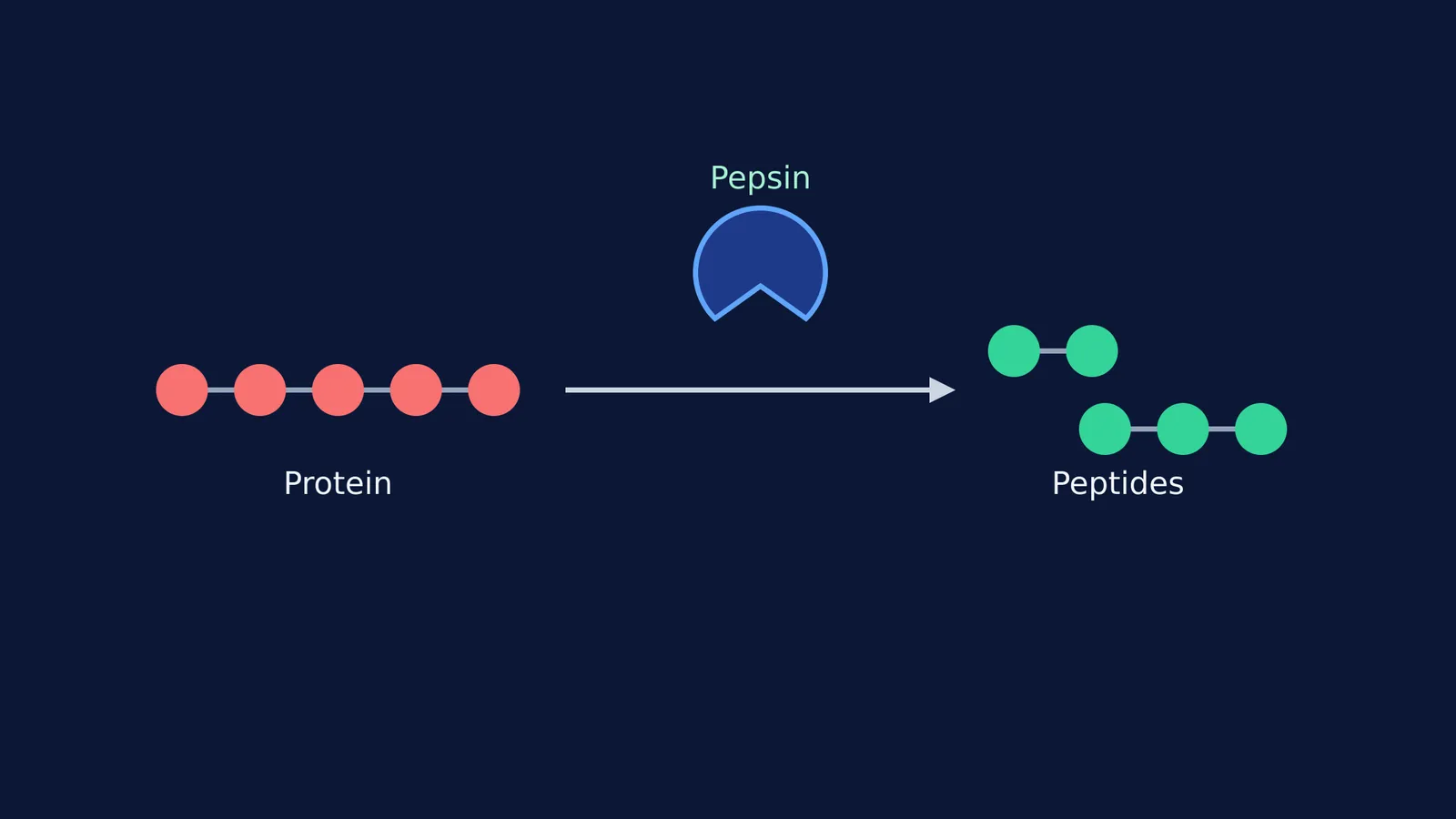
Today, we know that pepsin is a protease—an enzyme that specifically breaks down proteins into smaller chains of amino acids called peptides.
In the human stomach, pepsin is secreted by chief cells in an inactive form called pepsinogen. This prevents the enzyme from digesting the stomach lining itself. When pepsinogen mixes with the highly acidic hydrochloric acid in the stomach, it unfolds and clips off a small segment of itself to become active pepsin.
Once active, pepsin chops up the long protein molecules from our food, making them small enough to pass into the small intestine for further breakdown and absorption. This initial cleavage in the stomach is a critical first step in protein digestion, ensuring our bodies can harvest the essential amino acids needed to build new tissues and sustain life.
How can Fermi help you understand enzymes?
When you are studying biology or chemistry, reading about enzymes can sometimes feel abstract. If you are struggling to picture how molecules like pepsinogen unfold and activate in an acidic environment, the Fermi Simulation Lab offers interactive simulations for the ideas that are easier to see than to read.
If you have a question about protein structures or how pH affects enzyme activity, Fermi's AI tutor works out what you already know, builds a plan for the session, and teaches through it. You can also explore the Concept Library to find lessons on human digestion, enzymes, and the wider history of cell theory that Schwann helped establish.
Learning how these microscopic machines work is the key to understanding everything from our own digestion to modern medical treatments. Next time you review a chapter on the human digestive system, remember the young researcher who first isolated the chemical that makes it all possible.


