

On this page
Pass a current through salt water and two things happen at once: ions drift through the solution, and new substances appear at the electrodes. Faraday's laws of electrolysis tell you how much is produced at each electrode. They do not tell you which ions carried the current through the middle. The German physicist Johann Wilhelm Hittorf, born in Bonn in 1824, answered that in work published between 1853 and 1859: positive and negative ions do not share the work equally (Hittorf biography, Wikipedia).
His answer, the transport number, still turns up in JEE electrochemistry.
What is a transport number?
The transport number (also called the transference number) of an ion is the fraction of the total electric current carried by that ion in an electrolyte (Ion transport number, Wikipedia). The transport numbers of all the ions in a solution always add up to 1.
For a salt with one cation and one anion, the shares follow the ions' limiting conductivities: t₊ = λ₊/(λ₊ + λ₋) and t₋ = λ₋/(λ₊ + λ₋) (LibreTexts, Ionic migration/08:_Solutions/8.10:_Ions_and_Electrolytes/8.10.9D:_8.10.9D:_Ionic_migration)). Faster ions carry more of the current. Using the 25 °C values in that LibreTexts table (the units cancel):
Hydrochloric acid: λ(H⁺) = 349.98 and λ(Cl⁻) = 76.30, so t(H⁺) = 349.98/426.28 ≈ 0.82. Hydrogen ions carry about 82% of the current.
Potassium chloride: λ(K⁺) = 73.49 and λ(Cl⁻) = 76.30, so t(K⁺) ≈ 0.49. The two ions share almost equally.
Sodium chloride: λ(Na⁺) = 50.89 and λ(Cl⁻) = 76.30, so t(Na⁺) ≈ 0.40. Chloride does most of the carrying.
How did Hittorf show ions move at different speeds?
Hittorf's paper "Ueber die Wanderungen der Ionen während der Elektrolyse" (On the migrations of ions during electrolysis) appeared in Annalen der Physik in 1853 (Crossref record). Papers with the same title followed in 1856 and 1859. In 1853 he showed that some ions travel faster than others (Hittorf biography, Wikipedia).
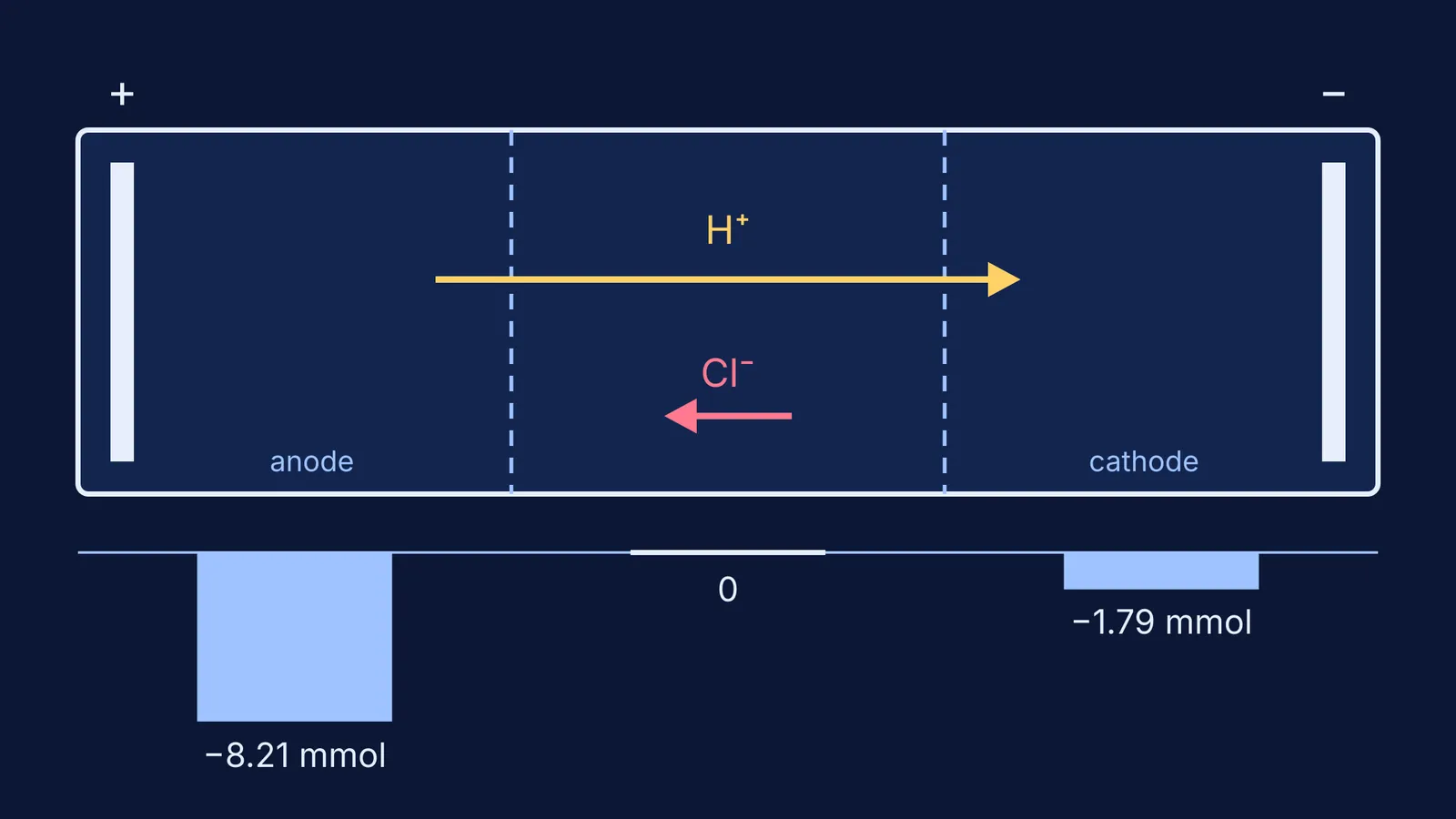
His method still carries his name. In a Hittorf cell the electrolyte sits in three connected compartments: one around the anode, one in the middle and one around the cathode. After the current has flowed, you measure how the concentration changed near each electrode (Ion transport number, Wikipedia). You never have to time a single ion.
Worked example: hydrochloric acid in a Hittorf cell
Suppose you electrolyse dilute HCl between inert electrodes and pass 10 mmol of electrons. The Faraday constant is 96,485.332 C per mole of electrons (NIST CODATA), so that is about 965 C, or 0.100 A for about 2 hours 41 minutes. Use t(H⁺) = 0.821 and t(Cl⁻) = 0.179, worked out above from the LibreTexts conductivity table/08:_Solutions/8.10:_Ions_and_Electrolytes/8.10.9D:_8.10.9D:_Ionic_migration).
Cathode compartment: 10 mmol of H⁺ is discharged as hydrogen gas. Meanwhile 0.821 × 10 = 8.21 mmol of H⁺ migrates in from the middle, and 1.79 mmol of Cl⁻ migrates out. Net loss: 1.79 mmol of HCl.
Anode compartment: 10 mmol of Cl⁻ is discharged as chlorine. 1.79 mmol of Cl⁻ migrates in and 8.21 mmol of H⁺ migrates out. Net loss: 8.21 mmol of HCl.
Middle compartment: each ion arrives as fast as it leaves, so nothing changes.
Check: 8.21 + 1.79 = 10, the charge passed. The ratio 8.21/1.79 ≈ 4.6 equals 349.98/76.30, the ratio of the ions' speeds. That is Hittorf's method in reverse: loss near the anode divided by loss near the cathode gives t₊/t₋.
If you find this easier to see than to read, the Fermi Simulation Lab has interactive simulations for ideas like this. We used one to show how molar conductivity changes with dilution.
Why do H⁺ and OH⁻ ions carry so much current?
In the LibreTexts table, H₃O⁺ (349.98) and OH⁻ (197.60) are far ahead of every other ion listed (LibreTexts, Ionic migration/08:_Solutions/8.10:_Ions_and_Electrolytes/8.10.9D:_8.10.9D:_Ionic_migration)). Other ions push their way through water's hydrogen-bonded network. These two are part of it, so a proton is passed from one water molecule to the next instead of one ion travelling the whole way. This is the Grotthuss mechanism, which the same page credits to Theodor Grotthuss in 1805.
How do you solve transport number questions?
Write both electrode reactions, and note whether the electrodes are inert.
Convert the charge into moles of electrons using the Faraday constant.
For each compartment, list what is discharged, what migrates in and what migrates out.
Check that t₊ + t₋ = 1 and, for inert electrodes, that the two compartment losses add up to the electrons passed.
If an electrode dissolves, as a copper anode does in copper sulphate, include the metal it releases.
Revise transport numbers alongside Kohlrausch's law and Wilhelm Ostwald's dilution law for weak electrolytes. If you keep losing track in step 3, the Fermi Problem Library has worked problems with a step-by-step solver that explains the reasoning rather than printing an answer.
Next time you see a transport number, picture Hittorf's three compartments and ask which ion is doing the carrying.


