On this page
In 1952, at the International Astronomical Union meeting in Rome, Walter Baade told astronomers that the universe was about twice as big as they had believed (EBSCO Research Starters). The evidence began a decade earlier, on dark wartime nights above Los Angeles. Here is how he sorted stars into two families, and the one line of maths that turned his discovery into a bigger universe.
How did a wartime blackout help Walter Baade?
Baade was a German astronomer who worked at Mount Wilson Observatory from 1931 to 1958 (biography). During the Second World War, as a German citizen, he was not allowed to do war work, so he stayed at the observatory (EBSCO). The same account notes that frequent blackouts of Los Angeles left the skies over Mount Wilson much darker than usual.
Using the 254-centimetre (100-inch) reflector, then the largest telescope in the world, and plates sensitive to red light, he first saw red giant stars in the Andromeda galaxy in 1943 (EBSCO). It was the first time stars in Andromeda's centre had been resolved (biography), and he published it in The Astrophysical Journal in 1944 (Baade 1944).
What are Population I and Population II stars?
What Baade saw led him to split stars into two groups (EBSCO).
Population I: stars in "normal", sunlike populations, like those around the Sun.
Population II: the stars found in globular clusters and in small galaxies such as Sculptor and Fornax.
A star's colour and brightness tell you about its size and temperature; our explainer on how a star's luminosity depends on its radius and temperature works through that formula.
Why did two kinds of Cepheids double the universe?
Cepheids are stars that brighten and dim in a steady rhythm. In 1912 Henrietta Swan Leavitt linked the period of 25 variable stars in the Small Magellanic Cloud to their luminosity, which made Cepheids the first "standard candles" for distances beyond our galaxy (Breuval, Huang and Riess, 2025). Measure the period, read off the true brightness, compare it with how bright the star looks, and you have its distance.
Baade's populations meant there were two different kinds of Cepheids, one belonging to each population (EBSCO). So the Cepheid yardstick needed checking.
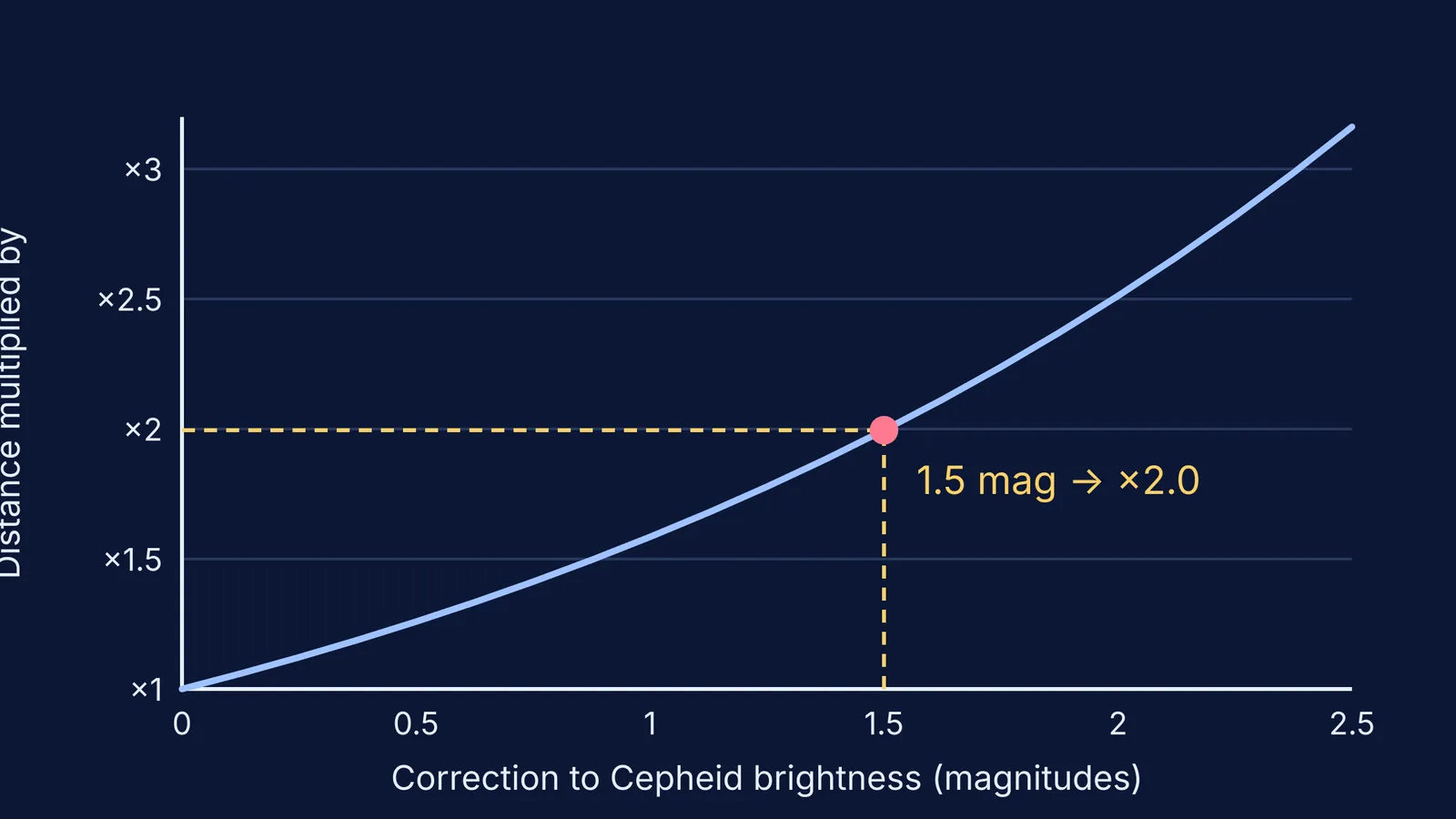
The test came at the new 200-inch telescope at Palomar. Allan Sandage's history of the telescope quotes Baade's report at Rome (Sandage, Annual Review of Astronomy and Astrophysics, 1999; full text). If the Cepheid distance were right, RR Lyrae variables in Andromeda should have appeared at magnitude 22.4, just within reach of a 30-minute exposure. Baade said "the very first exposures on M31, taken with the 200-inch, showed at once that something was wrong." The plates reached only the brightest Population II stars, which are about 1.5 magnitudes brighter than RR Lyrae stars, so the RR Lyrae stars had to sit at magnitude 23.9.
Andromeda was farther away than the Cepheids had said. Sandage writes that Baade's result "is generally considered to be the first major discovery with the Palomar telescope", and the correction meant the universe was twice as big as had been thought (EBSCO).
How does 1.5 magnitudes become twice the distance?
Astronomers use the distance modulus, m − M = 5 log₁₀(d / 10 parsecs), where m is how bright a star looks and M is how bright it really is. Here is Baade's correction worked through with the numbers from Sandage's review.
Old modulus, 22.4: d = 10^(22.4/5 + 1) = 10^5.48, about 302,000 parsecs.
Add Baade's 1.5 magnitudes to get 23.9: d = 10^5.78, about 603,000 parsecs.
Divide: 10^(1.5/5) = 10^0.3, which is about 2.0. Every distance measured with that Cepheid scale doubles.
Sandage gives the modern modulus as 24.44, which works out to about 773,000 parsecs, so later work pushed Andromeda farther still.
If logarithms still feel slippery, the Fermi Concept Library gives every concept in physics and mathematics its own lesson, so you can revise logs before magnitudes.
What can you learn from how Baade found the error?
Baade noticed that what he saw did not match the prediction, then hunted down the wrong assumption. Use the same audit when a physics numerical gives a strange answer:
Write down what you expected and what you got. Baade expected RR Lyrae stars at magnitude 22.4 and could not see them.
List every assumption in your method: constants, units, which formula applies.
Ask which assumption is most likely to be wrong. For Baade, it was the Cepheid calibration.
Estimate how big the correction must be before you redo everything.
Check the answer against something independent.
The Fermi Problem Library has worked problems with a step-by-step solver that explains the reasoning, which makes it easier to spot the step where your assumption went wrong.
Baade's bigger universe sits alongside how Alexander Friedmann predicted an expanding universe and Beatrice Tinsley's work on how galaxies evolve.