

On this page
Beatrice Tinsley was a New Zealand astronomer who showed that a galaxy's colour and brightness change as its stars are born, age and die. She was born in Chester, England, on 27 January 1941, grew up in New Zealand after her family emigrated in 1946, and studied physics at the University of Canterbury in Christchurch, according to her MacTutor biography. She submitted her PhD thesis at the University of Texas at Austin, *Evolution of galaxies and its significance for cosmology*, in January 1967.
What did Beatrice Tinsley discover about galaxies?
An obituary by Richard Larson and Linda Stryker describes her method: she built model galaxies "by putting together the available empirical and theoretical information on the evolution of stars to deduce how galaxies evolve in colour and luminosity." The obituary lists two major conclusions from her thesis:
"the colours of galaxies of all Hubble types can be explained as a result of different histories of star formation without assuming different ages"
"galaxies fade rapidly enough that substantial corrections are required when they are used as 'standard candles' in cosmological studies."
This mattered because testing cosmology with distant galaxies' brightness and redshift only works if their true brightness stays fixed. The same obituary, reprinted on Yale's page on Professor Tinsley, says her thesis "marked the beginning of modern detailed studies of galactic evolution."
How did her 1968 paper model a galaxy?
The main results appeared in February 1968 as Evolution of the Stars and Gas in Galaxies in The Astrophysical Journal. Her calculation started with gas, kept forming stars of 13 different masses, and stepped forward one billion years at a time. Each star was placed on the H-R diagram by mass and age, ended as a white dwarf, and returned its leftover mass to the gas. After 10 to 12 billion years of model time, she compared the model "galaxies" with real ones by colour, mass-to-light ratio and remaining gas.
The abstract states the big result: giant elliptical galaxies "may have been so much brighter at short wavelengths a few billion years ago" that the measured link between brightness and redshift could be read differently. New to the H-R diagram? Read Hertzsprung, Russell and the diagram that sorts the stars.
Why do galaxies change colour and fade as their stars age?
Heavy stars live fast and die young. Ohio State University lecture notes on the main sequence give a rough rule: a main-sequence star's luminosity goes as its mass to the fourth power, and its lifetime goes as 1/M³. The same notes give the Sun a main-sequence lifetime of about 10 billion years, while a star of 10 solar masses lasts about 10 million years. O and B stars, they add, "evolve very rapidly and live for only a few Million years."
So while a galaxy makes stars, a few heavy, hot, blue-white stars produce much of its light. Once star formation stops, they die first, the light shifts to cooler, redder stars, and the galaxy fades. In her 1980 review, Tinsley wrote that galaxies' "different proportions of red and blue stars in the light are due mainly to different current rates of star formation."
Worked example: how much brighter was a galaxy in the past?
You need only Class 11 logarithms and the Ohio State rules above.
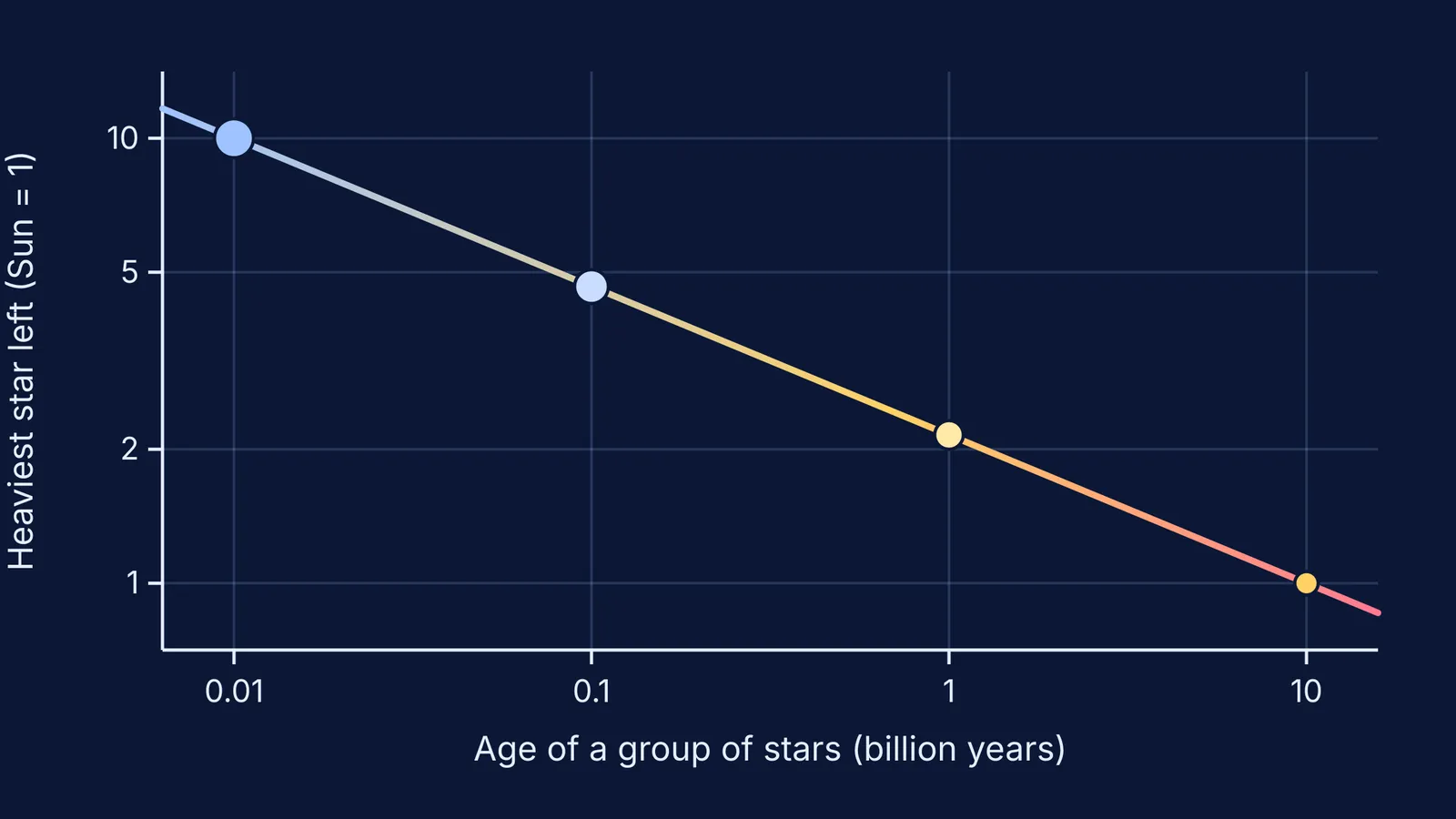
Which stars are left? Lifetime t ≈ 10 billion years ÷ M³ (M in solar masses), so the heaviest survivor has M ≈ (10 billion years ÷ t)^(1/3). At 1 billion years, M ≈ 10^(1/3) ≈ 2.15; at 10 billion years, about 1. The diagram at the top plots this rule.
How much light went with them? With L ∝ M⁴, a 2.15-solar-mass star shines about 2.15⁴ ≈ 21 times as brightly as the Sun.
Turn Tinsley's magnitude into a ratio. In her 1968 model I, the evolutionary correction to a giant elliptical's visual magnitude at redshift 0.53 is 0.68 magnitudes (the paper, section IV). At that redshift, visual light left the galaxy as ultraviolet. The magnitude scale, as LibreTexts explains, follows m₁ − m₂ = 2.5 log₁₀(I₂/I₁), with smaller magnitudes brighter. So the ratio is 10^(0.68/2.5) ≈ 1.9: almost twice as bright in that light as an unchanging galaxy.
If step 3 trips you up, the Fermi Problem Library has worked problems with a step-by-step solver that explains the reasoning rather than printing an answer.
What happened to Beatrice Tinsley after her discovery?
Yale appointed her Associate Professor of Astronomy in 1975 and promoted her to Professor in 1978, according to the obituary on Yale's tribute page. Her MacTutor biography notes she was the first woman professor of astronomy at Yale. She died on 23 March 1981, aged 40, after a three-year battle with cancer. Later honours include the American Astronomical Society's Beatrice M. Tinsley Prize (1986) and Mt Tinsley in Fiordland (2010).
Her work builds on Vesto Slipher's first redshifts of galaxies and Edwin Hubble's evidence that the universe is expanding; read those next.


