

On this page
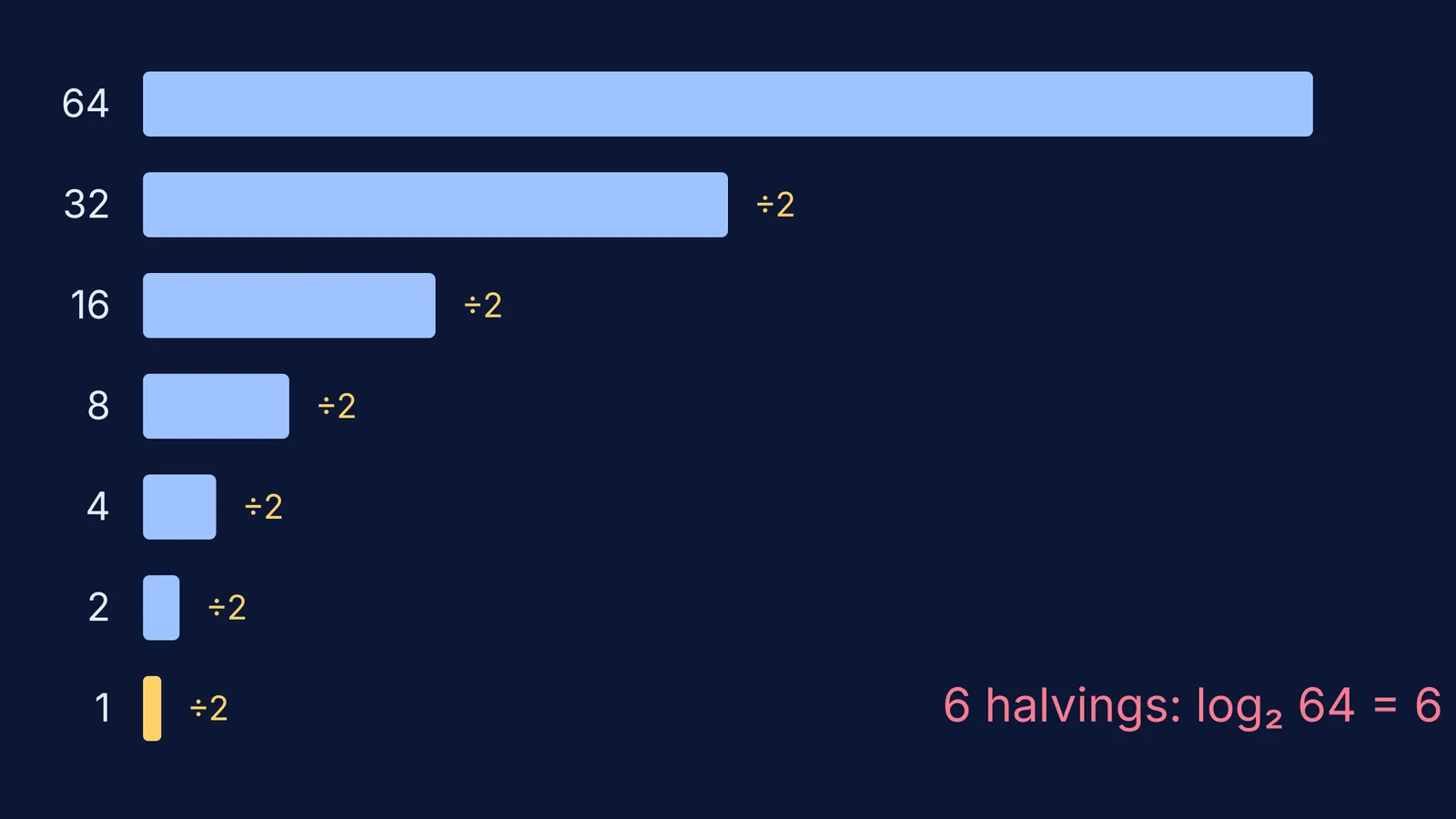
Take 64 and halve it: 32, 16, 8, 4, 2, 1. You halved it six times. In modern notation, 2 to the power 6 is 64, so log₂ 64 = 6. A Jain monk writing in the Deccan in the early ninth century had a name for that count: ardhaccheda.
Who was Virasena?
Virasena was a Digambara Jain monk and scholar, known for the *Dhavala*, a huge commentary on the *Shatkhandagama*, a Jain canonical text (Wikipedia: Virasena). The historian Hiralal Jain dated the completion of the Dhavala to 816 CE (same source). He was based in the Deccan and flourished under the Rashtrakuta kings Dhruva and Govinda III (same source); a survey of Indian mathematics places him at the court of King Amoghavarsha at Manyakheta, in present-day Karnataka (Wikipedia: Indian mathematics).
The Dhavala is not a maths textbook. A 2017 paper in the *Indian Journal of History of Science* places "Vīrasena (816 CE)" among Jain authors whose works deal mainly with karma theory and cosmology, with mathematics applied along the way (Jadhav, 2017). Jain cosmology dealt with very large quantities (MacTutor: Jaina mathematics), and the mathematics in these texts was a tool for handling them.
What is ardhaccheda in Jain mathematics?
Ardhaccheda is the number of times a number can be halved (Wikipedia: Indian mathematics). In modern notation, the ardhaccheda of x is log₂ x, the logarithm to base 2 (Banglapedia: Mathematics).
The same Banglapedia entry says Virasena also defined trakaccheda (repeated division by 3, so log₃ x) and caturthaccheda (repeated division by 4, so log₄ x). The Dhavala lists various rules for working with ardhaccheda (Wikipedia: Indian mathematics). Historians also think much of its mathematics came from earlier Jain writers who worked between 200 and 600 CE (same source).
Is ardhaccheda really a logarithm?
Partly. For powers of two, ardhaccheda and the binary logarithm give the same answer. For other numbers they do not: if you count only whole halvings, 12 goes to 6 and then 3 and stops, giving 2, while log₂ 12 is about 3.58. That is why one summary says ardhaccheda matches the binary logarithm on powers of two but behaves more like the "2-adic order" on other numbers (Wikipedia: Indian mathematics).
The idea still matters. Dipak Jadhav writes that John Napier (1550-1617) and Jost Bürgi (1552-1632) discovered logarithms by different routes, and that long before them the Jaina school had approached logarithms through the number of possible divisions of a quantity by two (Jadhav, 2017). The same paper notes that laws of logarithms to base two appear as rules in the *Trilokasara* of Nemicandra (981 CE). In Europe, Michael Stifel published a table of integers and powers of 2 in 1544 (Wikipedia: Binary logarithm). For the European side of the story, read our piece on Jost Bürgi and his tables of logarithms.
Not every historian goes as far. The MacTutor history site at St Andrews is more guarded: it says "some historians" believe they see evidence for the Jainas having developed logarithms to base 2 (MacTutor: Jaina mathematics). A fair way to say it: Virasena counted halvings and worked with rules for that count. That is not the same as a table of logarithms for fast calculation.
How can halving counts help you with logarithms today?
Here are five ways to use halving counts:
Exact values. Halve 1024 and you reach 1 after 10 steps, so log₂ 1024 = 10.
Estimates. 100 lies between 64 (6 halvings) and 128 (7 halvings), so log₂ 100 is between 6 and 7.
The product rule. 8 takes 3 halvings and 16 takes 4. Their product, 128, takes 3 + 4 = 7. That is log(mn) = log m + log n, seen by counting.
Half-life questions. A sample goes from 80 mg to 5 mg: 80, 40, 20, 10, 5. That is 4 halvings, so 4 half-lives. If one half-life is 3 hours, the time is 12 hours.
Knockouts and searching. A knockout tournament of 64 players needs 6 rounds. To guess a number from 1 to 1000 by asking "higher or lower?", 10 questions are enough, because 2 to the power 10 is 1024.
Once counting feels natural, switch to base 10. Our guides to finding the number of digits using log 10 and comparing logarithms without a calculator use the same habit of bracketing a number between known powers.
If the jump from counting halvings to the formal rules still feels shaky, the Fermi Concept Library has a lesson for every mathematics concept, each with its place in the map, so you can see what logarithms build on. For practice, the Fermi Problem Library has worked problems with a step-by-step solver that explains the reasoning rather than printing an answer.
Next time you see log₂, count the halvings first. Virasena did much the same in the ninth century.


