

On this page
Finding the number of digits in 2¹⁰⁰ looks impossible without a computer, but it is a classic problem that can be solved in two lines using common logarithms. It combines exponent rules with the base-10 logarithm, turning a massive number into a simple multiplication.
If you are stuck on a logarithm problem and don't know where to begin, Fermi's AI tutor can work out what you already know and build a plan for the session.
How to find number of digits in 2 power 100?
If you have a large number like 2¹⁰⁰, you can find its digit count using the common logarithm. The formula is to take the base-10 logarithm of the number, round it down to the nearest whole number (the floor), and add one.
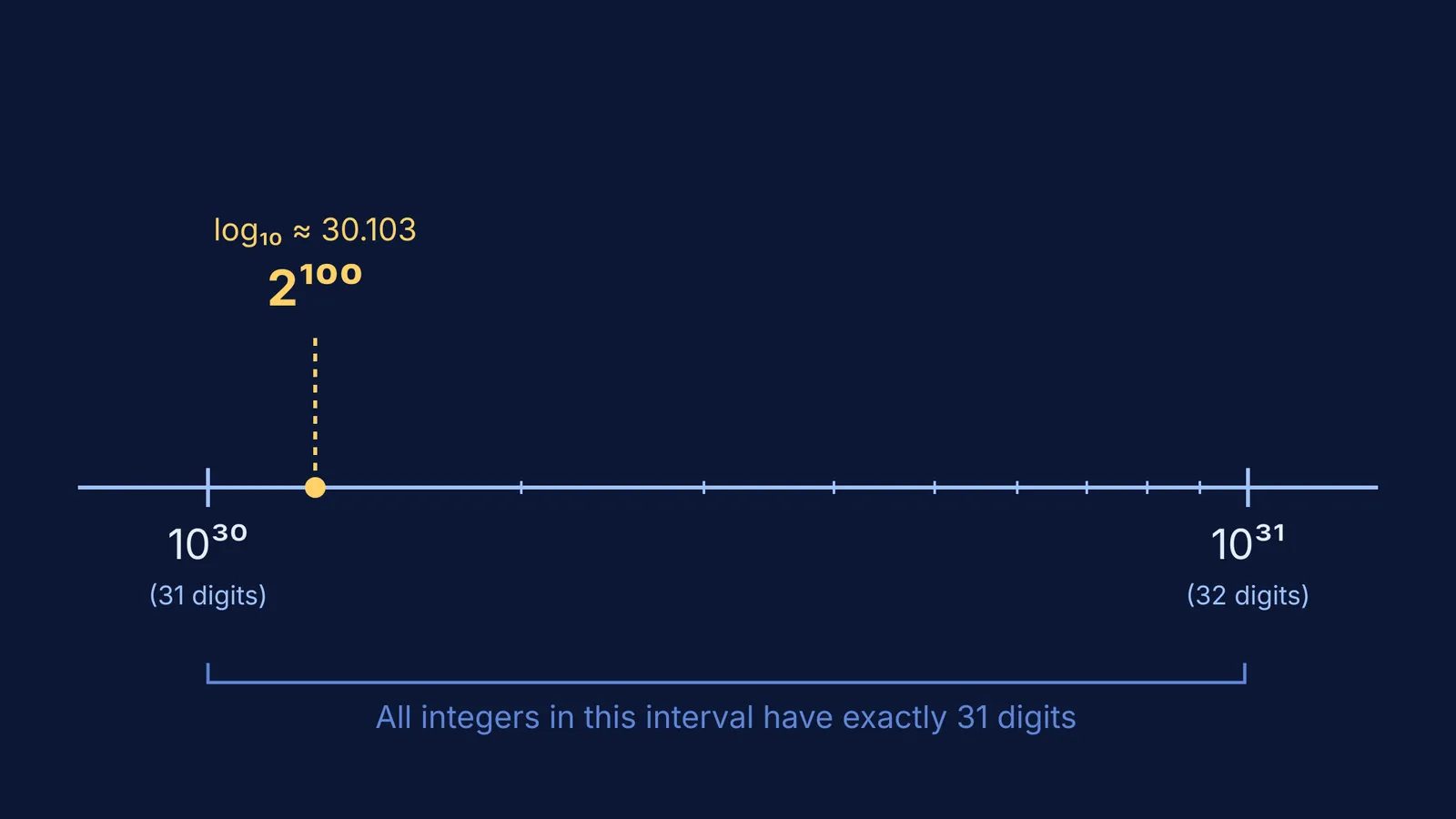
While 2¹⁰⁰ is a very large number, using exponent rules means we can pull the power down in front: log₁₀(2¹⁰⁰) = 100 × log₁₀(2). The value of log₁₀(2) is approximately 0.3010. The calculation becomes 100 × 0.3010, which equals 30.10.
The floor of 30.10 is 30. Adding 1 gives 31. Therefore, 2¹⁰⁰ has exactly 31 digits.
Why does adding one to the characteristic work?
The number of digits in our base-10 system is tied directly to powers of 10. For example, any number from 100 to 999 has three digits. These numbers sit between 10² (which is 100) and 10³ (which is 1000). The base-10 logarithm of any number in this range is 2 point something. The integer part is called the characteristic, and it tells you the exact power of 10. The 17th-century mathematician Henry Briggs developed these base-10 values, often called Briggsian logarithms, precisely to make large calculations manageable. You can read more about him in our post on Henry Briggs and how base-10 logarithms were first computed.
Because 2¹⁰⁰ evaluates to 10³⁰·¹⁰, it means the number is larger than 10³⁰ (a 1 followed by 30 zeros, which has 31 digits) but smaller than 10³¹ (which has 32 digits). Thus, it must have 31 digits. This same logic was used historically before calculators existed, a method pioneered in John Napier and logarithms: turning multiplication into addition.
How do you find the number of digits using log base 10?
You can apply this framework to any large power, not just base 2. Here is a step-by-step checklist to follow:
Write your large number in the form N = aᵇ.
Look up or recall the common logarithm of the base, log₁₀(a). For example, log₁₀(3) ≈ 0.4771.
Multiply the exponent b by log₁₀(a).
Take the integer part of your answer, which means rounding down to the floor.
Add 1 to get your final number of digits.
For example, to find the number of digits in 3⁵⁰, you multiply 50 × 0.4771, which gives 23.855. Rounding down gives 23, and adding 1 means 3⁵⁰ has 24 digits. This technique is a staple in competitive exams because it requires no heavy arithmetic. Logarithmic properties also appear frequently in calculus, as seen in our guide to Implicit and logarithmic differentiation for Class 12 and JEE. Memorising log₁₀(2) and log₁₀(3) is usually enough to solve most textbook problems without a calculator.
What if the base is a composite number?
If you are asked to find the number of digits in a power with a composite base, such as 6⁵⁰, you can still use the same method by breaking the base down into its prime factors. We know that 6 = 2 × 3. According to the properties of logarithms, log₁₀(6) is the same as log₁₀(2) + log₁₀(3).
Adding the values gives 0.3010 + 0.4771 = 0.7781. You then multiply this combined logarithm by your exponent. For 6⁵⁰, the calculation is 50 × 0.7781, which equals 38.905. Rounding down to the floor gives 38, and adding 1 means that 6⁵⁰ will have exactly 39 digits. This shows how knowing just two basic logarithm values can reveal the digit count for many different bases.
For more step-by-step math solutions that explain the reasoning rather than just printing an answer, try the Fermi Problem Library.


