On this page
John Napier is rightly celebrated for giving the world logarithms in 1614. But he was not the only one. Hundreds of miles away, a Swiss clockmaker and mathematician named Jost Bürgi had independently worked out a parallel system.
Bürgi created his *Arithmetische und Geometrische Progress-Tabulen* (Arithmetic and Geometric Progression Tables) around 1600 while working at the astronomical court in Prague. However, he kept his mathematical discovery quiet for two decades, finally publishing the tables in 1620. Because he waited so long, Napier's 1614 *Mirifici Logarithmorum Canonis Descriptio* captured the world's attention first, and Napier's terminology became the standard for generations of scientists.
How did Jost Bürgi's logarithm tables work?
While Napier approached logarithms through kinematics—imagining points moving along parallel lines at varying speeds to calculate trigonometric functions—Bürgi took a purely algebraic path, as detailed in historical accounts. He realised that multiplying large numbers could be heavily simplified by aligning a geometric progression with an arithmetic one.
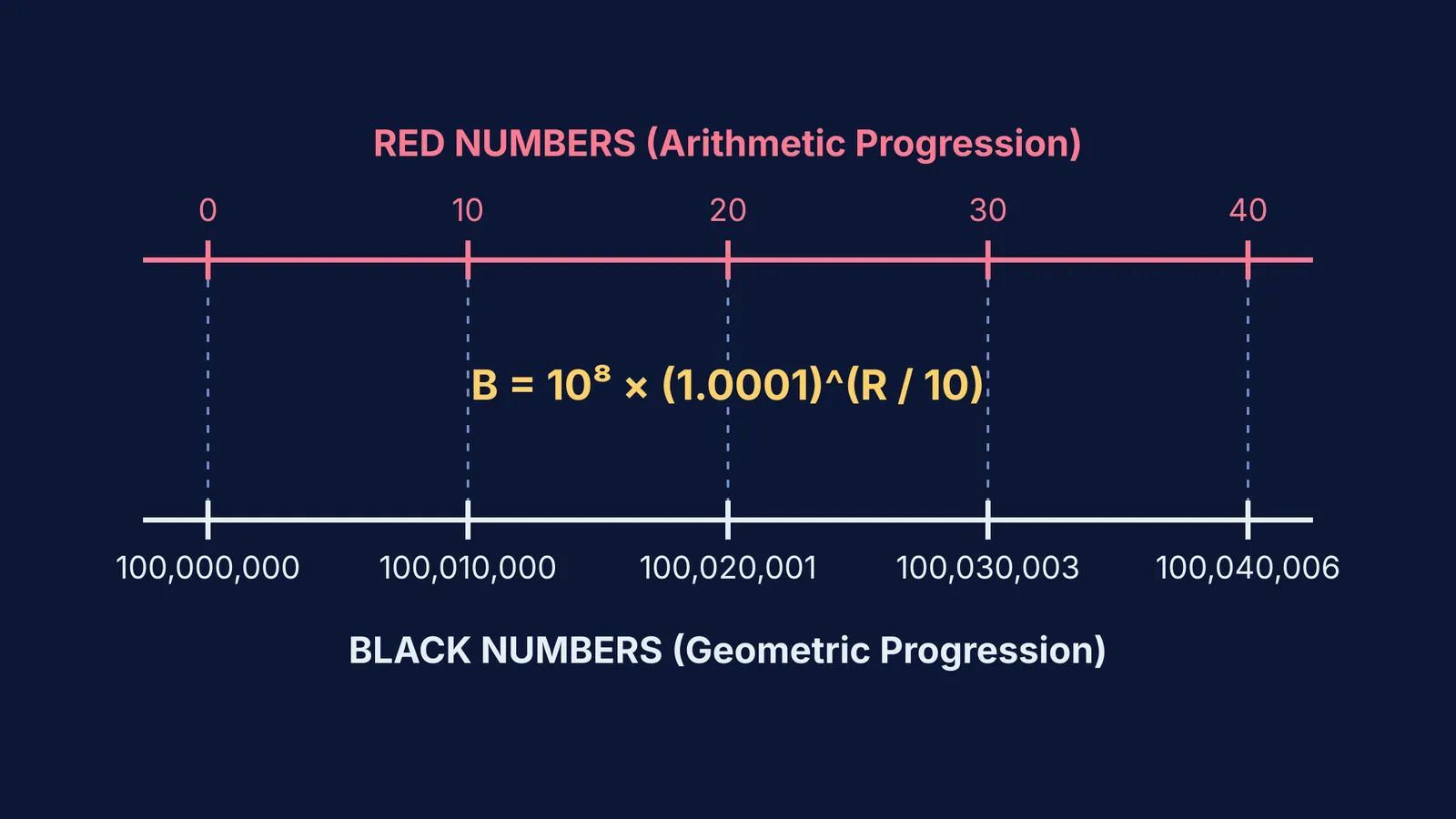
Bürgi’s tables were built on a geometric base extremely close to 1: precisely 1.0001 (which is 1 + 10⁻⁴). He printed two columns of numbers to map the relationship:
Red numbers: An arithmetic progression acting as the logarithms, increasing steadily by steps of 10 (0, 10, 20, 30, and so on).
Black numbers: A geometric progression acting as the actual values (or antilogarithms), growing by a continuous factor of 1.0001.
By calculating the function B = 10⁸ × (1.0001)^(R/10), Bürgi created a dense table where the black numbers grew very slowly. To multiply two complex numbers, an astronomer or mathematician simply found them in the black column, looked across to add their corresponding red numbers, and checked the black column for the result of that sum.
Why did Johannes Kepler say Bürgi "deserted it at birth"?
Johannes Kepler, the famous Imperial Astronomer in Prague, relied heavily on Bürgi's precise instruments and mathematical tools to track the orbits of the planets. Kepler knew first-hand that Bürgi had invented logarithms years before Napier, but he was immensely frustrated by the clockmaker's refusal to share his work with the wider scientific community.
In the 1627 preface to his landmark *Rudolphine Tables*, Kepler formally credited Bürgi with the discovery but heavily criticised his secrecy. He wrote that the clockmaker, "being an indolent man, and very uncommunicative, instead of rearing up his child for the public benefit he deserted it at birth." Even when Bürgi finally published his tables in 1620, he made a critical error: he left out the *Gründlicher Unterricht* (the step-by-step instruction manual). Without it, his tables were almost impossible for his contemporaries to understand or apply to their own work.
The Bürgi Test: sharing your reasoning
Bürgi's story is a lasting lesson in the sciences: discovering a brilliant idea is only half the work. Sharing it clearly so others can build upon it is just as crucial.
If you are preparing for competitive exams like JEE Main or NEET-UG, you might find yourself acting a bit like Bürgi. You might work out a clever shortcut or a clearer way to see a physics problem, but leave it as a messy scrawl in the margins of your notebook. To ensure you actually understand a concept and do not abandon it "at birth," try this active-learning framework:
Write down the insight: The moment you spot a pattern or a faster way to solve a problem, write it out clearly as if explaining it to a student a year younger than you. Do not assume you will remember it tomorrow.
Examine the reasoning: Do not just write down the final formula. Detail the specific steps that got you there. If you are stuck on a difficult mathematical proof or simply do not know where to start, Fermi's AI tutor can work out what you already know and build a plan for the session, teaching you the line of reasoning instead of just printing the final answer.
Teach a peer: Explaining your method out loud exposes the hidden gaps in your own understanding. If your classmate can follow your logic from start to finish, the idea is truly yours.
Mathematics is not just about getting the correct black number from the red one. As John Napier proved, it is about communicating the method so well that the whole world can use it. If you want to see how other mathematical methods were developed and shared, read about Henry Briggs and how base-10 logarithms were first computed or explore Al-Karaji, the binomial table and an early form of induction.