On this page
In the late 1800s, cattle driven north from Texas looked perfectly healthy, yet the local cattle that mixed with them often fell ill and very often died, according to the Handbook of Texas entry on Texas fever. Theobald Smith (1859-1934), a pathologist at the US Bureau of Animal Industry (Schultz, Emerging Infectious Diseases, 2008), and the veterinarian Fred L. Kilborne set out to find out why, in experiments that began in 1889 (the original report, Internet Archive). Their answer is also one of the cleanest controlled experiments you can study.
What did Theobald Smith and Fred Kilborne discover?
Their 1893 report, Bulletin No. 1 of the Bureau of Animal Industry, ends with a list of conclusions (original report). Two matter most. First, the fever destroys red blood cells, and the culprit is a single-celled parasite living inside those cells. Second, in their words, "Texas fever in nature is transmitted from cattle which come from the permanently infected territory to cattle outside of this territory by the cattle tick."
It also solved the puzzle of the healthy Texas herds: cattle from the infected territory, "though otherwise healthy, carry the micro-parasite of Texas fever in their blood" (original report). Today the parasite is called Babesia bigemina and the tick Rhipicephalus annulatus (Beard, Eisen and Eisen, Journal of Medical Entomology, 2021).
A vector is a living carrier, such as a tick or a mosquito, that passes a disease agent from one host to another.
How did the tick experiment work?
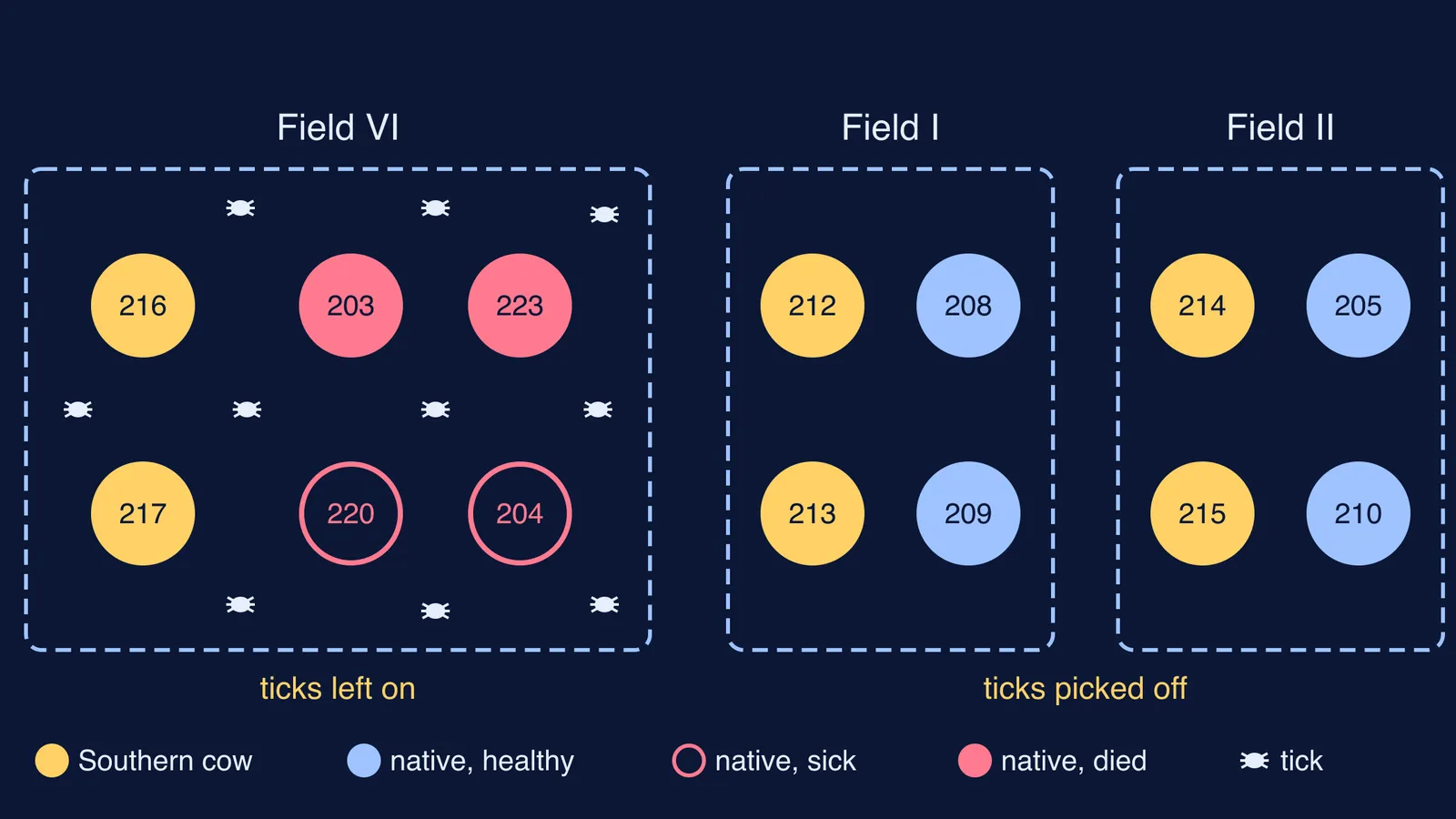
The design is clearest in the summer of 1892 (original report). Six cows came from two farms near New Bern, North Carolina, inside the infected southern zone, and were split across fenced fields shared with local "native" cattle.
Field VI (the control): two southern cows kept their ticks. All the exposed natives caught Texas fever, and two of the three exposed earliest died.
Fields I and II: two southern cows each, with ticks picked off and the cows re-examined for weeks for any too small to see at first. The four native cows in these fields stayed well all summer.
Same farms, same season. The only difference was the ticks.
They also tested rival ideas. In 1890 a heifer fed about 2,000 live adult ticks stayed well, so eating ticks was not the route. In 1892 one native cow grazed the infected field for 20 days and stayed healthy, because it was moved out before young ticks appeared (original report).
To prove it, they hatched ticks in glass dishes in the laboratory and placed the young ticks on healthy cattle. In autumn 1890 those cattle developed fever and a sudden loss of red blood cells, and the hatched-tick experiments succeeded again in 1891 and 1892 (original report).
Why was this the first proof of an arthropod vector?
Their 1893 work documented for the first time experimental transmission of a disease agent through the bite of a blood-feeding arthropod (Beard, Eisen and Eisen, 2021). The same idea of a living carrier runs through later discoveries such as Ronald Ross's work tracing malaria to mosquitoes, and through the mosquito vectors of malaria and dengue you study in school.
The payoff: kill the tick and you stop the disease. The Bureau of Animal Industry launched a national tick-eradication campaign on 1 July 1906, quarantining areas and dipping cattle repeatedly, and the country was declared free of cattle fever ticks in 1943 except for a permanent quarantine zone in south Texas (USDA National Agricultural Library). That zone runs for about 580 miles along the Rio Grande.
How can you design an experiment like Smith and Kilborne?
Borrow their logic for any school practical. Here is the checklist, with their version of each step from the original report.
Name one suspect. Theirs: the tick.
Build a control group that matches in every other way. Theirs: cows from the same two farms in every field.
Remove only the suspect. Theirs: ticks picked off, cows re-examined for any they missed.
Repeat it. Field II was set up as an exact duplicate of Field I, in case one failed.
Test the rival explanations. Theirs: feeding ticks to a heifer, moving a cow before the eggs hatched.
Watch the timing. The 20-to-25-day delay pointed them to the young ticks.
Worked example: do seeds need light to sprout? Suspect: light. Control: same seeds, soil and water, one tray in a dark cupboard. Repeat with a second pair of trays. Rival idea: the cupboard is cooler, so record both temperatures. More on this in our guide to control groups in biology experiments.
If words like vector, host and protozoan blur together, the Fermi Concept Library gives each biology concept its own lesson and shows its place in the map. And when you draft your own experiment, Fermi's AI tutor can work through it with you, noticing where you are stuck and checking your understanding as it goes.
Next time you meet a disease vector, ask their question: what is the one difference between the sick and the healthy?