On this page
Long before electric pumps, builders in Gujarat and Rajasthan stored water through the dry months in stepwells: wells you can walk down into. You can read one with ideas from school science.
What is a stepwell?
A stepwell is a well with a staircase: a long trench of stepped terraces and pillared pavilions that leads down to a vertical well shaft, as CyArk's survey of Rani ki Vav describes it.
Rani ki Vav at Patan, Gujarat, is 64 m long and 20 m wide, and its well shaft is 27 m deep, according to the Indira Gandhi National Centre for the Arts. The same page says it is believed to have been built by Queen Udayamati, wife of King Bhimadeva I (who ruled 1022 to 1063). It became a UNESCO World Heritage Site in June 2014 (CyArk).
Chand Baori at Abhaneri, Rajasthan, has 3,500 narrow steps in a precise geometric pattern, according to the Ministry of Tourism's Incredible India page, which dates it to the 9th century. That page gives two depths, about 20 metres and over 98 feet, so treat any single figure with care.
How do stepwells reach the water table?
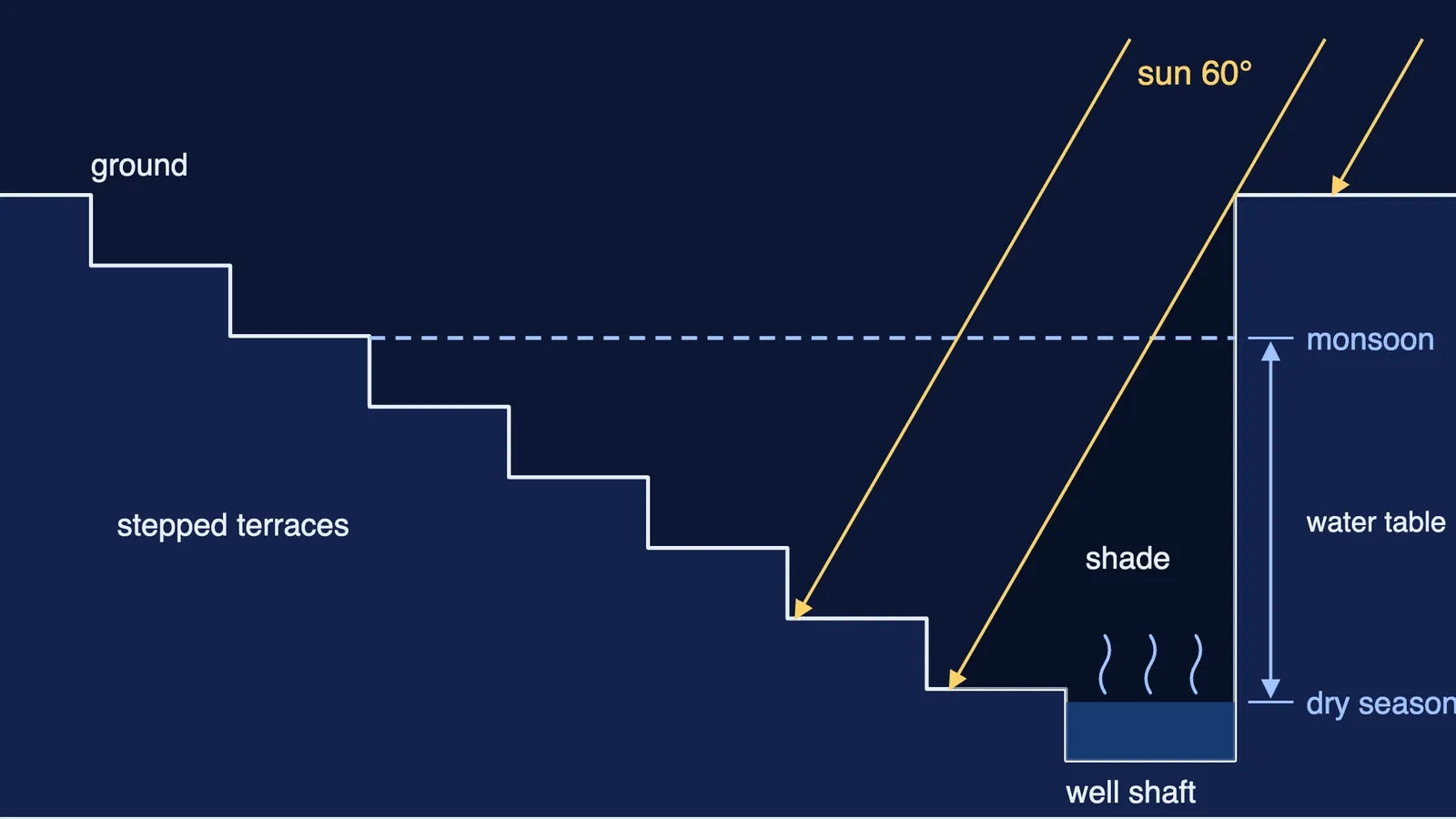
The water in a stepwell is groundwater, and its level is not fixed. At Rani ki Vav, water entered through an opening in the well cylinder and its level rose and fell with the season; when the water table was high, it could reach the uppermost steps, CyArk records.
That moving target is the design problem a stepwell solves. A stepwell lets you walk down to wherever the water is this month: after the monsoon you stop at an upper terrace, and late in the dry season you keep going towards the shaft. Storing water when it falls and using it later is also the idea behind rooftop rainwater harvesting that recharges a borewell.
Why does a stepwell lose less water to evaporation?
Water evaporates from its surface, faster in sun, wind and dry air. A stepwell keeps its water deep, narrow and shaded: Rani ki Vav is 20 m wide, yet its well shaft is 27 m deep (IGNCA). Here is a worked example with round numbers, not the measurements of any real well.
Store 1,000 cubic metres of water in a pond 1 m deep. It needs 1,000 square metres of open surface.
Store the same water in a shaft 10 m by 10 m, filled 10 m deep. Its surface is 100 square metres, one tenth as much.
Now add shade. If that 10 m wide shaft holds its water 20 m below the rim, sunlight shining straight across it reaches the water only when the sun is more than tan⁻¹(20 ÷ 10), about 63°, above the horizon. A lower sun lights only the upper walls.
Air inside a deep, walled trench is usually stiller than wind across an open tank.
The diagram at the top shows the same effect for a sun 60° up behind the shaft: the shaft wall's shadow covers the lowest steps, and the dry-season water sits in shade.
Why is it cooler at the bottom of a stepwell?
Brian Ford and Mark Hewitt took measurements in stepwells, well houses and bath houses in northern India in March and April 1995. All the structures still gave comfortably cool interiors in summer, and the paper discusses how these buildings combine thermally massive structures with evaporative cooling (Architectural Research Quarterly, 1996).
Thermal mass: thick stone and earth heat up slowly, so they lag behind the afternoon's heat.
Evaporative cooling: water turning to vapour takes heat from the air and stone around it. It works best in dry air, which is why air coolers stop working in humid weather.
Researchers are now testing this in Jodhpur, where summer air temperatures frequently reach 48°C. An IIT Jodhpur study simulated a stepwell and a water tank and concluded that heritage waterbodies can provide ambient comfort in an arid climate (Banerjee and Solanki, ICUC12, 2025). Tania Sharmin and colleagues surveyed 300 residents and tourists and measured temperature, humidity and wind at one stepwell; preliminary results say people felt the heat less as they went down (ICUC12, 2025).
If latent heat still feels abstract, the Fermi Concept Library has its own lesson for every concept in physics and chemistry, and the Fermi Simulation Lab has interactive simulations for ideas that are easier to see than to read.
How can you read a stepwell like an engineer?
Next time you visit one, or study a photo, ask five questions:
Where is the water now, and which terrace would it reach after a good monsoon?
How much water surface is open to the sky compared with the depth?
When can sunlight reach the water? Estimate tan⁻¹(depth below rim ÷ width).
What holds the heat? Notice the stone and earth around you at each level.
Where does the air move? Feel for a breeze at each landing.
If groundwater interests you, read how to become a hydrologist in India.