On this page
Ladakh is a cold desert. Rain and snow there rarely add up to more than 100 mm a year, and winter temperatures can drop to -30°C, according to a University of Aberdeen geographer writing in The Conversation. When the warm growing season arrives, lower streams quickly dry up, and there is little water until June. Farmers need water most in spring, to sow, and that is when it runs short (The Wire).
Engineer Sonam Wangchuk's answer was to save winter water as ice, in a shape that melts slowly and late. He called it an ice stupa.
What is an ice stupa?
An ice stupa is an artificial ice reservoir: a human-made ice structure built in winter by spraying water through a fountain, designed to release its water slowly in spring and summer (Balasubramanian and colleagues, Frontiers in Earth Science, 2022).
Since 2014, mountain communities in Ladakh have built dozens of these every winter, and their meltwater is crucial for spring irrigation, the same peer-reviewed study says. Wangchuk is one of its co-authors.
For an earlier Ladakhi way of storing winter water, read how Chewang Norphel built flat artificial glaciers. Wangchuk's design stacks the ice upwards instead.
When did Sonam Wangchuk build the first ice stupa?
In winter 2013, Wangchuk and his students froze 150,000 litres of water in a six-foot-high prototype in Leh, The Wire reported. In winter 2014, with donations of Rs 75 lakh, the team built a larger stupa that released two million litres of water well into June.
On 15 November 2016 he received a Rolex Award for Enterprise, the same report says.
How does an ice stupa work without pumps or electricity?
The whole system runs on gravity and cold air. The 2022 study describes the steps:
Take water from a source higher up the valley, usually a high-altitude lake or glacial stream.
Carry it down in a pipeline. Because the source sits higher than the fountain, the drop in height pushes the water out, with no pump.
Let it spray from a fountain nozzle. The droplets freeze in subzero winter air.
Keep spraying through the winter nights. As ice builds up below the nozzle, the team raises it by adding lengths of metal pipe.
In spring and summer, the ice melts slowly and the meltwater goes to the fields.
Why is an ice stupa cone-shaped?
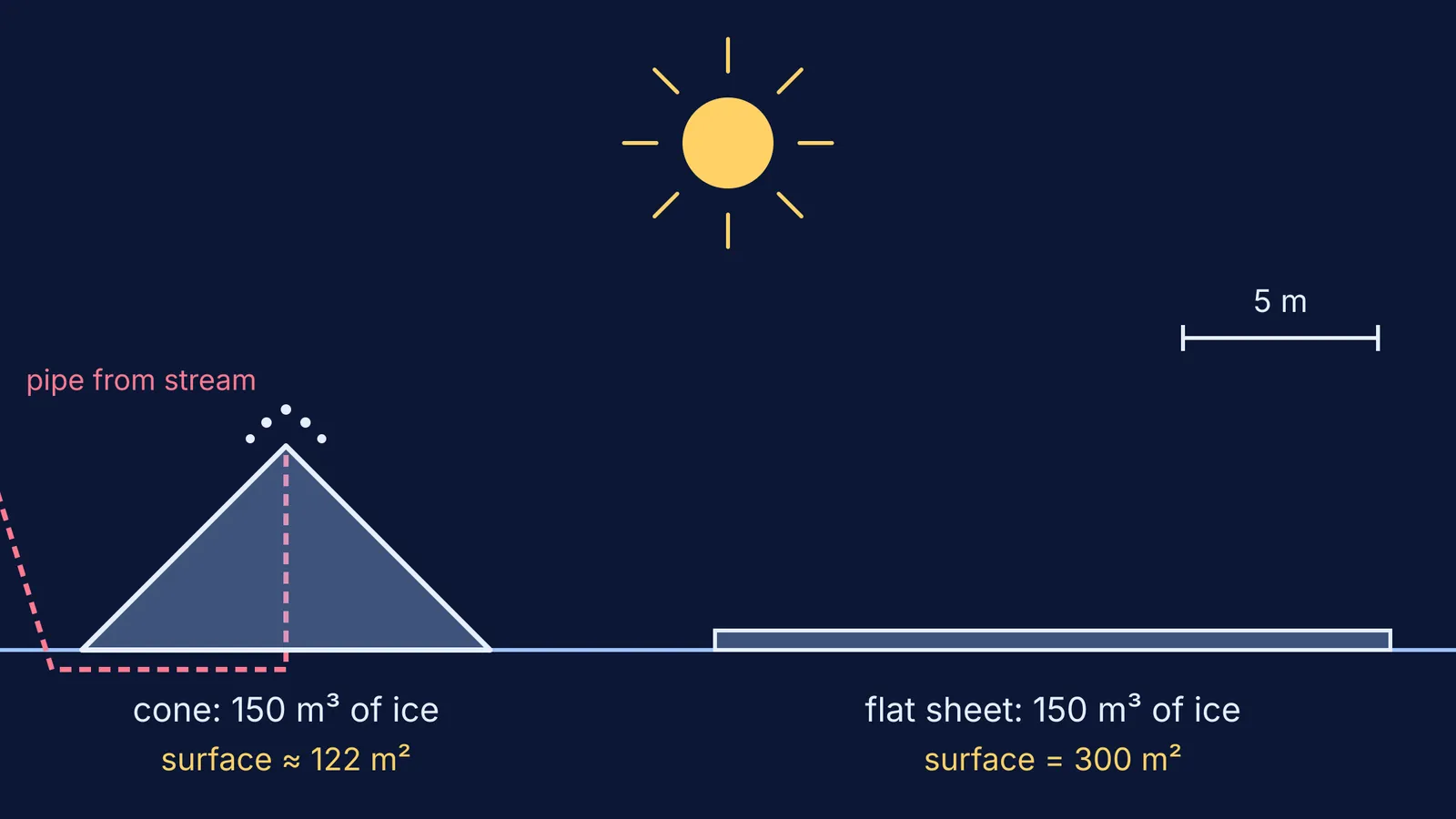
Sunlight and warm air melt ice through its surface, so a long-lasting store needs a lot of ice behind a small surface. Here is our own illustrative comparison, using the 150,000 litres (150 m³) of the first prototype reported by The Wire. The real prototype was a different shape.
Flat sheet, 0.5 m thick. Area = 150 ÷ 0.5 = 300 m² of ice facing the sky.
Cone as tall as its radius (h = r). Volume = πr²h ÷ 3 = πr³ ÷ 3 = 150, so r³ = 450 ÷ π ≈ 143.2, giving r ≈ 5.23 m.
Slant height l = √(r² + h²) = 5.23 × √2 ≈ 7.40 m.
Curved surface = πrl ≈ 3.14 × 5.23 × 7.40 ≈ 122 m².
Same water, and the cone exposes less than half the surface of the sheet.
Try it yourself:
Redo the sum for a cone twice as tall as its radius. Does the surface go up or down?
Compare with why ice packed in sawdust melts slowly: the same idea, cutting the heat that reaches the ice.
If the cone formulas or latent heat feel shaky, the Fermi Concept Library has a lesson for every concept in physics and mathematics. The Fermi Problem Library has worked problems with a step-by-step solver that explains the reasoning, so you can check your own version of this sum.
Do ice stupas actually work?
They store real water, but they waste a lot while being built. The 2022 study modelled a stupa at Gangles, Ladakh, at 4,025 m in winter 2020-21. Its maximum ice volume, 685 m³, was four times that at the Guttannen site in Switzerland. Yet its net water losses were 81% of all the water put in; across all the stupas studied, most losses came from fountain water that ran off without freezing. The authors expect drier, colder and less cloudy sites to give longer-lasting stupas.
Weather is the other risk. Too-cold nights freeze water in the delivery pipes. "In Ladakh right now, many of the ice structures have stopped being built not because the farmers chose to stop watering. It is because the weather chose to stop working," said Suryanarayanan Balasubramanian, the study's lead author, in an American Geophysical Union release. His team tested an automated fountain that sets how much to spray, and when, from models and weather data. Preliminary drone measurements found it used 13% of the water of a manual fountain for the same or more meltwater, the release says.
To see how that water is used in the fields, read why drip irrigation saves water.