

On this page
Pick a grey-green lichen off an old wall in Shimla or a temple compound in Mysuru and you are holding at least two living things, not one. The Swiss botanist Simon Schwendener (1829 to 1919) said so in 1867, and most lichen experts of his day said he was wrong. He was right about the partnership, and his idea is now in your textbook.
Are lichens a fungus plus an alga?
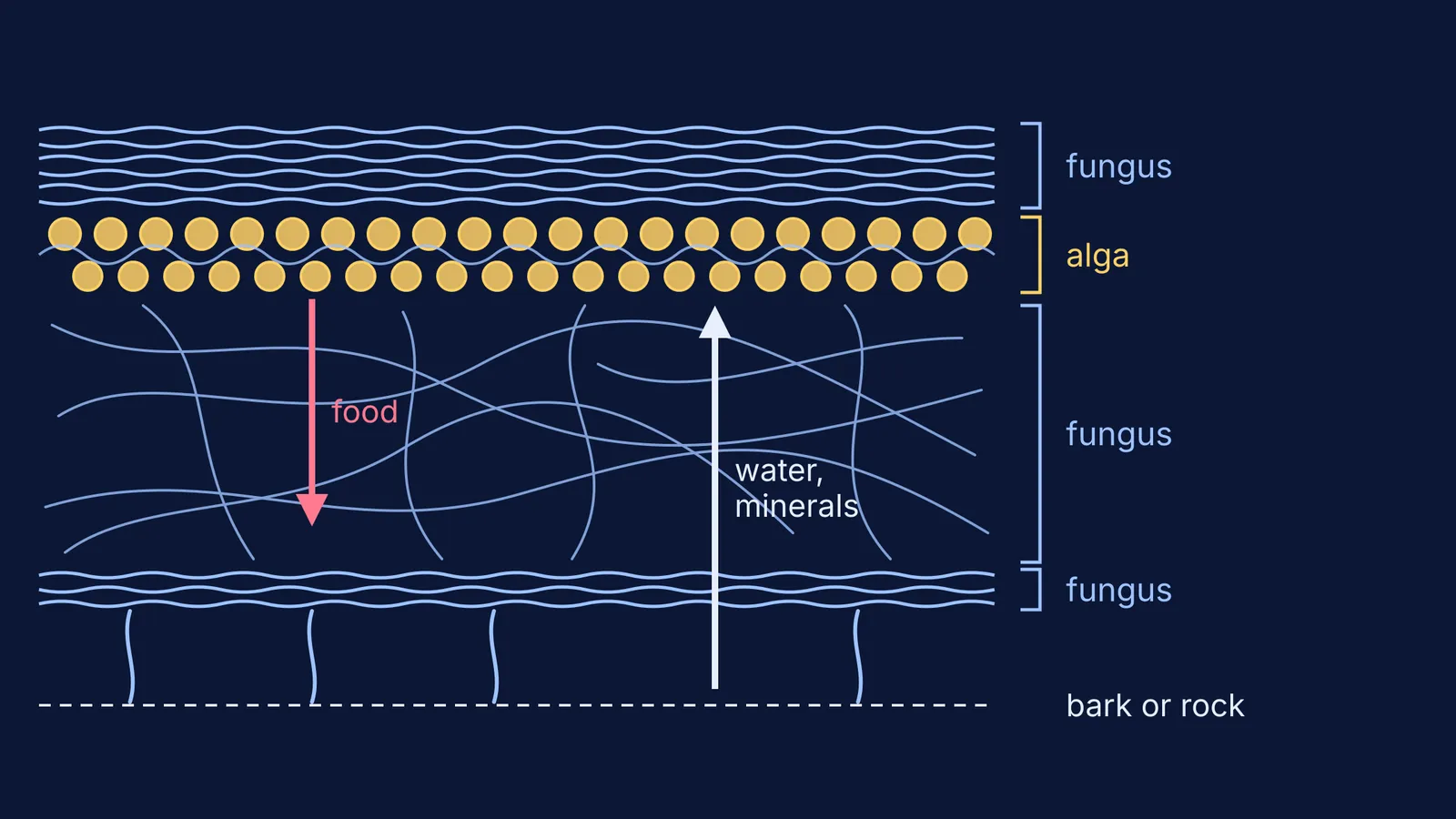
Yes. The NCERT Class 11 biology textbook, in the chapter Biological Classification, puts it this way: "Lichens are symbiotic associations i.e. mutually useful associations, between algae and fungi."
The same page names the partners. The algal partner is the phycobiont and is autotrophic. The fungal partner is the mycobiont and is heterotrophic. In NCERT's words, "Algae prepare food for fungi and fungi provide shelter and absorb mineral nutrients and water for its partner." The book adds that lichens are "very good pollution indicators" because they do not grow in polluted areas.
A partnership in which both sides benefit is called mutualism. Lichens are one of the standard examples, along with the fig and its wasp, which we explain in how fig and wasp mutualism works.
What did Schwendener actually claim in 1867?
Schwendener spent about ten years in Munich as assistant to the botanist Carl Nägeli, studying lichen anatomy under the microscope. That account comes from a history of the controversy by M. E. Mitchell in the botanical history journal Huntia (2002).
The green cells inside a lichen were then called gonidia and were thought to be the lichen's own reproductive cells. Schwendener came to see them as algae, with fungal threads (hyphae) growing over them. At a meeting of the Swiss natural science society in Rheinfelden on 10 September 1867, he was recorded as saying that "lichens may not be autonomous plants, but fungi in association with algae", Mitchell reports. By 1869 he went further: lichens were "ascomycetes parasitic on algae".
He was not alone. Anton de Bary had suggested in 1866 that some gelatinous lichens might form when a fungus invades an alga. Schwendener applied the idea to all lichens.
Why was the lichen theory mocked?
Mitchell's paper records the reaction. The Finnish lichenologist William Nylander, the leading lichen classifier of his time, attacked it in 1870. In 1871 the American lichenologist Henry Willey wrote that "no true lichenist will be likely to assent". The Presbyterian minister and lichenologist James Crombie mocked the idea of lichens turned "into a ... master fungus, and an imprisoned algal slave". William Leighton called it "purely imaginary" in 1879, and the mycologist Mordecai Cooke called it "this doomed hypothesis".
Two reasons sat behind the anger, Mitchell argues. If lichens were really fungi, lichenology would no longer be its own field. And there was a real scientific objection: parasites weaken their hosts, yet the algae inside lichens looked healthy.
How was it finally proved?
By putting the two partners together. In 1878 Joseph Hooker told the Royal Society that Ernst Stahl's success in "manufacturing such lichens as Endocarpon and Thelidium, by the juxtaposition of the appropriate algae and fungi" might almost decide the question, Mitchell records.
The parasite problem was solved with language. Albert Frank argued that the link between lichen fungus and alga was "something more than simple parasitism" and proposed the word *Symbiotismus*. You can read more about his work on fungi and tree roots in Albert Frank and mycorrhiza. De Bary then made "symbiosis" widely known in 1879, as the Encyclopedia of the Environment explains. Mitchell concludes that by the early 1890s the dispute had run its course.
The story is still growing. In 2016 a team led by Toby Spribille reported in Science that some North American beard-like lichens contain a third partner: a basidiomycete yeast living in the outer layer.
How do you write this in an exam?
NCERT's end-of-chapter exercise asks: "What do the terms phycobiont and mycobiont signify?" Here is a model answer you can adapt.
Define: a lichen is a symbiotic, mutually useful association between an alga and a fungus.
Phycobiont: the algal partner. It is autotrophic and makes food by photosynthesis for both partners.
Mycobiont: the fungal partner. It is heterotrophic, gives shelter and absorbs water and mineral nutrients.
Add one fact: lichens are good pollution indicators because they do not grow in polluted air.
Common slips to avoid:
Calling a lichen a plant. It is a partnership of two organisms.
Mixing up lichens and mycorrhiza. Mycorrhiza is a fungus living with plant roots.
Swapping the terms. Remember "phyco" for alga, "myco" for fungus.
If phycobiont, mycobiont, mutualism and symbiosis start to blur together, the Fermi Concept Library has a lesson for every concept in biology, each with its place in the map, so you can see how the terms connect.
For a hands-on follow-up, read where litmus comes from: the acid-base indicator in your chemistry lab is made from lichens.


