

On this page
Many fine roots of an oak or a pine are wrapped in fungus. In 1885 a German botanist named that partnership and argued something critics found hard to accept: the fungus helps feed the tree.
Who was Albert Bernhard Frank?
Albert Bernhard Frank was a German botanist, plant pathologist and mycologist, born in Dresden on 17 January 1839 and died in Berlin on 27 September 1900, according to his Wikipedia biography. In 1877, eight years before mycorrhiza, he coined the word symbiosis to describe lichens, the same source notes. Our explainer on viruses, viroids and lichens covers that partnership.
What did Frank find on tree roots?
The King of Prussia, Wilhelm I, commissioned Frank to find ways to cultivate truffles, the prized fungi that fruit underground; the project failed, but it led him to work out the nature of mycorrhizae (Wikipedia). M. C. Rayner's 1945 book Trees and Toadstools dates the government's request to about 1881.
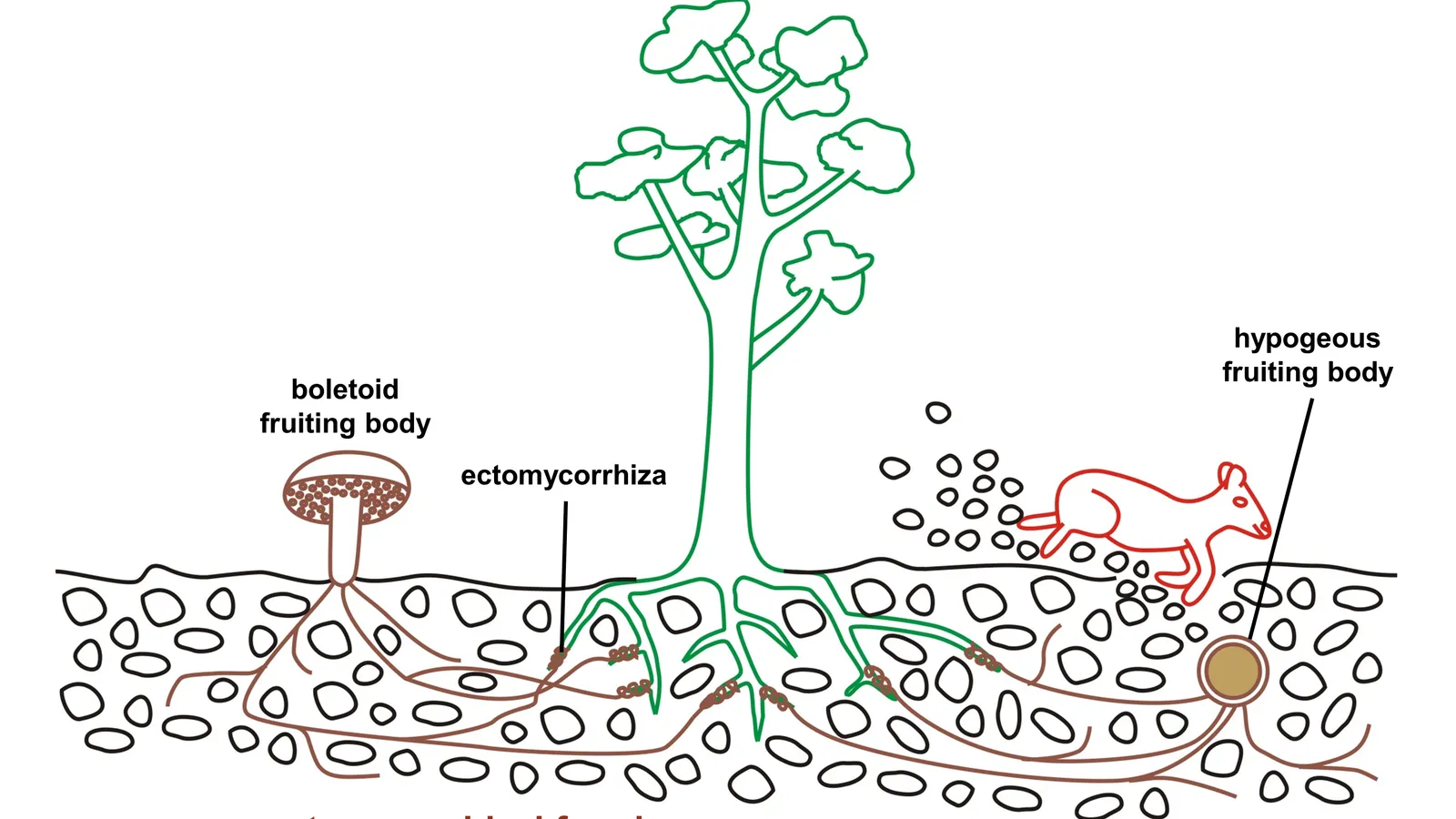
Digging among the roots, Frank found branched rootlets that were shorter and thicker than ordinary ones, each a young root enclosed in a sheath of fungal threads covering its whole surface, tip included, as Rayner describes. Rayner lists the trees: oak, beech, hornbeam, alder, hazel, chestnut, and conifers such as pine and spruce.
Frank published his paper in 1885 in the Berichte der Deutschen Botanischen Gesellschaft; an English translation appeared in the journal Mycorrhiza in 2005.
Mycorrhiza comes from the Greek mykes, fungus, and rhiza, root: literally a fungus root (Wikibooks summary of Frank's paper). Frank's claim, as that summary puts it, was that certain trees, above all the beech family (Cupuliferae), do not feed themselves from the soil alone; the fungus takes over that job. In Rayner's account, Frank held that the fungal mantle, in direct contact with the soil, absorbs water and dissolved salts for the tree, and that the fungus might also tap food locked up in the organic matter of the soil humus.
Why did critics think the fungus was a disease?
Frank's interpretation provoked what Rayner called a storm of controversy. Some plant pathologists argued that mycorrhizas were simply symptoms of disease. Rayner's reply is a good lesson in reading evidence: the critics had no sign that the hyphae damaged the roots, and the healthier and more vigorous the trees, the more fungus roots they carried. A parasite should do the opposite.
What do we know about mycorrhiza today?
The partnership turned out to be the rule, not the exception. A 2018 review in New Phytologist by Brundrett and Tedersoo estimates that 72% of vascular plants form arbuscular mycorrhizas, 2.0% ectomycorrhizas (the sheathed type Frank saw), 1.5% ericoid and 10% orchid mycorrhizas, while only 8% are completely non-mycorrhizal.
The trade runs both ways. In arbuscular mycorrhizas the fungus grows inside the root cortex to get carbon supplied by the plant, and in return moves mineral nutrients, especially phosphate, from the soil to the plant, as Maria Harrison's 1999 review explains.
Frank's "entire nutrition" claim went further than later evidence supports, at least for arbuscular mycorrhizas, a different type from the one he studied. A 2011 review by Sally and Andrew Smith describes two uptake routes in arbuscular mycorrhizal roots: directly through the root surface and root hairs, and through the fungus. The fungal route delivers phosphorus and some nitrogen, but the root keeps its own route too. The fungus helps; it does not do the whole job.
How do you explain mycorrhiza in an exam answer?
A clear answer covers four things. Use this frame:
Define it: a mutually beneficial association between a fungus and the roots of a plant.
Say who gives what: the plant gives carbon (sugars); the fungus gives water and minerals, especially phosphate.
Name the type: ectomycorrhiza forms a sheath outside the root; arbuscular mycorrhiza grows inside cortex cells.
Add one piece of evidence or history: Frank named it in 1885 after studying tree roots.
Worked example. Question: Why is mycorrhiza called a symbiosis and not an infection? Answer: Because both partners benefit. The fungus gets carbon from the plant, and the plant gets phosphate and other minerals from soil the fungus reaches. Healthy, vigorous trees carry more fungus roots, not fewer, which is the opposite of what a disease would show.
Three traps to avoid:
Mycorrhiza is the partnership, not the name of a fungus.
It is not limited to trees; most vascular plants form one kind or another.
The fungus helps with nutrition; it does not replace the root.
If fungi are hazy, start with our guide to Kingdom Fungi and its four classes. The Fermi Concept Library gives every biology concept its own lesson and its place in the map, so you can see how symbiosis connects to the ideas around it. For another partnership that changed biology, read about Lynn Margulis and the bacteria inside your cells.


