

On this page
Where does litmus come from in nature?
Most school chemistry labs begin with a strip of blue or red paper dipped into an unknown beaker. Yet the dye that makes this routine test work is not synthesized in a modern chemical plant. Litmus is a natural mixture of dyes extracted from specific species of lichens, primarily *Roccella tinctoria* and *Lecanora tartarea*, as documented by Encyclopedia Britannica.
Lichens are symbiotic associations between a fungus (the mycobiont) and an alga or cyanobacterium (the photobiont). In botany curricula, lichens are placed in the division Thallophyta because their body lacks true roots, stems, or leaves. For students exploring where symbiotic organisms fit in taxonomy, our guide on viruses, viroids and lichens examines their position outside five-kingdom classifications.
Living lichens do not contain the colored litmus dye itself. Instead, they manufacture colorless secondary metabolites known as depsides, such as erythrin and lecanoric acid. As traced by Compound Interest, the name litmus derives from the Old Norse *litmosi*, meaning dye moss, reflecting how coastal communities collected rock-dwelling organisms for dyeing textiles centuries before chemists used them to measure acidity.
How do lichens turn into a laboratory pH indicator?
Transforming raw lichen biomass into a usable chemical indicator requires controlled chemical synthesis rather than simple extraction. As explained by Compound Interest, the raw lichens are crushed and treated with ammonia, lime (calcium hydroxide), and potassium carbonate in the presence of atmospheric oxygen.
Under alkaline conditions, lichen depsides hydrolyse into orcinol (3,5-dihydroxytoluene). Over weeks of air oxidation and fermentation, orcinol couples with ammonia and oxygen to generate complex chromophores. Irish chemist Robert Kane separated this mixture into distinct pigments, including azolitmin and erythrolitmin, in an 1840 paper in the *Philosophical Transactions of the Royal Society of London*. Later structural work confirmed that litmus consists of polymeric dyes based on a 7-hydroxyphenoxazone core, published in *Biotechnic & Histochemistry*.
Laboratory litmus paper is made by soaking porous filter paper in this concentrated extract. Blue litmus paper is prepared by treating the paper with a dilute alkali, while red litmus paper is prepared by adding a faint trace of acid. When students struggle to map chemical structures across biological groups, the Fermi Concept Library covers every concept in physics, chemistry, biology, mathematics and computing, each with its own lesson and its place in the map.
Why does litmus turn red in acids and blue in bases?
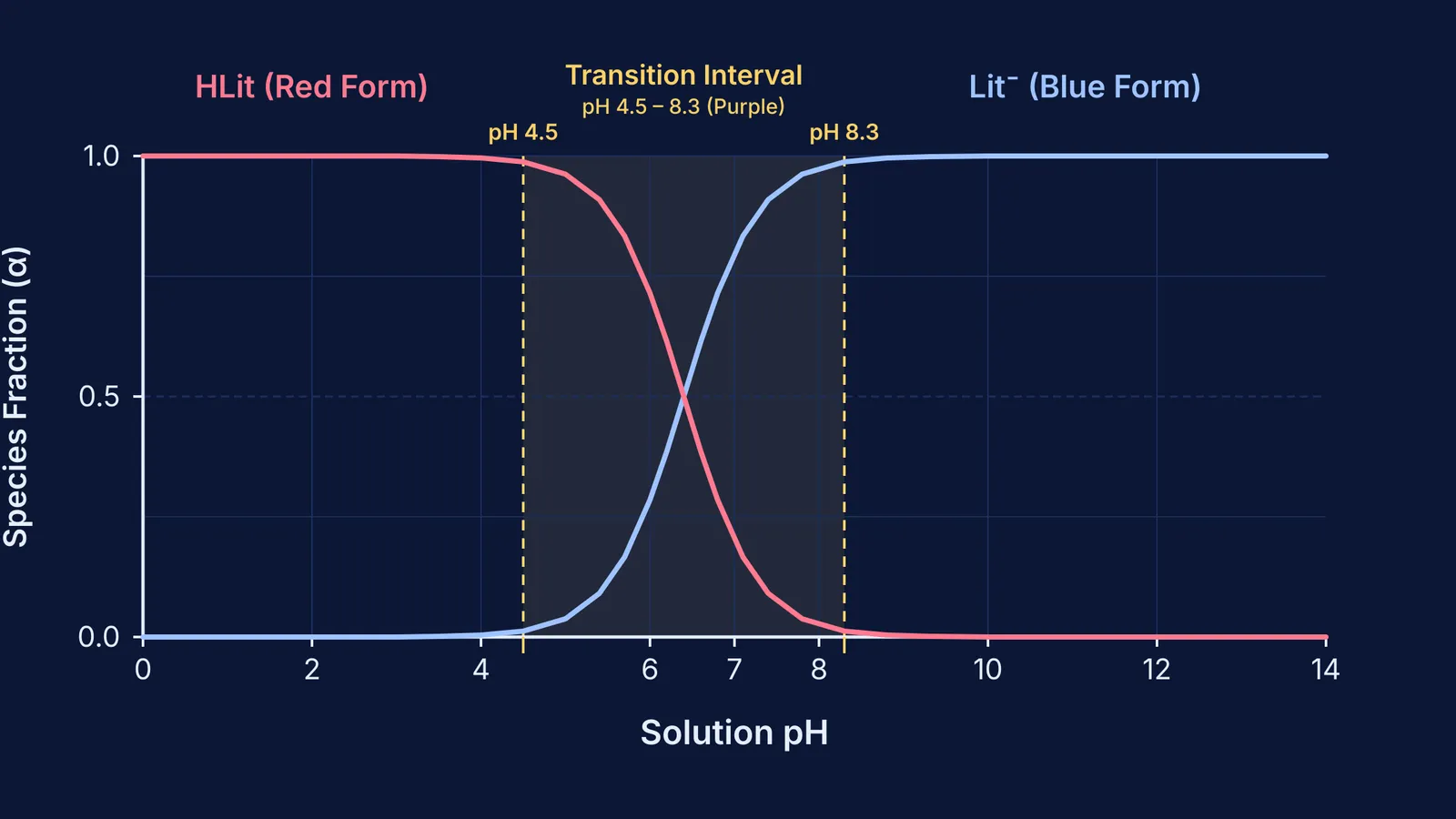
Litmus acts in aqueous solution as a weak diprotic acid, conventionally abbreviated as HLit. As described by Encyclopedia Britannica, litmus is the oldest and most widely used indicator for distinguishing acidic from alkaline solutions, turning red in acid and blue in base. Its visible response stems from the reversible protonation and deprotonation of 7-hydroxyphenoxazone chromophores.
As detailed by Compound Interest, the dye exists predominantly in its red protonated state below pH 5 and shifts to its blue deprotonated state above pH 8, with an intermediate purple shade at neutral pH. Standard chemical indicator tables place the full color transition interval between pH 4.5 and pH 8.3 at 25 °C.
In acidic solutions below pH 4.5, excess hydronium ions drive the dissociation equilibrium toward unionized HLit. In this protonated form, the molecule absorbs green and yellow wavelengths of light, making the test strip appear red.
In alkaline solutions above pH 8.3, hydroxide ions deprotonate the dye to its conjugate base, Lit⁻. This deprotonation alters electronic resonance across the phenoxazone core, shifting light absorption and reflecting a deep blue color. In pure neutral water at pH 7.0, an equal balance of both forms produces a characteristic purple shade.
Because the transition zone covers 3.8 pH units, litmus serves as a qualitative test rather than a precision indicator for titrations. For sharp equivalence points, review our guide to acid-base titration curves.
How do you solve litmus test problems in science exams?
Class 10 science and competitive exams frequently test litmus reactions using trick questions on dry gases, salts, and non-aqueous liquids. You can solve these problems with a four-step decision protocol:
Identify the chemical state: Determine whether the sample is a gas, solid, or aqueous solution.
Check for moisture: Confirm whether water is present on the paper or in the sample, because ionic dissociation requires a solvent.
Classify the aqueous species: Label the solute as acidic, basic, or neutral.
Predict strip responses: Blue turns red in acids, red turns blue in bases, and neutral salts leave both strips unchanged.
Consider an exam scenario with three unlabeled test tubes:
Lemon juice (citric acid): Turns moist blue litmus red and leaves red litmus unchanged.
Baking soda solution (sodium hydrogen carbonate): Turns moist red litmus blue and leaves blue litmus unchanged.
Sodium chloride solution: Leaves both red and blue litmus unchanged because it is a neutral salt.
For a complete review of practical classifications, consult our walkthrough on acids, bases and salts in Class 10. When working through qualitative analysis problems that require multi-step reasoning, the Fermi Problem Library provides worked problems with a step-by-step solver that explains the reasoning rather than printing an answer.


