On this page
Seymour Benzer trained in physics at Purdue University before turning to phage genetics (biography). He took one small region of the phage T4 chromosome, called rII, and split it into hundreds of separately mutable points in a single line. That line of points is still how we picture a gene.
Why did Benzer choose the rII region of phage T4?
It let him see very rare events. In his 1955 paper in PNAS, Benzer showed that an rII mutant makes unusual "r" plaques on E. coli strain B, grows normally on strain K12S, and makes no plaques at all on K12S carrying phage lambda, which he called K. Wild-type T4 grows on all three.
Cross two different rII mutants on B, plate the offspring on K, and only wild-type recombinants form plaques. Benzer wrote that such recombinants could be detected "even in proportions as low as 10⁻⁸" (Benzer 1955).
How close can two mutations be and still recombine?
Follow Benzer's rough calculation from the 1955 paper:
Benzer took the T4 genetic map as about 200 units long, where 1 unit is 1% recombination.
T4 DNA has about 2 × 10⁵ nucleotide pairs.
Per pair: 200 ÷ (2 × 10⁵) = 10⁻³ per cent recombination.
As a fraction that is 10⁻⁵, so two mutants one pair apart should give about 1 wild recombinant in 10⁵ offspring.
The K plate detects 1 in 10⁸, a proportion 1,000 times smaller than the 1 in 10⁵ from step 4.
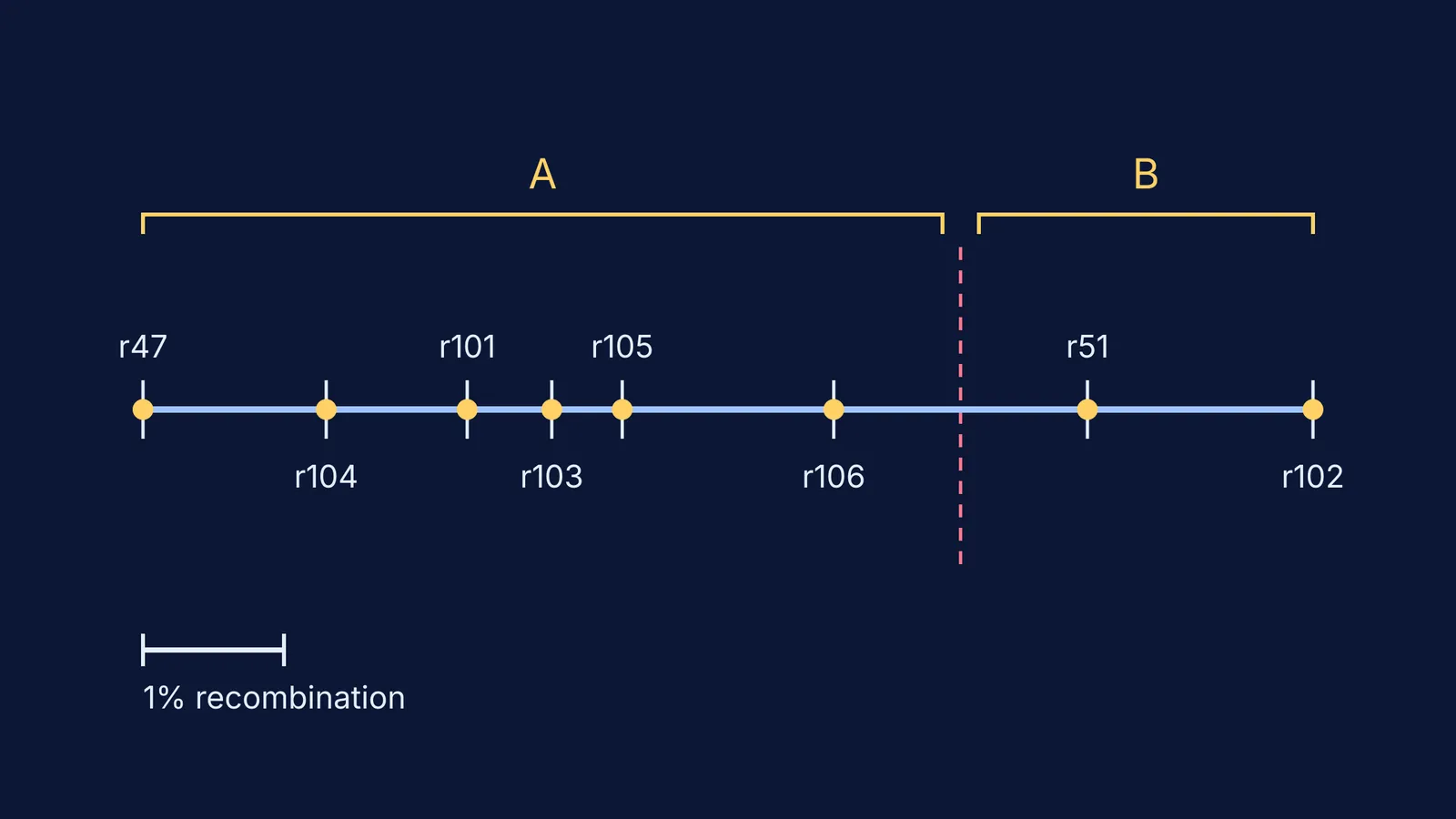
He called this "exceedingly rough", but the margin suggested rII crosses could approach the scale of single base pairs. His 1955 recombination map placed eight mutants along about 8.3 units, from r47 at 0 to r102 at 8.3. From his smallest non-zero values, he concluded that the units separable by recombination are "not larger than the order of a dozen nucleotide pairs".
What is a cistron, and how did Benzer find two?
Benzer also infected strain K with two rII mutants at once, the trans test. If both defects lay in the same segment, very few cells burst; if in different segments, the phages made up for each other and lysis was extensive (Benzer 1955). This split rII into segments A and B, each of which, he suggested, "might control the production of a specific polypeptide chain".
By 1961 he described the region as "two adjacent cistrons, or functional units" (Benzer 1961, PNAS). The trans test is the complementation test in your textbook.
How did Benzer map thousands of mutants without millions of crosses?
Testing every pair "would require millions of crosses", he wrote in the 1961 paper. Instead he used deletions, mutants missing a stretch of rII. A point mutant crossed with a deletion covering its site gives no wild recombinants (a zero); otherwise it gives some (a one).
Seven deletions each start at a different point and run to the right-hand end: r1272, r1241, rJ3, rPT1, rPB242, rA105 and r638. The number of zeros, counted from the left, names the main segment. Try it:
Mutant X gives 0 0 0 1 1 1 1: three zeros, so segment A3.
Mutant Y gives 0 0 0 0 0 0 0: seven zeros, so segment B.
Mutant Z gives 0 1 0 1 1 1 1: impossible on a line, so retest it.
Seven deletions allow 128 yes-or-no patterns. Benzer reported that thousands of mutants showed only the seven with an unbroken run of zeros from the left, and that excluding the other 121 "confirms the linear order". More deletions then cut rII into 47 smaller segments.
What did the 1961 map show about hotspots?
The 1961 paper mapped 1,612 spontaneous mutants to 251 distinct sites, and the sites were far from equal. The top hotspot collected more than 500 mutations; many sites appeared once. A Poisson fit predicted at least 129 unseen sites, so the map was at most 66% complete. Adding chemically induced mutants brought the total to over 2,400 mutations and 304 sites. His order also matched an independent recombination map of phage T4D by Edgar, Feynman, Klein, Lielausis and Steinberg.
How can you use Benzer's work in your own revision?
Draw rII with its two cistrons; mark one point mutation and one deletion.
Redo the five-step calculation without looking.
Invent a mutant and place it by counting zeros.
Benzer's 1955 paper leans on the Hershey-Chase experiment for DNA as the genetic material; the next step is how Charles Yanofsky proved genes and proteins line up. For practice, try recombination frequency and map distance numericals.
If cistron, allele and locus still blur together, the Fermi Concept Library gives each concept its own lesson and its place in the map. If a mapping numerical goes wrong, the Fermi Problem Library has a step-by-step solver that explains the reasoning rather than printing an answer.