On this page
The discovery of a single subatomic particle in 1974 changed modern physics so profoundly that scientists call it the "November Revolution" (Physics Today). Before this historic event, the fundamental building blocks of matter were thought to be just three types of quarks: up, down, and strange.
The sudden discovery of a heavy, exceptionally long-lived particle proved that a fourth quark existed, confirming the mathematical theories of the Standard Model and rewriting particle physics.
How did Samuel Ting discover the J particle?
In the early 1970s, Samuel C. C. Ting led a research team from the Massachusetts Institute of Technology. They set up their experiment at the Brookhaven National Laboratory in New York. To search for new particles, Ting's team used the Alternating Gradient Synchrotron to fire a high-intensity 30 GeV beam of protons into a stationary beryllium target (Physical Review Letters).
This experiment required high precision. Ting built a sophisticated "two-arm spectrometer" to detect the pairs of electrons and positrons produced when the beryllium target was bombarded. The goal was to sift through billions of collisions to find rare, heavy particles.
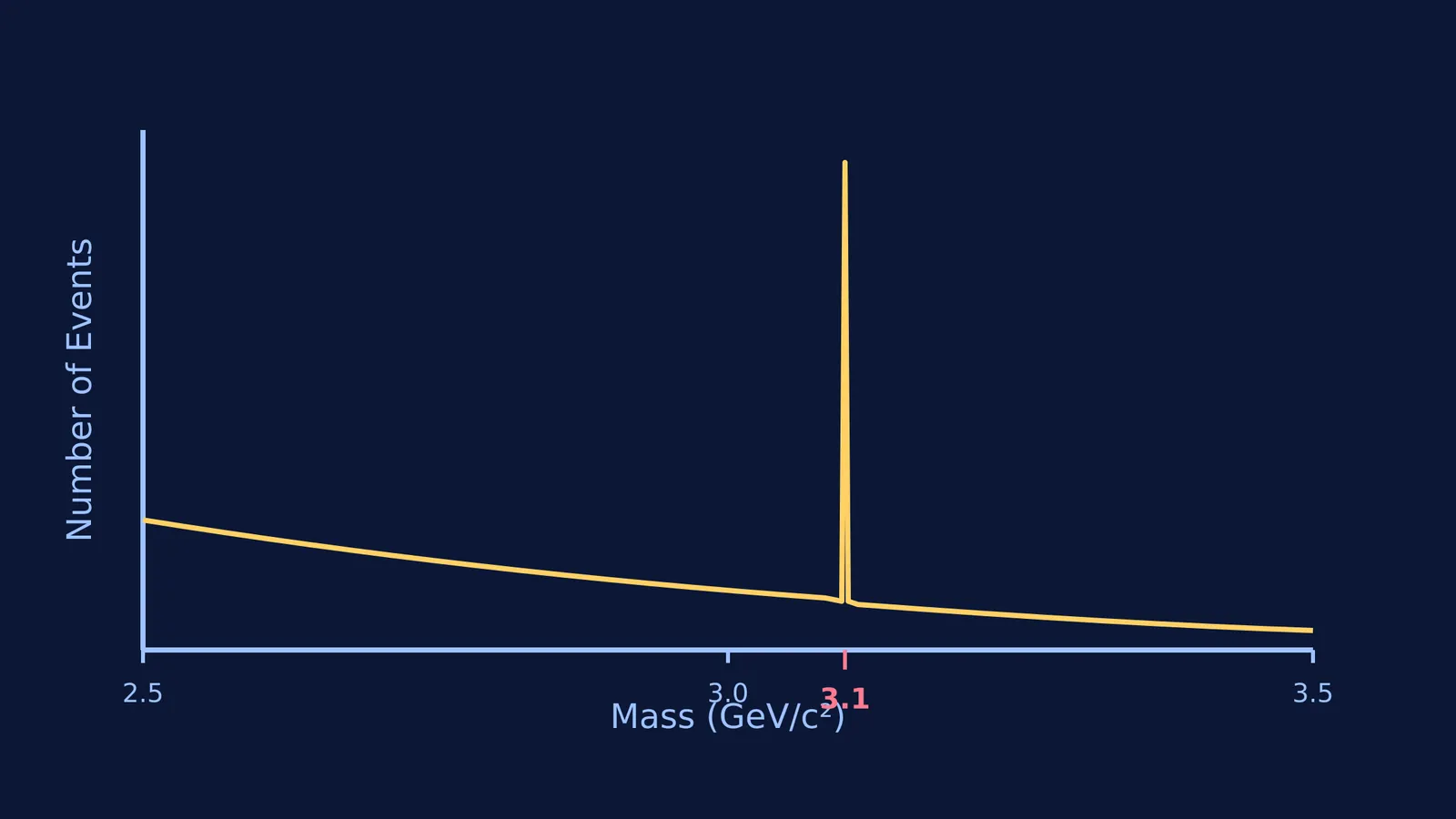
By late summer 1974, his team detected an unusual pattern. There was a sharp, narrow peak in their data at a mass of exactly 3.1 GeV/c². In particle physics, a wide bump in a mass spectrum means a particle decays almost instantly. A sharp spike, however, indicates a new, unexpectedly heavy, and long-lived particle. Ting named his discovery the "J" particle.
Why does the J/psi particle have two names?
While Ting's team was analysing their data in New York, a separate team on the opposite side of the country was making the exact same discovery using a completely different method. At the Stanford Linear Accelerator Center (SLAC) in California, Burton Richter's team used the SPEAR electron-positron storage ring. They accelerated electrons and positrons towards each other and observed the resulting annihilations.
Richter's team found the same massive resonance at 3.1 GeV/c² (Physics Today). Richter named the discovery the "psi" (ψ) particle.
On 11 November 1974, Ting and Richter met during a committee meeting at SLAC and realised they had found the same heavy particle. They agreed to publish their findings simultaneously, and both landmark papers appeared in the same issue of *Physical Review Letters* on 2 December 1974. To honour both independent discoveries, the physics community compromised, and the particle became known as the J/psi (J/ψ) meson.
This simultaneous breakthrough is an example of independent scientific discovery, much like How Werner Heisenberg Built Matrix Mechanics in Helgoland or How Michael Faraday Discovered Electromagnetic Induction in 1831.
How did the J/psi particle confirm the charm quark?
The J/psi particle is classified as a meson, which means it is made of a quark and an antiquark bound together. Specifically, the physics community soon identified it as a bound state of a charm quark and a charm antiquark, a unique combination that is now known as charmonium.
Its discovery provided the first solid experimental evidence for the charm quark. Theorists Sheldon Glashow, John Iliopoulos, and Luciano Maiani had predicted this fourth quark in 1970 (the GIM mechanism) to explain why certain particle decays do not occur in nature (Physical Review D). By proving the charm quark was real, the J/psi completed the "second generation" of matter. It proved that quarks come in pairs, matching the charm quark with the strange quark, just as the up quark pairs with the down quark. This was a crucial step for the Standard Model of particle physics.
If you have concept gaps when studying modern physics and the Standard Model, the Fermi Concept Library covers every concept in physics, chemistry, biology, mathematics and computing. You can also test basic atomic structures yourself if you Build an atom simulation: predict element, charge and isotope.
Why did Ting and Richter win the 1976 Nobel Prize?
The impact of the J/psi particle was immediate. The discovery ended years of theoretical debate and transformed quarks from abstract mathematical conveniences into proven physical entities.
Just two years after the November Revolution, Samuel Ting and Burton Richter were jointly awarded the 1976 Nobel Prize in Physics "for their pioneering work in the discovery of a heavy elementary particle of a new kind" (NobelPrize.org).
How do physicists read a mass spectrum?
When you study particle physics, you will often see graphs showing collision events against mass. Here is a practical checklist for reading a mass spectrum like the one Ting and Richter analysed:
Look for resonances: New particles appear as peaks (resonances) above the smooth background curve of normal collision data.
Check the width: A wide, gentle bump means a particle decays very quickly.
Check for a sharp spike: A very narrow spike—like the one found at 3.1 GeV/c²—means the particle has an unusually long lifetime before decaying, often indicating a new quantum property (like "charm").
Read the x-axis: The exact position of the centre of the peak on the x-axis gives the precise mass of the newly discovered particle.
By looking for these narrow spikes in messy collision data, physicists continue to use Samuel Ting's methods today to hunt for new particles at the Large Hadron Collider.