On this page
Most crystal structures in your chemistry textbook were worked out from X-ray diffraction patterns. Every one of them ran into the same problem: the pattern tells you how bright each spot is, but not its phase. The Indian physicist Sivaraj Ramaseshan helped show one way round this. He changed the colour of the X-rays.
Who was S. Ramaseshan?
Sivaraj Ramaseshan was born in Calcutta on 10 October 1923 and studied at Nagpur University, according to his biography at the Raman Research Institute. He worked at the Indian Institute of Science (IISc) from 1945, headed physics at IIT Madras from 1962 to 1966, and led materials science at the National Aeronautical Laboratory from 1966 to 1979. He was Director of IISc from 1981 to 1984.
The same RRI biography credits him with India's first high-pressure laboratory and the first nutation damper for Aryabhata, India's first satellite. He received the Shanti Swarup Bhatnagar Award in 1966 and the Padma Bhushan in 1985. He died on 29 December 2003.
What is anomalous X-ray scattering?
An atom scatters X-rays mainly through its electrons. A simple model treats those electrons as free, so the atom's scattering factor is a plain positive number, f0. That model breaks down when the X-ray energy is close to the energy that binds an inner electron, near the atom's absorption edge.
The scattering factor then becomes f0 + f′ + if″, where f′ is usually negative and f″ is positive, as M. Vijayan and Ramaseshan explain in their International Tables for Crystallography chapter (1993). These extra terms are called the dispersion correction. They are most pronounced when the X-ray wavelength is near an absorption edge of the atom.
The same chapter notes that the best-known effect, the breaking of Friedel's law, was observed in 1930. J. M. Bijvoet and his colleagues used it in the early 1950s to find the absolute configuration of molecules. The KMnO4 work used the other, real term, f′.
How did Ramaseshan solve KMnO4 with two wavelengths?
In 1957, Ramaseshan, K. Venkatesan and N. V. Mani published "The use of anomalous scattering for the determination of crystal structures-KMnO4" in the Proceedings of the Indian Academy of Sciences. The crystal was potassium permanganate, and the anomalous scatterer was manganese.
The International Tables chapter gives the numbers behind the trick. With copper Kα radiation, manganese has f′ = −0.568. With iron Kα radiation, f′ = −3.367, a much larger effect. So switching from copper to iron X-rays makes each manganese atom scatter as if it had lost about 2.8 electrons, while the other atoms change much less.
That is like swapping manganese for a lighter atom without touching the crystal. The chapter says the two data sets "can now be treated as those arising from two perfectly isomorphous crystals". Comparing them first located the manganese atoms, then gave the signs of the structure factors, since KMnO4 is centrosymmetric. In a centrosymmetric crystal, every phase is either 0° or 180°, so the phase problem shrinks to finding a + or a − sign.
How does the two-wavelength sign test work?
Here is the logic with made-up round numbers, so you can see why two wavelengths are enough.
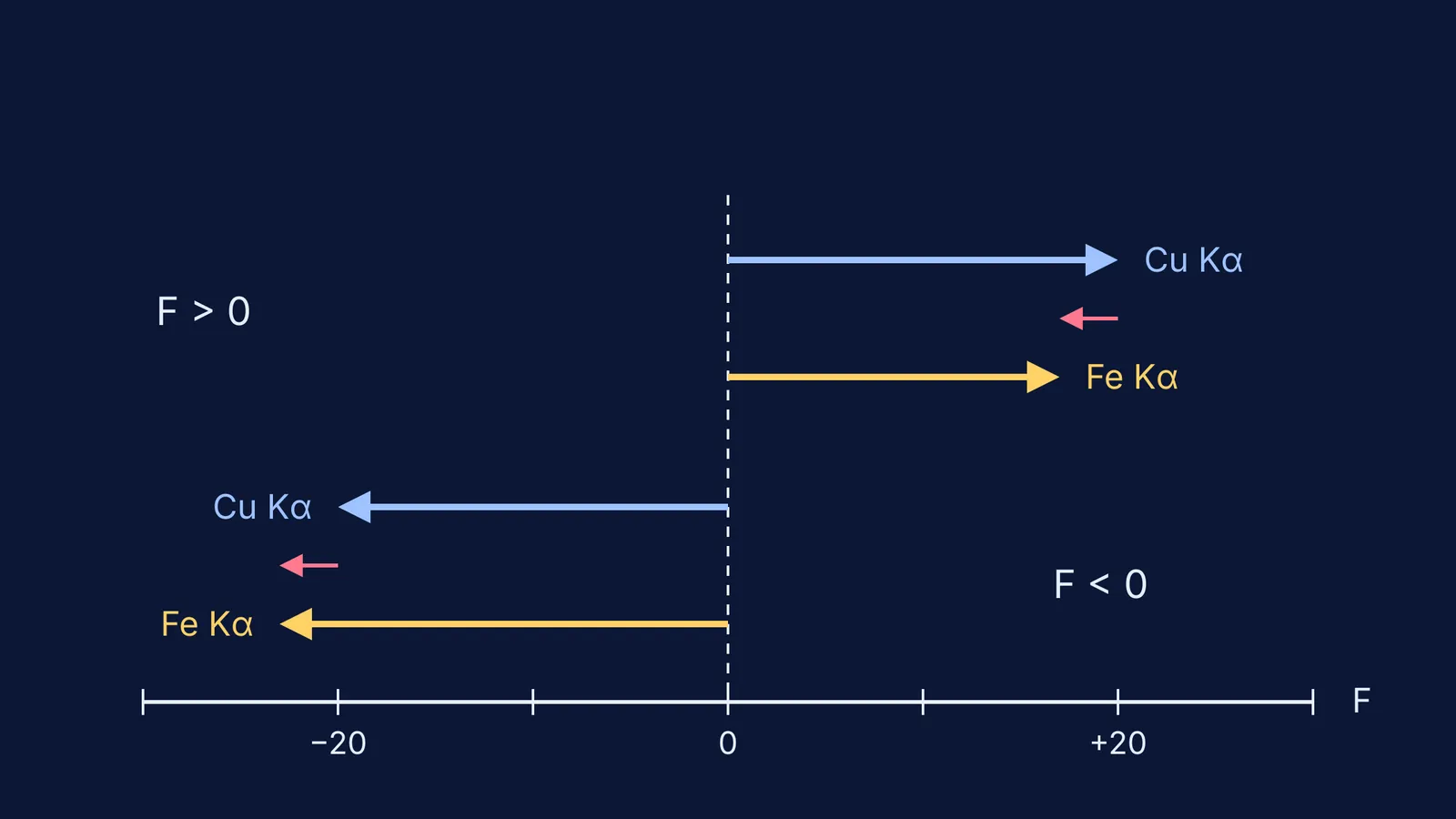
You measure one reflection with copper X-rays and get a magnitude of 20. The true value is either +20 or −20.
You know where the manganese atoms are. For this reflection, their contribution works out positive, and you know that switching to iron X-rays lowers it by 3 units.
If the true value was +20, the iron value is 20 − 3 = +17, so the magnitude falls.
If the true value was −20, the iron value is −20 − 3 = −23, so the magnitude rises.
You measure with iron X-rays. A smaller magnitude means the sign is +, and a larger one means −.
The drawing at the top of this post shows the same two cases on a number line. Repeat this for every reflection, and you have the signs you need to build an electron-density map.
If phases still feel slippery, it can help to see an idea rather than read about it. The Fermi Simulation Lab has interactive simulations for ideas that are easier to see than to read.
Why does anomalous scattering still matter?
The International Tables chapter lists later uses of anomalous scattering. These include a derivative of vitamin B12 studied by Dale, Hodgkin and Venkatesan in 1963, and a revival of interest once synchrotron sources made it possible to choose any desired wavelength. The chapter ends with this multiwavelength method. You can read how Dorothy Hodgkin used X-rays to solve penicillin, B12 and insulin.
For JEE and board exams, this links three topics you already study: X-ray wavelengths, absorption, and Bragg's law for diffraction by crystals.
If a term like structure factor or absorption edge is new to you, the Fermi Concept Library gives each physics and chemistry concept its own lesson. Start there, then come back to Ramaseshan's two wavelengths.