On this page
Look at the label on a school shirt marked "non-iron" or "easy care". The cotton inside it has been changed at the level of molecules, and one of the chemists behind that change was Ruth Benerito. Her idea is a piece of polymer chemistry you can test at home with two pieces of cloth.
Who was Ruth Benerito?
Ruth Benerito lived from 1916 to 2013, finished high school at 14 and later earned a PhD in physical chemistry from the University of Chicago, according to her Science History Institute biography. She spent most of her career at the US Department of Agriculture's Southern Regional Research laboratories in New Orleans, and retired from the USDA in 1986.
The USDA's own Agricultural Research magazine reports that she received more than 55 patents during her 33-year career there. It also notes she was inducted into the National Inventors Hall of Fame in 2008 and received the Lemelson-MIT Lifetime Achievement Award in 2002.
The timing mattered. Nylon and polyester were invented in the 1930s and 1940s, and clothes made from them needed no pressing, as the Science History Institute biography explains. Cotton was losing ground, and wash-and-wear treatment "came along in the nick of time after World War II", in the words of the USDA magazine.
Why does cotton wrinkle in the first place?
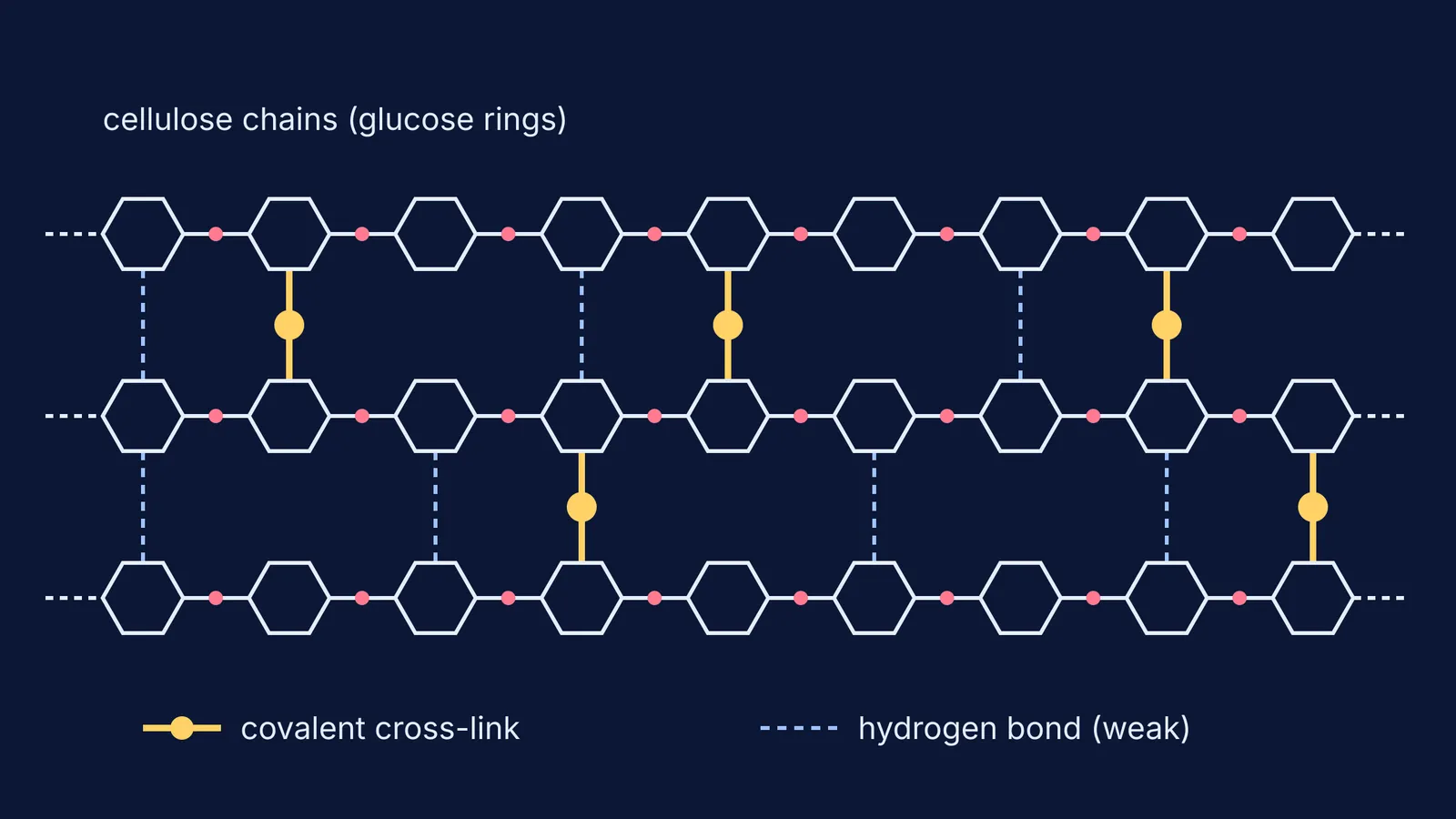
Cotton is mostly cellulose: the cellulose content of cotton fibre is about 90%. Cellulose is a long, unbranched chain of several hundred to many thousands of glucose units, joined by β(1→4) links. Each glucose unit carries -OH groups, and these form hydrogen bonds with neighbouring chains, holding them side by side.
Here is the problem. Hydrogen bonds are weak and easily broken, which makes cotton fabric prone to wrinkling, as the Science History Institute puts it. When you crush a shirt, especially when it is damp, chains slide past each other. The old hydrogen bonds break and new ones form in the bent position, so the crease stays.
If you want a refresher on why cellulose is built so differently from starch, our post on why starch turns blue-black with iodine but cellulose does not walks through the shape of the chains.
How does cross-linking make cotton wrinkle-free?
Benerito's team found a way to tie the chains to each other with something stronger than hydrogen bonds. The treatment inserted short organic molecules between cellulose molecules "rather like the rungs of a ladder", according to the Science History Institute.
A cross-link is a covalent bond, or a short chain of them, that joins two separate polymer chains. Once neighbouring chains are tied together at many points, they can bend when you fold the cloth, but they are pulled back towards their original positions when you let go. That is the whole trick behind permanent press.
This is the same idea that separates a thermosetting plastic from a thermoplastic. Our explainer on why pressure cooker handles are made of Bakelite shows how heavy cross-linking stops a polymer from softening when hot.
What does cross-linking cost the fabric?
No finish is free. One of the most common commercial cross-linkers for cellulose fibres and textiles today is DMDHEU, which a 2021 paper in ACS Sustainable Chemistry and Engineering describes as generally a mixture of formaldehyde, glyoxal and urea. The paper notes that its curing step needs a high temperature, typically 160 °C, and that the fibre or textile suffers severe strength loss after cross-linking.
The same authors tested two formaldehyde-free cross-linkers, citric acid and BTCA (1,2,3,4-butanetetracarboxylic acid), on man-made regenerated cellulose fibres rather than cotton. BTCA cross-linked better than citric acid, but fibres treated with either had relatively low mechanical performance.
So a wrinkle-resistant finish is a trade-off: tying the chains together helps the cloth resist creasing, but it can also leave the fibre weaker.
A worked example: test it with two pieces of cloth
You can see Benerito's chemistry with things already in your cupboard.
Find two cotton items of similar thickness: a plain cotton handkerchief, and a shirt whose label says "non-iron", "easy care" or "wrinkle-free".
Dampen a corner of each, scrunch it tightly in your fist for one minute, then let go.
Hang both corners to dry and compare the creases.
Predict before you look: the treated corner should recover more, because its chains are tied together.
Write your explanation in three steps: what holds the chains (hydrogen bonds), what the crease does (breaks and re-forms them), what the finish adds (covalent cross-links that pull back).
If your result surprises you, that is useful too. Fabrics differ in weave and thickness, and a finish can wear down after many washes, so ask which variable you did not control.
If the picture of chains sliding and bonds re-forming is hard to hold in your head, the Fermi Concept Library covers every concept in chemistry, each with its own lesson and its place in the map. And if this story makes you curious about the work itself, read our guide to careers in textile chemistry, from dyes to finishes.