On this page
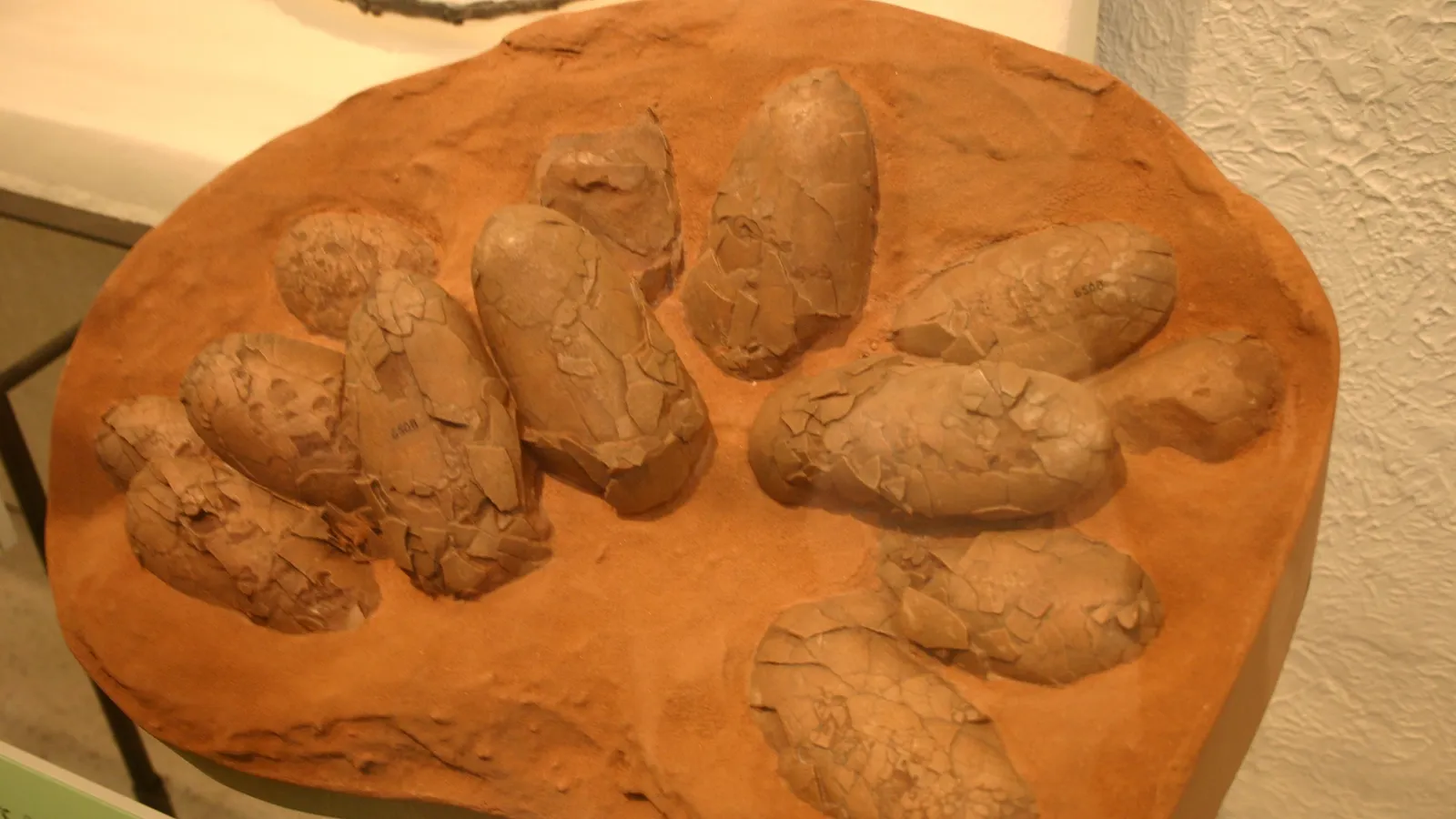
In the summer of 1923, a team from the American Museum of Natural History was working the red sandstone of the Flaming Cliffs in Mongolia's Gobi Desert when it found clutches of fossil eggs. They were the first eggs that scientists recognised as dinosaur eggs. The team was led by Roy Chapman Andrews, and the story of those eggs is also a story about how science corrects itself: the dinosaur blamed for stealing them turned out to be their parent.
Who was Roy Chapman Andrews?
Andrews was born on 26 January 1884 and later became director of the American Museum of Natural History in New York, according to this history of his expeditions in Scientific American. He wrote of himself: "I was born to be an explorer...There was never any decision to make."
From 1922 he led the Central Asiatic Expeditions, which travelled with an odd mix of automobiles and camels. The main goal was not dinosaurs at all: Andrews hoped to find fossils of early humans in Asia, as the same Scientific American piece explains. The dinosaur eggs were a lucky side result.
What did Andrews find in the Gobi in 1923?
The first scientifically recognised dinosaur egg fossils were found in 1923 by an American Museum of Natural History crew that was looking for evidence of early humans in Mongolia, as the dinosaur egg entry on Wikipedia summarises. The word "recognised" matters. In 1859 a French priest and naturalist, Jean-Jacques Pouech, had already found fossil eggshell in southern France, but he thought giant birds had laid it.
The Roy Chapman Andrews entry dates the find to 13 July 1923. Because the plant-eating dinosaur Protoceratops was common at the site, the eggs were credited to it.
One nest held about 15 eggs, and the skull of a theropod dinosaur lay above it, separated by only about 10 centimetres of sediment, according to the Oviraptor entry. In 1924 Henry Fairfield Osborn named the animal Oviraptor philoceratops, "the egg stealer with a fondness for ceratopsian eggs", as the Linda Hall Library's exhibit on early dinosaur papers explains. Osborn wrote that its position "immediately put the animal under suspicion of having been overtaken by a sandstorm in the very act of robbing the dinosaur egg nest", but he admitted the name might be misleading.
Who really laid the Flaming Cliffs eggs?
In the 1990s, museum teams back in the Gobi found an egg of the same type with an embryo inside. In a 1994 paper in Science, Mark Norell and colleagues reported that skull features identify the embryo as a member of Oviraptoridae. Their abstract notes that the 1923 nest found beneath the Oviraptor skull "suggests that this dinosaur may have been a brooding adult."
A year later, the same group described an oviraptorid fossilised sitting on its nest in Nature. The specimen, now called Citipati and found in 1993, sits atop its eggs with folded forelimbs and crouched hind limbs, the way a bird broods, as the Citipati entry describes. The "egg thief" had most likely died protecting its own nest.
If you want the longer back story, read how Richard Owen coined the word dinosaur and how Mary Anning's fossil finds shaped early palaeontology.
How can you reason like a palaeontologist (without Osborn's mistake)?
The Oviraptor story is a clean worked example of a thinking habit that also helps in biology answers. Here it is as four steps, applied to the 1923 nest as the Oviraptor entry describes it.
Write the observation alone. A skull lies about 10 centimetres above a clutch of about 15 eggs.
Write your inference and label it. Inference: the animal was robbing the nest.
List at least one rival explanation. Rival: the animal was sitting on its own eggs.
Name the evidence that would decide. An embryo inside one of the eggs. When it turned up in the 1990s, it backed the rival.
Try the same four lines on your own work this week:
In a practical write-up, keep "what I saw" and "what I think it means" in separate sentences.
Before you commit to a reason in an answer, ask what else could produce the same result.
When you revise, mark any claim you cannot point to evidence for.
If a question about reptile eggs trips you up, revisit the features that define reptiles, including their eggs.
Step 3 is the hard one, because you can only think of rival explanations for ideas you understand well. If a gap in the basics is what stops you, the Fermi Concept Library gives every concept in biology, chemistry, physics, mathematics and computing its own lesson and shows where it sits on the map, so you can fill the gap before you reason from it.
Next time you see a fossil egg in a museum, ask the Gobi question: what was actually seen, and what was guessed?