On this page
Sometimes a journal withdraws a paper it has already published, so that scientists, doctors and students stop relying on it. That can be a scandal. It is also one of the ways science fixes its own record. Here is why papers get pulled, two famous cases, and how to check any study yourself.
Why are research papers retracted?
A retraction is a journal's formal notice that a paper's findings should no longer be relied on. The paper usually stays online, but its record is flagged: in Crossref, the title of one famous retracted paper now begins with the word "RETRACTED" (Crossref record11096-0)).
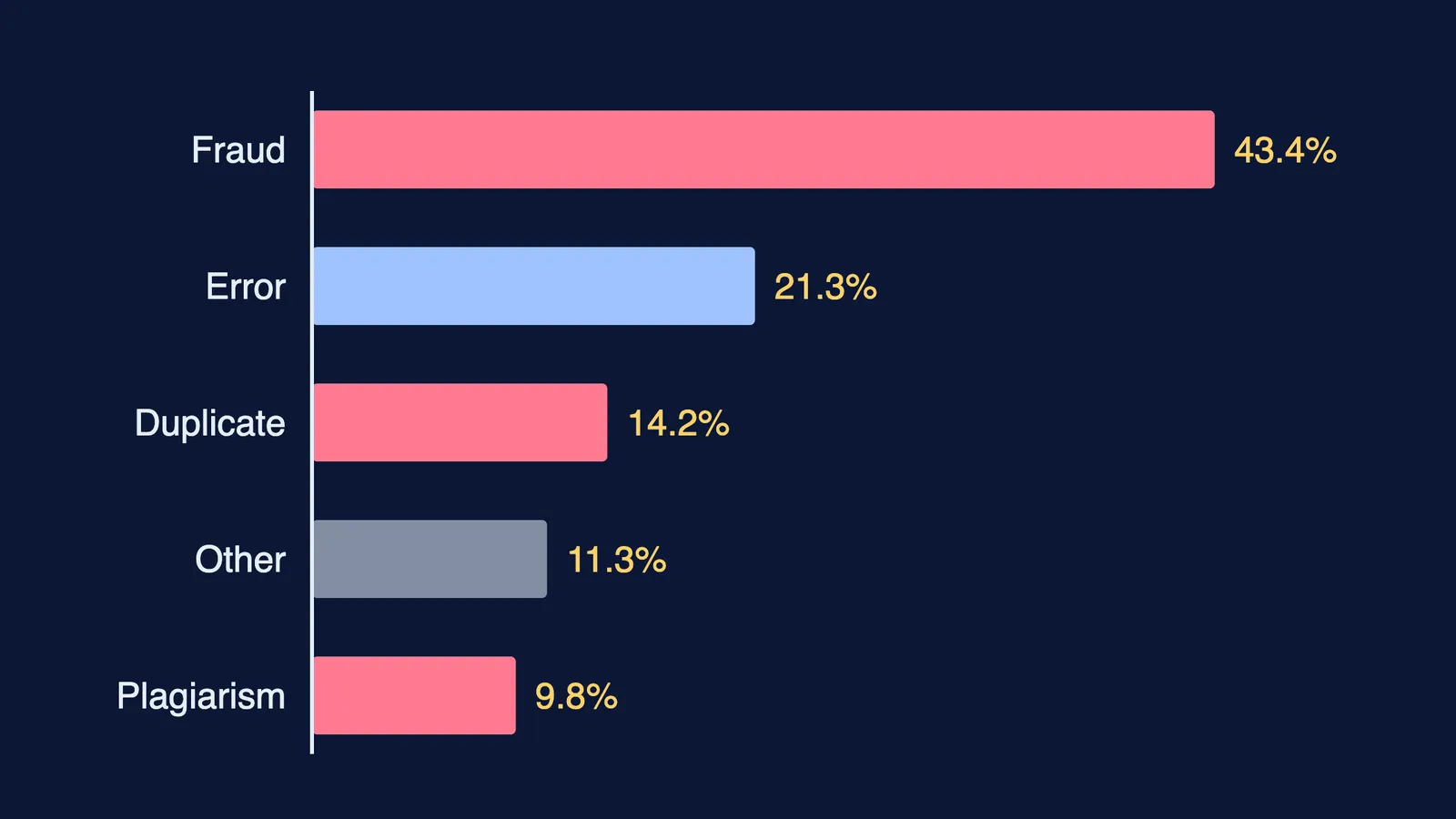
The reasons fall into two broad groups: someone cheated, or someone made a mistake. A widely cited study by Ferric Fang, R. Grant Steen and Arturo Casadevall in PNAS reviewed all 2,047 biomedical and life-science papers that PubMed listed as retracted on 3 May 2012 (Fang et al., PNAS 2012). Of those retractions:
67.4% were for misconduct: 43.4% for fraud or suspected fraud, 14.2% for duplicate publication and 9.8% for plagiarism.
Only 21.3% were because of error.
The percentage of scientific articles retracted because of fraud had risen about tenfold since 1975, the same study found (Fang et al., PNAS 2012).
Retractions have since reached new highs. More than 10,000 research papers were retracted in 2023, a record, as publishers struggled to clean up sham papers and peer-review fraud, according to a Nature analysis (Nature, December 2023).
What do famous retracted papers show?
Frances Arnold shared the 2018 Nobel Prize in Chemistry for her work on the evolution of enzymes. In May 2019 her Caltech group published a paper in Science on using enzymes to make lactams (Crossref record). When the lab tried to reproduce the work, it did not hold up. The retraction notice said the enzymes "do not catalyze the reactions with the activities and selectivities claimed", and that the first author's lab notebook was missing contemporaneous entries and raw data for key experiments (Retraction Watch, 2 January 2020).
Arnold announced the retraction herself on Twitter on 2 January 2020: "It is painful to admit, but important to do so. I apologize to all. I was a bit busy when this was submitted, and did not do my job well." Holden Thorp, Science's editor in chief, said the journal was very appreciative of the "forthcoming and proactive" way Arnold and her coworkers had dealt with it (Retraction Watch).
The Wakefield paper is a case of misconduct. In 1998 The Lancet published a paper by Andrew Wakefield and 12 coauthors describing 12 children, which implied a link between the MMR vaccine and autism (CMAJ news report). The paper called them "a consecutive series", but Britain's General Medical Council ruled in January 2010 that the children had been carefully selected, and that some of Wakefield's research was funded by lawyers acting for parents in lawsuits against vaccine makers. The Lancet retracted the paper in February 2010, twelve years after publishing it; by then it had turned tens of thousands of parents against the MMR vaccine (CMAJ).
Does a retraction mean science is broken?
No. It means one paper failed a check that science runs all the time: can someone else get the same result? Arnold's paper fell because the result could not be reproduced. The same test has reshaped whole ideas in psychology, as our post on what the ego depletion replications found shows.
The weak point is people. We like results that fit what we already believe, which is why confirmation bias in studying and science matters, and why retractions sometimes come late. A single exciting paper is a lead, not a fact.
How can you check if a paper has been retracted?
Before you quote a study in a project, a debate or a family WhatsApp group, run these four checks.
Find the DOI, the code that starts with "10." on the paper's page.
Type api.crossref.org/works/ followed by the DOI into your browser. Look for "RETRACTED" in the title or a "retraction" entry under "updated-by". Crossref now holds the Retraction Watch database as a public resource (Crossref).
Ask whether anyone else has repeated the result. One study is weaker than several that agree.
Read who was studied and how many. Twelve hand-picked children cannot tell you about millions.
Worked example: open the Crossref record for the Wakefield DOI, 10.1016/S0140-6736(97)11096-0. The title starts "RETRACTED:", and the "updated-by" field lists a retraction dated 6 February 2010 (Crossref record11096-0)).
If someone forwards you a study, you can reply: "Interesting. Has it been retracted, and has anyone repeated it?" That is a fair question about any claim, not an insult.
When a claim does not match what you thought you understood, go back to the underlying idea. The Fermi Concept Library has every concept in physics, chemistry, biology, mathematics and computing, each with its own lesson, so you can check the science before deciding what to believe.
Next time you see "a study shows", spend one minute on the DOI before you share it.