

On this page
A white dwarf is what is left when a star like the Sun runs out of fuel. Most have masses close to 0.6 times the Sun's, and the first ones measured, Sirius B and 40 Eridani B, packed roughly a solar mass into a radius about 0.01 times the Sun's, for densities near 10^6 g/cm³, according to Simon Blouin's review "White dwarf fundamentals".
Something has to stop all that matter falling inward. In 1926 the Cambridge physicist Ralph Fowler showed what it is, using quantum ideas that were only months old.
Who was Ralph Fowler?
Ralph Howard Fowler (1889–1944) was a mathematical physicist at Cambridge, and the MacTutor biography notes that it was Fowler who introduced Paul Dirac to quantum theory in 1923. On 26 August 1926 Fowler communicated Dirac's paper containing what we now call the Fermi-Dirac distribution to the Royal Society, as Luisa Bonolis recounts in her history of compact stars before 1940.
What was the white dwarf puzzle?
An ordinary star is held up by the pressure of hot gas. Arthur Eddington pointed out in 1926 that this leads to a paradox for a dense, dying star: to cool down, its matter would have to expand back to ordinary density, which needs energy the star no longer has. In Eddington's words, "Imagine a body continually losing heat but with insufficient energy to grow cold!" (Bonolis). Fowler's answer, Bonolis explains, was that the trouble came from linking energy to temperature in the classical way.
How does the Pauli exclusion principle hold up a white dwarf?
Wolfgang Pauli published the exclusion principle in Zeitschrift für Physik in 1925. In the words of Blouin's review, identical fermions such as electrons cannot simultaneously occupy the same quantum state.
Now squeeze a huge number of electrons into a small space. The low-momentum states fill first, so every extra electron must take a state with more momentum. Even at absolute zero the electrons keep moving fast, and moving particles push on whatever confines them.
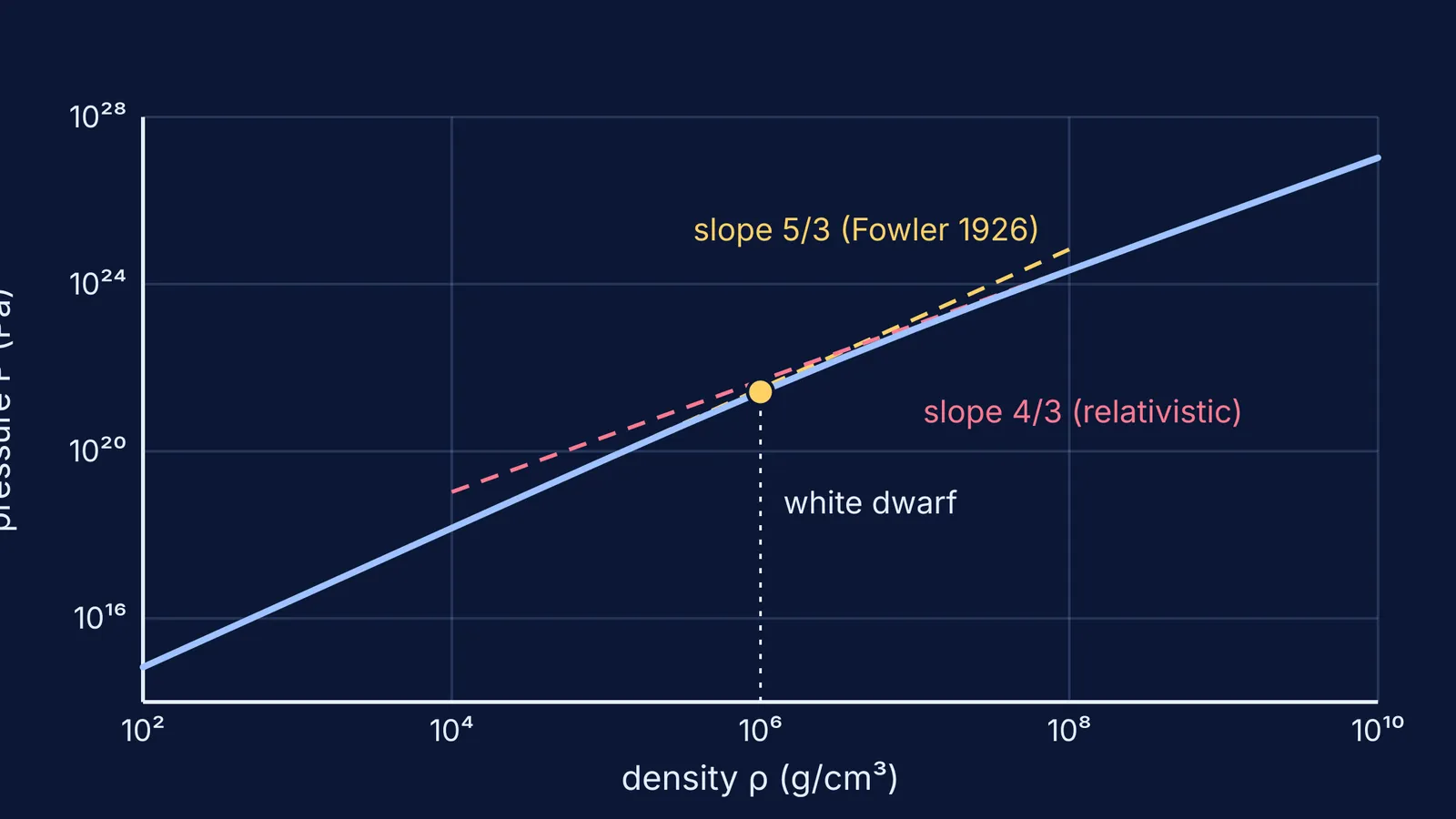
Fowler's paper "On Dense Matter" appeared in Monthly Notices of the Royal Astronomical Society on 10 December 1926. It applied Fermi-Dirac statistics to white dwarf matter and showed that its electrons are degenerate. In his 1929 book Statistical Mechanics, Fowler wrote that the material of a fully cooled star "is best likened to a single gigantic molecule in its lowest quantum state" (Bonolis). Blouin credits Fowler with the pressure law for degenerate electrons: P = (3π²)^(2/3)/5 × ħ²/mₑ × nₑ^(5/3), where nₑ is the number of electrons per cubic metre.
How big is degeneracy pressure inside a white dwarf?
Check this with a calculator. Take a white dwarf of 0.6 solar masses (the typical mass in Blouin's review) with a radius of 0.01 solar radii, and a density of 10^6 g/cm³.
Count electrons. 10^6 g/cm³ is 10^9 kg/m³. Carbon and oxygen have about two nucleons per electron, so nₑ = ρ/(2 × 1.66×10⁻²⁷ kg) ≈ 3.0×10³⁵ per m³.
Find the top momentum. p = ħ(3π²nₑ)^(1/3) ≈ 2.2×10⁻²² kg m/s, about 0.8 mₑc: near light speed, even in a cold star.
Apply Fowler's formula. P ≈ 3.2×10²¹ Pa. The full relativistic formula gives about 2.6×10²¹ Pa.
Ask what gravity demands. For a uniform sphere, the average pressure needed for balance is GM²/(5RV), with V the volume: about 1.9×10²¹ Pa here.
Compare. Supply and demand match in order of magnitude, which is Fowler's point. Doubling the density raises the pressure 2^(5/3) ≈ 3.2 times, so a contracting star quickly finds its balance.
Where did Chandrasekhar take Fowler's idea?
Step 2 hides a problem. In heavier white dwarfs the electrons approach light speed, and the pressure law softens from ρ^(5/3) to ρ^(4/3) (Blouin). Bonolis describes how Wilhelm Anderson and Edmund Stoner, in papers from 1928 to 1930, found that relativity gives white dwarfs a limiting mass. On 31 July 1930, aged 19, Subrahmanyan Chandrasekhar left Bombay to study under Fowler and worked on the problem during the voyage (Bonolis). Blouin puts the Chandrasekhar limit at about 1.4 solar masses: above it, electron degeneracy cannot hold a white dwarf up. His later work is in our post on Chandrasekhar's dynamical friction.
How can you study this for Class 11 and 12 physics?
Start from chemistry. Counting electrons for given quantum numbers, as in our example on maximum electrons with n = 3 and l = 1, uses the rule Fowler applied to a star.
Redo the five steps yourself and keep the powers of ten honest.
Link it to brightness. Sirius B is about 26,000 K yet smaller than Earth (HyperPhysics); our explainer on luminosity from radius and temperature shows why small means faint.
Say the key idea in one line: pressure from density, not heat.
If the exclusion principle feels shaky, the Fermi Concept Library has a lesson for every concept in physics and chemistry. For estimates like this one, the Fermi Problem Library has worked problems with a step-by-step solver that explains the reasoning rather than printing an answer.


