

On this page
When you are asked to find the maximum number of electrons for a given set of quantum numbers, the key is to determine how many orbitals fit that description and then multiply by two, as dictated by the Pauli exclusion principle.
Here is how to solve the classic problem: finding the maximum electrons with n = 3 and l = 1.
What do n and l mean?
Quantum numbers define the state of an electron in an atom (Wikipedia). The first two quantum numbers narrow down the location to a specific subshell:
Principal quantum number (n): This tells you the main energy level or shell. Here, n = 3 means the electron is in the third shell. The higher the value of n, the larger the shell and the further it is from the nucleus.
Azimuthal quantum number (l): This tells you the shape of the orbital, or the subshell. The values of l range from 0 up to n - 1. A value of l = 1 corresponds to a p orbital.
Together, n = 3 and l = 1 describe the 3p subshell. You can dive deeper into Quantum numbers and electron configuration, rule by rule to see how these build the entire atom.
How many orbitals are in the 3p subshell?
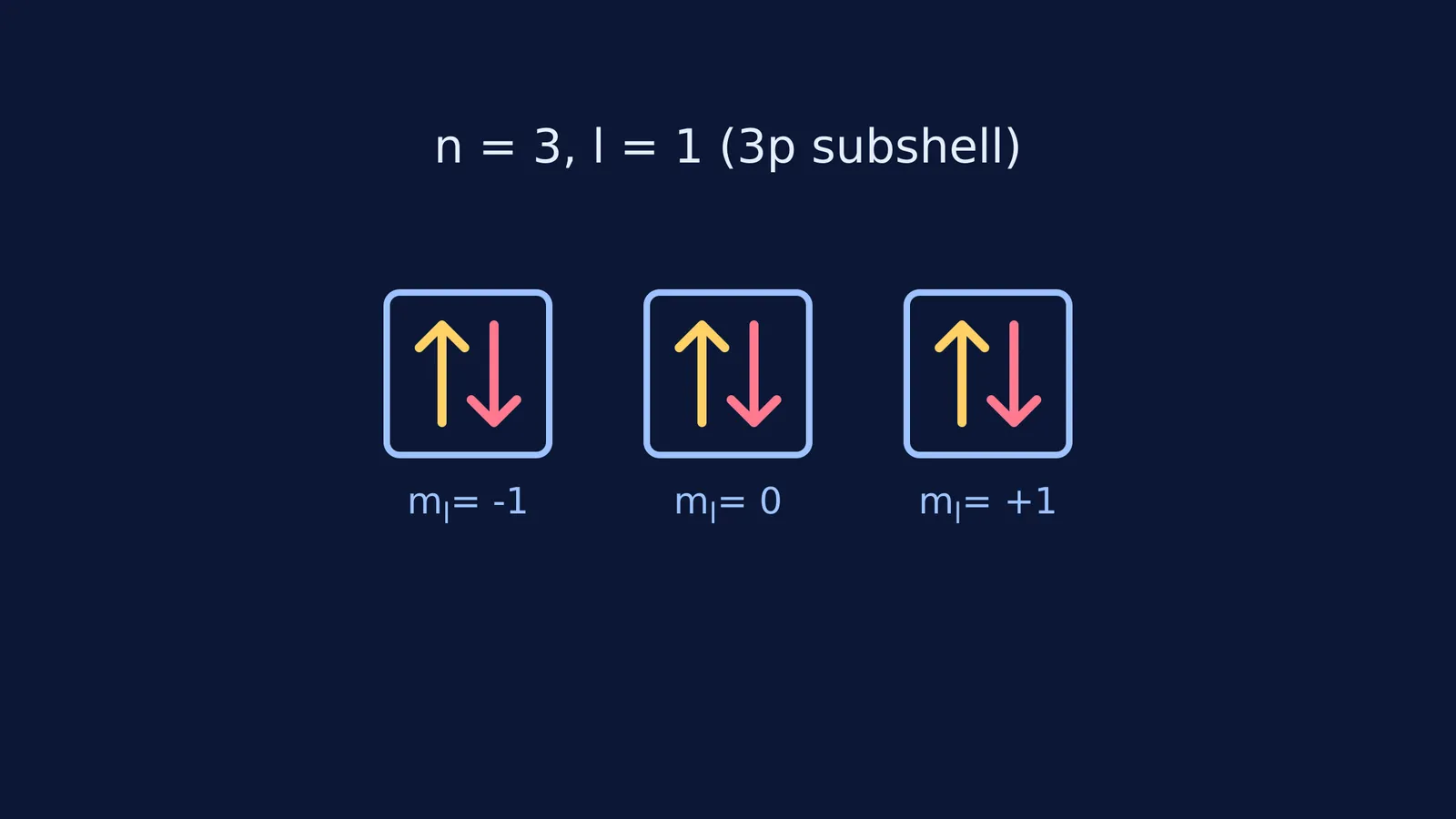
The magnetic quantum number (m_l) describes the spatial orientation of the orbital. For a given subshell l, m_l can take integer values from -l to +l.
Since l = 1, the possible values for m_l are: -1, 0, and +1.
This means there are exactly 3 orbitals in any p subshell. This rule scales consistently for all types of subshells across the atom.
Applying Pauli's exclusion principle
The spin quantum number (m_s) describes the electron's intrinsic spin, which can be either +1/2 or -1/2. According to the Pauli exclusion principle, no two electrons in an atom can have the exact same four quantum numbers. Therefore, each orbital can hold a maximum of two electrons, provided they have opposite spins.
With 3 orbitals in the 3p subshell, the calculation is straightforward: 3 orbitals × 2 electrons per orbital = 6 electrons.
So, a maximum of 6 electrons can share the quantum numbers n = 3 and l = 1. The rules of filling these orbitals also determine the Electron configuration of ions like Fe³⁺ and Cu⁺.
How to memorise the subshell sizes
It is helpful to know the capacity of standard subshells by heart to save time during an exam. The mathematical formula for the number of orbitals is always 2l + 1, and the maximum number of electrons is always 2(2l + 1).
Here is a handy checklist for the common subshells:
s subshell (l = 0): 1 orbital, maximum 2 electrons.
p subshell (l = 1): 3 orbitals, maximum 6 electrons.
d subshell (l = 2): 5 orbitals, maximum 10 electrons.
f subshell (l = 3): 7 orbitals, maximum 14 electrons.
When you encounter n = 3 and l = 1, you can instantly recognise l = 1 as the p subshell and know that it holds 6 electrons without doing the full calculation from scratch.
What if m_l or m_s is also given?
Exams like JEE and NEET often tweak this question by giving you three or all four quantum numbers. Here is a framework to handle the variations step-by-step:
Given n, l, and m_l: If the question states n = 3, l = 1, and m_l = 0, it is pointing to one specific orbital. Because the exact orbital is specified, the maximum number of electrons is just 2.
Given n, l, and m_s: If you are given n = 3, l = 1, and m_s = +1/2, you are restricted to electrons with an "up" spin. There is one such electron in each of the 3 orbitals, making the maximum number 3.
Given all four numbers: If n = 3, l = 1, m_l = -1, and m_s = +1/2, this describes exactly 1 electron. No other electron can share this exact state.
Given only n: If the question simply asks for the maximum electrons in the n = 3 shell, the formula is 2n². For n = 3, that would be 2 × 3² = 18 electrons.
If you find yourself repeatedly stuck on finding the right formulas for quantum numbers, the Fermi Concept Library can help you trace the rules back to their origins. Fermi's AI tutor can walk you through the atomic structure step-by-step, checking your understanding of orbitals and spins as it goes.


