

On this page
What is dynamical friction in astrophysics?
In everyday physics, friction requires physical contact: a sliding block rubs against a floor, or a falling meteor compresses atmospheric gas. Space, however, is a near-perfect vacuum. When a star or globular cluster orbits through a galaxy, it never collides with other stars directly. The average distance between stars is so vast that direct physical collisions are virtually impossible.
Yet in March 1943, Indian-born astrophysicist Subrahmanyan Chandrasekhar published a foundational paper in The Astrophysical Journal demonstrating that a moving mass in space still experiences genuine friction. He called this phenomenon dynamical friction, or gravitational drag.
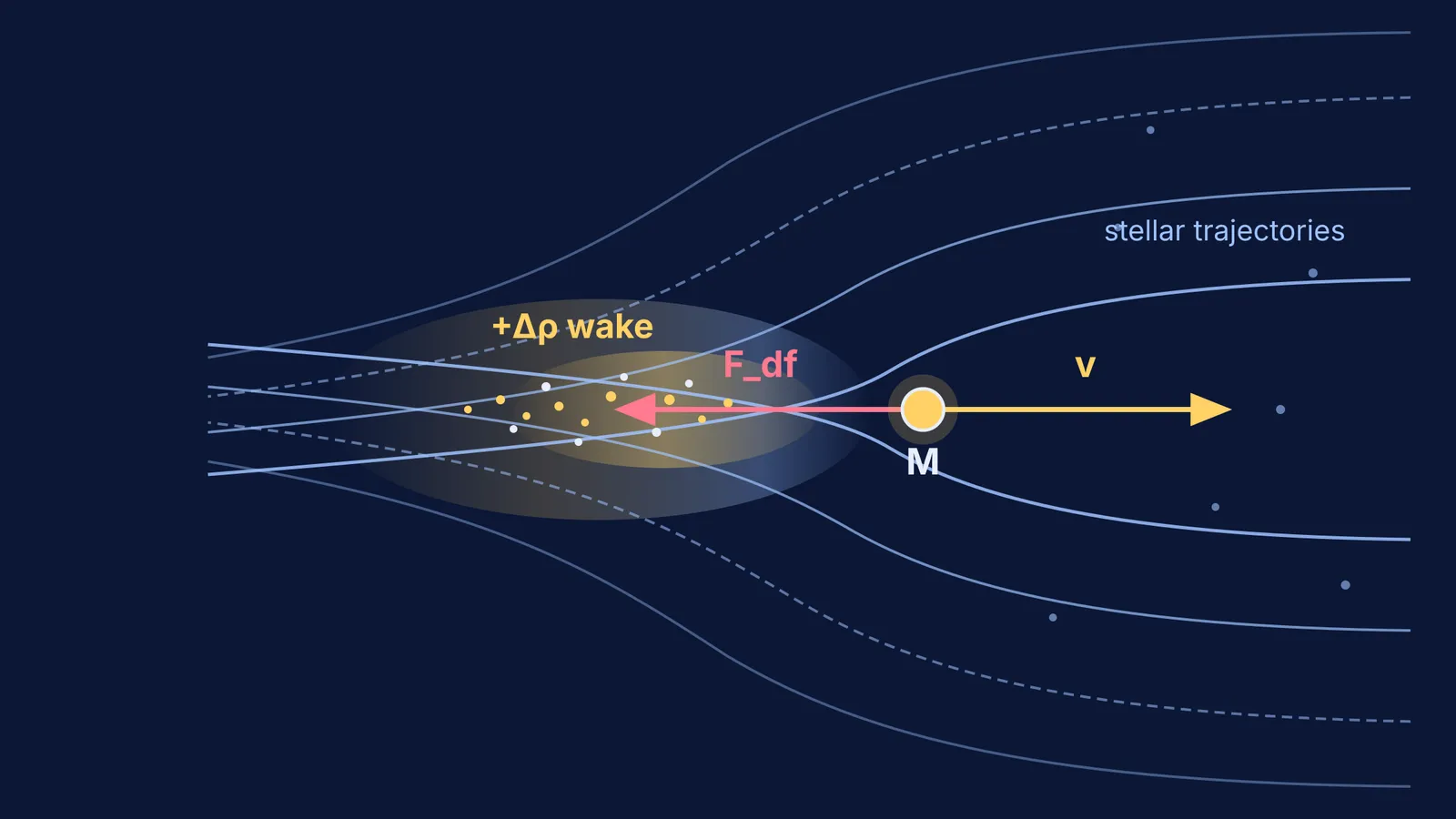
The drag arises because gravity has infinite range. As a massive body of mass M travels forward at velocity v through a field of lighter stars of individual mass m, it attracts the surrounding stars toward its path. In the centre of mass frame of each encounter, every background star undergoes hyperbolic gravitational scattering. Because the heavy body continues moving forward, the deflected stars do not congregate around it; instead, they converge behind it. This creates a dense trailing region known as a gravitational wake. Because more stellar mass is concentrated behind the moving body than ahead of it, the gravitational attraction of the wake pulls backward on the body, steadily draining its momentum and kinetic energy.
Why does the drag force scale with mass squared?
Chandrasekhar's mathematical derivation revealed a striking feature of gravitational drag: the decelerating force does not scale linearly with the mass of the moving object, but with the square of its mass (F_df ∝ M²).
This quadratic dependence comes from two consecutive gravitational steps:
The excess mass pulled into the trailing wake is directly proportional to the body's mass M.
The backward gravitational force between that wake and the body is also proportional to M.
Multiplying both effects gives a drag force proportional to M². Because acceleration equals force divided by mass (a = F/M), the resulting deceleration is directly proportional to mass: a_df ∝ M.
This single relationship explains why dynamical friction sorts objects by mass across the cosmos. As Chandrasekhar applied to star clusters, an ordinary star of 1 solar mass experiences negligible dynamical deceleration over the age of the universe. But a globular cluster containing 10⁶ solar masses feels a deceleration a million times greater, causing its orbit to decay.
The velocity dependence is equally counter-intuitive. In a 1943 review on stochastic stellar dynamics, Chandrasekhar showed that at high velocities (v ≫ σ, where σ is the velocity dispersion of background stars), the drag force drops off as 1/v². Fast-moving bodies zip through the field so quickly that background stars have no time to deflect and focus into a dense wake.
How does dynamical friction shape star clusters and galaxies?
Dynamical friction is the engine driving cosmic structure on galactic scales. In 1975, astrophysicists Scott Tremaine, Jeremiah Ostriker, and Lyman Spitzer published an influential study in The Astrophysical Journal showing that globular clusters orbiting the Andromeda galaxy (M31) lose angular momentum through dynamical friction against halo stars. Over several billion years, the most massive clusters spiral inexorably into the galactic nucleus, where they merge to build the ultra-dense central star cluster.
The same mechanism governs galaxy mergers. When two galaxies collide, their dark matter halos and stellar disks interpenetrate. Dynamical friction drags the central supermassive black holes of both systems toward the centre of the newly formed elliptical galaxy. As observed in modern studies of the centre of our galaxy, dynamical friction brings massive black holes from thousands of parsecs apart down to roughly 1 parsec, where gravitational wave emission eventually takes over.
Earlier in his career, Chandrasekhar had derived the famous white dwarf mass limit using quantum mechanics and special relativity. With dynamical friction, he applied the mathematics of Brownian motion to astrophysics, proving that gravity alone can generate macroscopic dissipation.
For students who find multi-body gravitational deflections and wake formation difficult to visualise on static paper, the Fermi Simulation Lab provides interactive simulations for the ideas that are easier to see than to read.
How do you calculate the orbital decay time for a star cluster?
To see dynamical friction in action, as calculated for galactic halos, consider a massive globular cluster orbiting inside a galactic halo. For a cluster of mass M on a circular orbit at radius r within a halo with flat circular velocity v_c, the dynamical friction sinking time is given by:
t_df ≈ [1.17 / ln Λ] · [r² v_c / (G M)]
Here G is the gravitational constant (6.674 × 10⁻¹¹ m³ kg⁻¹ s⁻²), and ln Λ is the Coulomb logarithm, typically between 10 and 15 for galactic halos.
Let us calculate the sinking timescale for a cluster with mass M = 10⁶ M_☉ (where 1 M_☉ ≈ 1.989 × 10³⁰ kg) orbiting at r = 1 kpc (1 kpc ≈ 3.086 × 10¹⁹ m) in a galaxy with circular velocity v_c = 220 km/s (2.2 × 10⁵ m/s) and ln Λ = 10:
Converted to astronomical units, the standard scaling yields t_df ≈ [2.64 × 10¹¹ yr / ln Λ] · (r / 2 kpc)² · (v_c / 250 km/s) · (10⁶ M_☉ / M).
Substituting our parameters: t_df ≈ [2.64 × 10¹¹ / 10] · (0.5)² · (220 / 250) · 1 ≈ 5.8 × 10⁹ years (5.8 billion years).
Because 5.8 billion years is shorter than the Milky Way's age of roughly 13.6 billion years, any massive cluster initially orbiting within 1 kpc has already sunk into the galactic centre. In contrast, at r = 5 kpc, the r² term increases the timescale by a factor of 25 to roughly 145 billion years, explaining why outer globular clusters remain in stable orbits today.
When preparing for physics exams or university mechanics where multi-body conservation laws and relative motion appear, the Fermi Problem Library offers worked problems with a step-by-step solver that explains the reasoning rather than printing an answer. To explore how gravitational potential energy and orbital mechanics fit into the broader physics syllabus, the Fermi Concept Library contains every concept in physics, chemistry, biology, mathematics and computing, each with its own lesson and its place in the map.


