On this page
Most of the universe cannot be seen. Dark matter gives off no light, and black holes swallow it. Priyamvada Natarajan, who was born in Coimbatore and studied for her PhD at Cambridge under Martin Rees (Wikipedia), has built a career on finding both. She is now the Joseph S. and Sophia S. Fruton Professor and Chair of Astronomy at Yale, and Time named her one of its 100 most influential people of 2024. Yale News highlights her work "using gravitational lensing to study dark matter" and her "theoretical work on the formation and growth of black holes" (Yale News).
What did Priyamvada Natarajan discover about black holes?
Astronomers kept finding enormous black holes very early in cosmic history, and that was a puzzle. A black hole left behind by a dead star starts small. Could it grow big enough in time?
In 2006, Natarajan and Giuseppe Lodato proposed another route. In the young universe, gas discs inside the first dark matter haloes could funnel mass to their centres and form a black hole directly, with no star stage in between. Their model predicted that roughly 5% of such discs, in haloes of about 10 million Suns, should host a black hole of about 100,000 Suns (Lodato and Natarajan, MNRAS 2006). Astronomers call this a heavy seed, made by direct collapse.
In a 2017 paper, she and her colleagues predicted what such an object would look like to the James Webb Space Telescope: a young galaxy where the light from gas falling into the black hole outshines all its stars. They called it an obese black hole galaxy; later papers say outsize or over-massive (Natarajan et al., ApJ 2017).
In 2023, that prediction found a likely match. NASA's Chandra X-ray Observatory and the James Webb Space Telescope spotted a growing black hole in the galaxy UHZ1, seen just 470 million years after the Big Bang; the release says it agrees with her 2017 predictions (Chandra press release). The team's paper estimates its mass at about 40 million Suns, comparable to the mass of the galaxy's stars (Natarajan et al., 2023). Nearby galaxies usually have black holes holding only about a tenth of a percent of their stars' mass (Chandra).
"We think that this is the first detection of an 'Outsize Black Hole' and the best evidence yet obtained that some black holes form from massive clouds of gas," Natarajan said in the Chandra release. The X-ray result appeared in Nature Astronomy (Bogdán et al., 2023).
How does she map dark matter with gravitational lensing?
Mass bends light, as Einstein's general relativity of 1915 predicts. A galaxy cluster, packed with dark matter, acts like an uneven lens: it stretches, brightens and multiplies the images of galaxies behind it. Measure the distortions and you can work backwards to where the mass must be.
Natarajan's group used Hubble Frontier Fields images of three clusters, Abell 2744, MACSJ0416 and MACSJ1149. They mapped dark matter clumps down to about 10^9.5 Suns (Natarajan et al., MNRAS 2017). The number of clumps of each size matched cold dark matter predictions "over four decades in subhalo mass", though the clumps sat at different distances from cluster centres than in simulations (arXiv abstract). Dark matter may make up about 80% of the matter in the universe (Yale News, 2017).
The two lines of work meet in UHZ1. The cluster Abell 2744 sits in front of it, and its lensing magnified the galaxy's light and X-rays by about a factor of four (Chandra).
Why couldn't a small black hole grow fast enough?
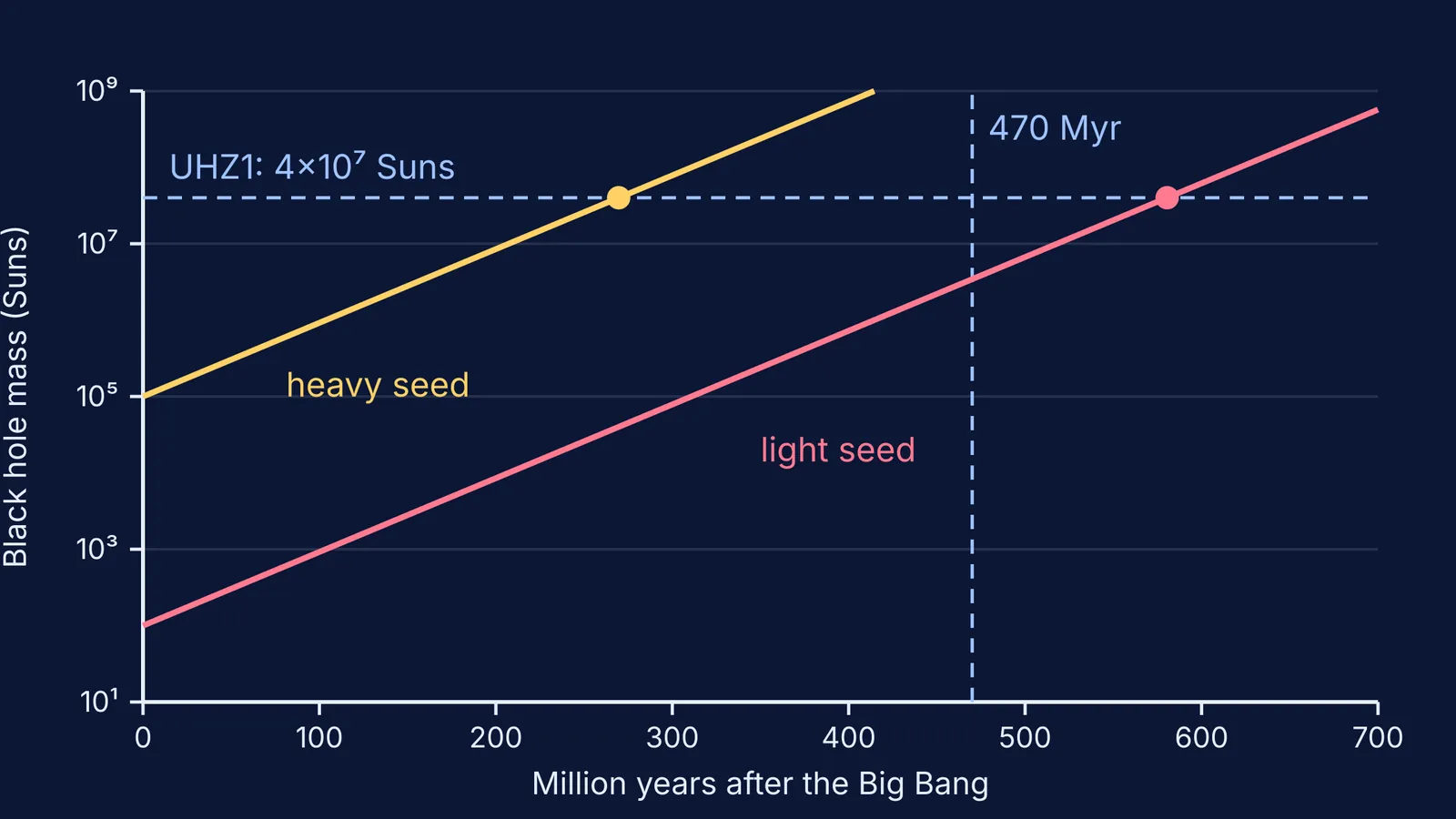
You can check the heavy-seed idea yourself with Class 11 logarithms. A black hole feeding as fast as physics allows (the Eddington limit) grows exponentially, with an e-folding time of about 45 million years (Wise, 2023). So mass after time t is M = M₀ × e^(t/45), with t in millions of years.
Light seeds weigh about 10 to 100 Suns; heavy seeds about 10,000 to 100,000 Suns (Chandra). Target: 40 million Suns.
Light seed, M₀ = 100 Suns. Growth needed = 4 × 10^5. ln(4 × 10^5) ≈ 12.9 e-folds. Time = 12.9 × 45 ≈ 580 million years.
Heavy seed, M₀ = 100,000 Suns. Growth needed = 400. ln(400) ≈ 6.0 e-folds. Time = 6.0 × 45 ≈ 270 million years.
Compare with 470 million years. Even if the light seed formed at the Big Bang and never stopped eating, it misses. The heavy seed has time to spare.
How can you study ideas like this?
Turn every headline number into a sum. Ask how long, how big, compared with what.
Draw it. Curved light paths and exponential growth are easier to see than read; the Fermi Simulation Lab has interactive simulations for ideas like these.
Fill the gaps first. If e-folding or gravitational potential feels shaky, the Fermi Concept Library has a lesson for each concept in physics and mathematics.
Follow the thread. Read how C. V. Vishveshwara heard black holes ring and how Chandrasekhar explained dynamical friction.
Pick one number from this article tonight and check it with your own calculator.