

On this page
In August 1970, C. V. Vishveshwara, a physicist from Bengaluru, published a three-page paper in *Nature* called “Scattering of Gravitational Radiation by a Schwarzschild Black-hole” (Nature 227, 936–938). It showed that a disturbed black hole rings in tones set by its mass, and the ringing fades. Forty-five years later, LIGO heard that ringing at the end of the first black hole merger ever recorded.
What did Vishveshwara find in 1970?
Vishveshwara was born in Bangalore on 6 March 1938, studied at the University of Mysore and earned his PhD at the University of Maryland in 1968 with a thesis on the stability of the Schwarzschild metric, according to his Physics Today obituary. That metric is the non-spinning black hole of Karl Schwarzschild's first black hole solution.
In 1970 he ran computer calculations that scattered gravitational waves off such a black hole. The obituary sums up the finding: any deformation of a black hole “relaxes via the emission of gravitational waves whose frequency and decay rate depend only on the black hole mass”, like “dying tones of a bell struck with a hammer”.
A later review lists the paper as a milestone: at late times the waveform consists of damped sinusoids, now called ringdown waves (Berti, Cardoso and Starinets, arXiv:0905.2975).
What are quasinormal modes of a black hole?
A stretched string has normal modes, set frequencies it vibrates at, as in standing waves in strings and pipes. A black hole has fading ones.
Quasinormal modes are “eigenmodes of dissipative systems”, in the words of the same review. Because of the event horizon, a disturbed black hole always loses energy, so each mode has a complex frequency: the real part is the pitch, the imaginary part the fading rate. These depend only on the black hole's mass and spin, so the ringing tells you what the black hole is.
How did LIGO hear a black hole ring?
On 14 September 2015 at 09:50:45 UTC, both LIGO detectors recorded a signal that swept upward in frequency from 35 to 250 Hz (LIGO and Virgo, Physical Review Letters 2016). It matched general relativity's prediction for two merging black holes “and the ringdown of the resulting single black hole”. The two black holes were about 36 and 29 times the Sun's mass, and the final one about 62, with the energy of about 3.0 solar masses radiated as gravitational waves.
A companion paper found the data after the signal's peak “consistent with the least-damped quasi-normal mode” expected from the final black hole's mass and spin (Tests of general relativity with GW150914). LIGO and Virgo cited Vishveshwara's 1970 paper in that first detection report, his obituary notes. He died in Bengaluru on 16 January 2017; he had been founding director of the city's Jawaharlal Nehru Planetarium.
This first ringdown was weak, not loud enough to test the no-hair theorem cleanly, as Naresh Dadhich and K. Rajesh Nayak note (Resonance 2024). India's own detector is covered in gravitational waves and LIGO-India, explained with real numbers.
How do you calculate a black hole's ringing frequency?
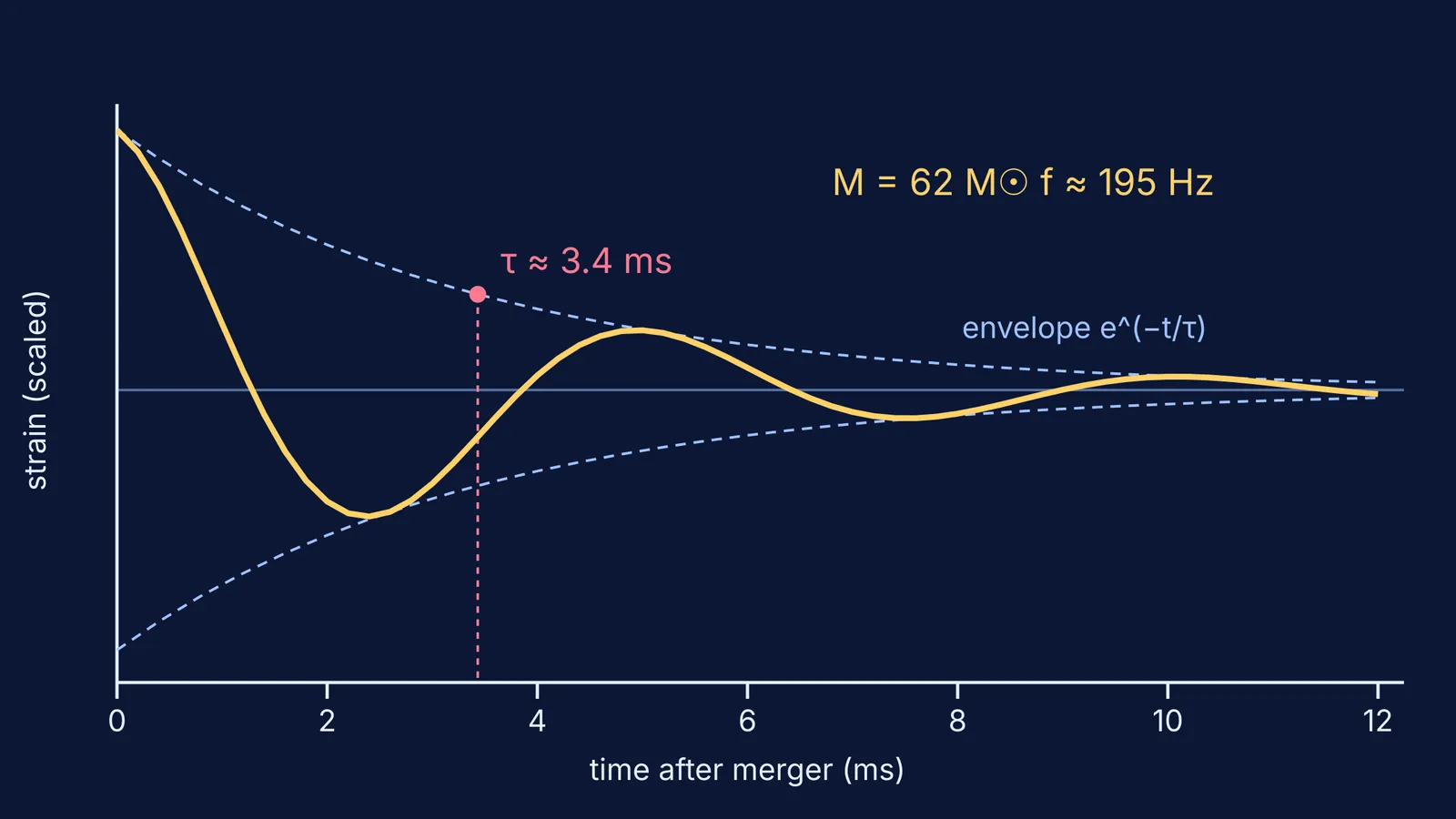
The Berti review gives the main tone of a non-spinning black hole of mass M in two formulas, where M☉ is the Sun's mass (arXiv:0905.2975, section 9.1):
frequency f = 1.207 × 10⁻² × (10⁶ M☉ / M) Hz
damping time τ = 55.37 × (M / 10⁶ M☉) s
A 10-solar-mass black hole: f = 1.207 × 10⁻² × 10⁵ ≈ 1207 Hz, and τ = 55.37 × 10⁻⁵ s ≈ 0.55 ms.
A 62-solar-mass black hole, the size of LIGO's first remnant: f = 12,070 ÷ 62 ≈ 195 Hz, and τ = 55.37 × 62 × 10⁻⁶ s ≈ 3.4 ms.
A million-solar-mass black hole: f ≈ 0.012 Hz and τ ≈ 55 s, far too low for LIGO; the review points to the planned space detector LISA.
Notice the patterns. Frequency goes as 1/M, so doubling the mass halves the pitch, as a bigger bell rings lower. Damping time goes as M. The product f × τ = 1.207 × 10⁻² × 55.37 ≈ 0.67 is the same for every non-spinning black hole: the ringing shrinks to 1/e (about 37%) of its size within two-thirds of one oscillation.
LIGO's final black hole was spinning, which shifts the tone, so 195 Hz is only a ballpark.
What can students take from Vishveshwara's method?
He asked a plain question of a strange object: if you poke it, what happens? Bring that habit to oscillation problems in Class 11 or JEE physics:
Check the units on both sides.
Reason with proportions (f ∝ 1/M) before substituting numbers.
Sketch the answer as a fading envelope times a cosine.
If damped oscillations are hard to picture, the Fermi Simulation Lab has interactive simulations for ideas that are easier to see than to read.


