

On this page
Paul Walden's 1896 paper reported something surprising: a compound could be turned into its own mirror image just by swapping one group for another and back again. If you are studying haloalkanes for Class 12, JEE Main or NEET-UG, this is the history behind the line "SN2 gives inversion of configuration".
What is Walden inversion?
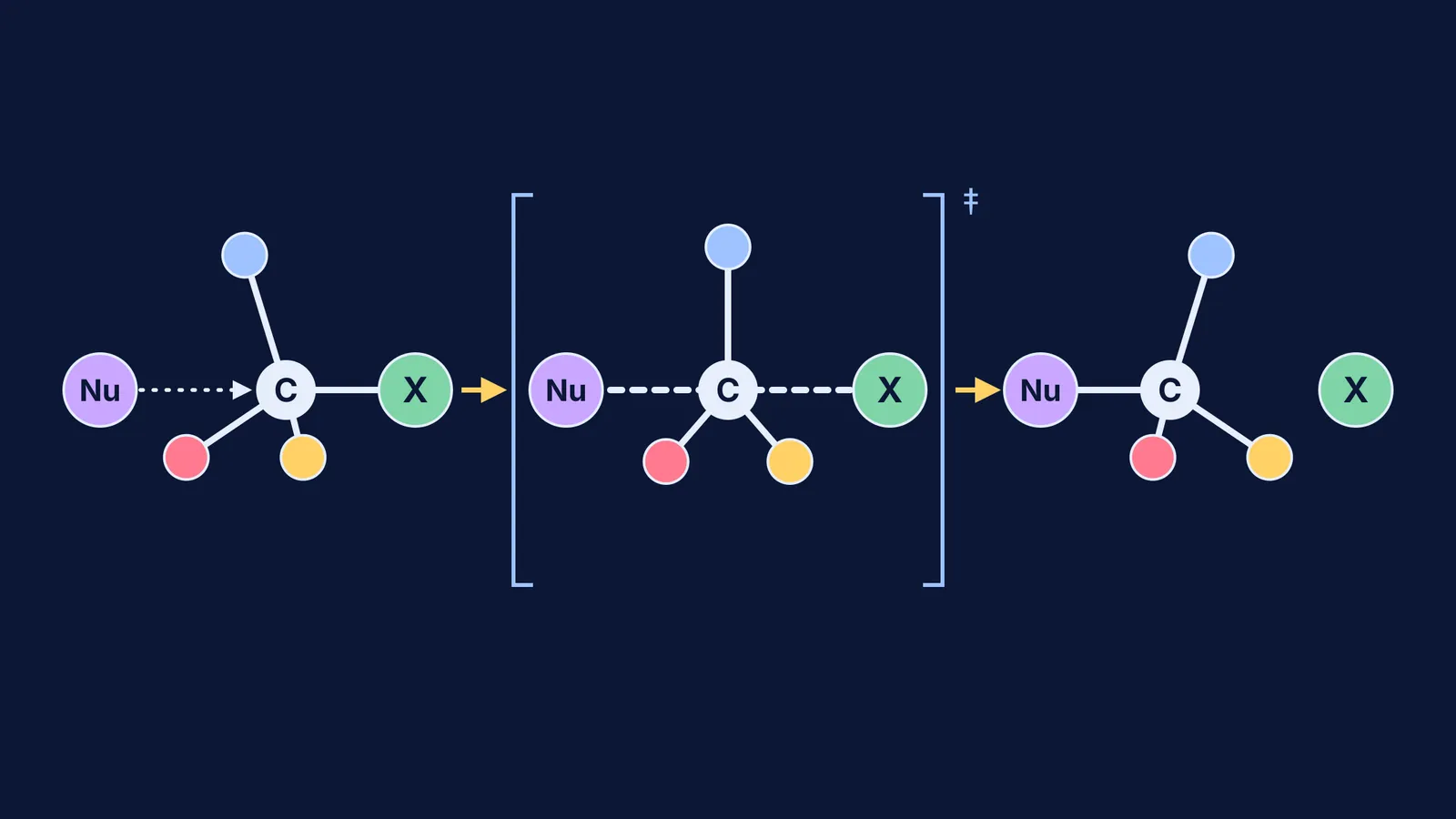
Walden inversion is the inversion of a stereogenic (chiral) centre during a chemical reaction, so the product has the opposite 3D arrangement to the starting material (Wikipedia: Walden inversion). Picture an umbrella turning inside out in a strong wind: the three groups on the carbon flip from pointing one way to pointing the other.
The two forms are enantiomers, mirror images that rotate plane-polarised light in opposite directions. If isomer types confuse you, see our guide to telling enantiomers, diastereomers and identical structures apart.
Who discovered Walden inversion?
Paul Walden was born on 26 July 1863 in Livonia, then part of the Russian Empire, and was a professor at the Riga Polytechnic from 1894 to 1911 (Wikipedia: Paul Walden). He later led the chemical laboratories of the St Petersburg Academy of Sciences and became a professor at Rostock. In 1914 he also made ethylammonium nitrate, the first room-temperature ionic liquid, which melts at 12 °C.
His inversion result appeared in 1896 as “Ueber die gegenseitige Umwandlung optischer Antipoden” (“On the mutual conversion of optical antipodes”) in Berichte der deutschen chemischen Gesellschaft, volume 29, pages 133 to 138 (Crossref record).
The experiment is now called the Walden cycle (Wikipedia: Walden inversion). It links malic acid, which has an OH on its chiral carbon, and chlorosuccinic acid, which has a Cl in the same place:
(+)-chlorosuccinic acid with silver oxide in water gives (+)-malic acid.
(+)-malic acid with phosphorus pentachloride (PCl5) gives (−)-chlorosuccinic acid.
(−)-chlorosuccinic acid with silver oxide gives (−)-malic acid.
(−)-malic acid with PCl5 takes you back to (+)-chlorosuccinic acid.
Halfway round the loop you hold the mirror-image compound, so some substitution had flipped the carbon.
How does the SN2 mechanism explain Walden inversion?
In 1935 E. D. Hughes and four co-workers published “Aliphatic substitution and the Walden inversion. Part I” in the Journal of the Chemical Society (Crossref record). Hughes and Christopher Ingold went on to label substitution mechanisms SN1 and SN2, now called the Hughes–Ingold symbols (Wikipedia: Christopher Kelk Ingold).
SN2 stands for nucleophilic substitution, bimolecular: the rate depends on both the substrate and the nucleophile, rate = k[RX][Nu−] (Wikipedia: SN2 reaction). The nucleophile attacks the carbon from the side opposite the leaving group, in one step, as the leaving group departs. The other three groups pass through a flat arrangement and come out on the far side, the umbrella flip in the diagram above.
A classic test used optically pure 2-iodooctane and radioactive iodide. Radioactive iodine entered the molecule at exactly half the rate at which the sample lost its optical activity, which is only possible if every substitution inverts the carbon (University of Texas course notes).
What about Walden's silver oxide step, which keeps the configuration? Current accounts explain it as two inversions in a row: the carboxylate first displaces chloride inside the same molecule to form a small lactone ring, then hydroxide opens the ring, so the net result is retention (Wikipedia: Walden inversion).
How do you predict the product of an SN2 reaction?
Take (R)-2-bromobutane reacting with hydroxide ion by SN2.
Find the chiral carbon: C2 carries Br, CH3, C2H5 and H.
Rank the groups by CIP rules: Br > C2H5 > CH3 > H.
Apply backside attack: OH enters opposite Br, and CH3, C2H5 and H flip like an umbrella.
Re-rank in the product: OH > C2H5 > CH3 > H. OH has taken the top rank that Br held.
Read the label: the geometry flipped and the ranking order is unchanged, so the product is (S)-butan-2-ol.
Check before you answer:
Is the carbon chiral at all? If not, the flip changes nothing you can see.
Is it really SN2? Primary and secondary halides with a strong nucleophile usually are, but solvent choice also steers SN1 versus SN2, and SN1 gives a different stereochemical result from SN2.
Did you redraw all three groups flipped, rather than swapping Br for OH in place?
Did you re-rank priorities in the product before writing R or S?
If you keep losing marks by swapping the group in place, the Fermi Problem Library has worked problems with a step-by-step solver that explains the reasoning rather than printing an answer. If CIP ranking is the shaky part, the Fermi Concept Library gives each chemistry concept its own lesson.
Every "inversion of configuration" you write traces back to Walden's 1896 paper.


