On this page
On the morning of 6 July 1885, a mother from Alsace brought her nine-year-old son to Louis Pasteur's laboratory in Paris. Joseph Meister had been bitten by a rabid dog fourteen times, according to the Institut Pasteur's history of Pasteur's final years. Our post on Pasteur and germ theory covers his earlier work. Now he had to decide whether to try an untested treatment on a child.
The stakes were total. Once the virus reaches the nervous system and symptoms appear, rabies is fatal in 100% of cases, says the WHO rabies fact sheet.
How did Pasteur make the rabies vaccine?
Pasteur's idea was to weaken the rabies agent itself. In the Institut Pasteur's words, he suspended sections of spinal cord from rabid rabbits inside flasks to dry in a moisture-free atmosphere, and their virulence gradually declined until it disappeared.
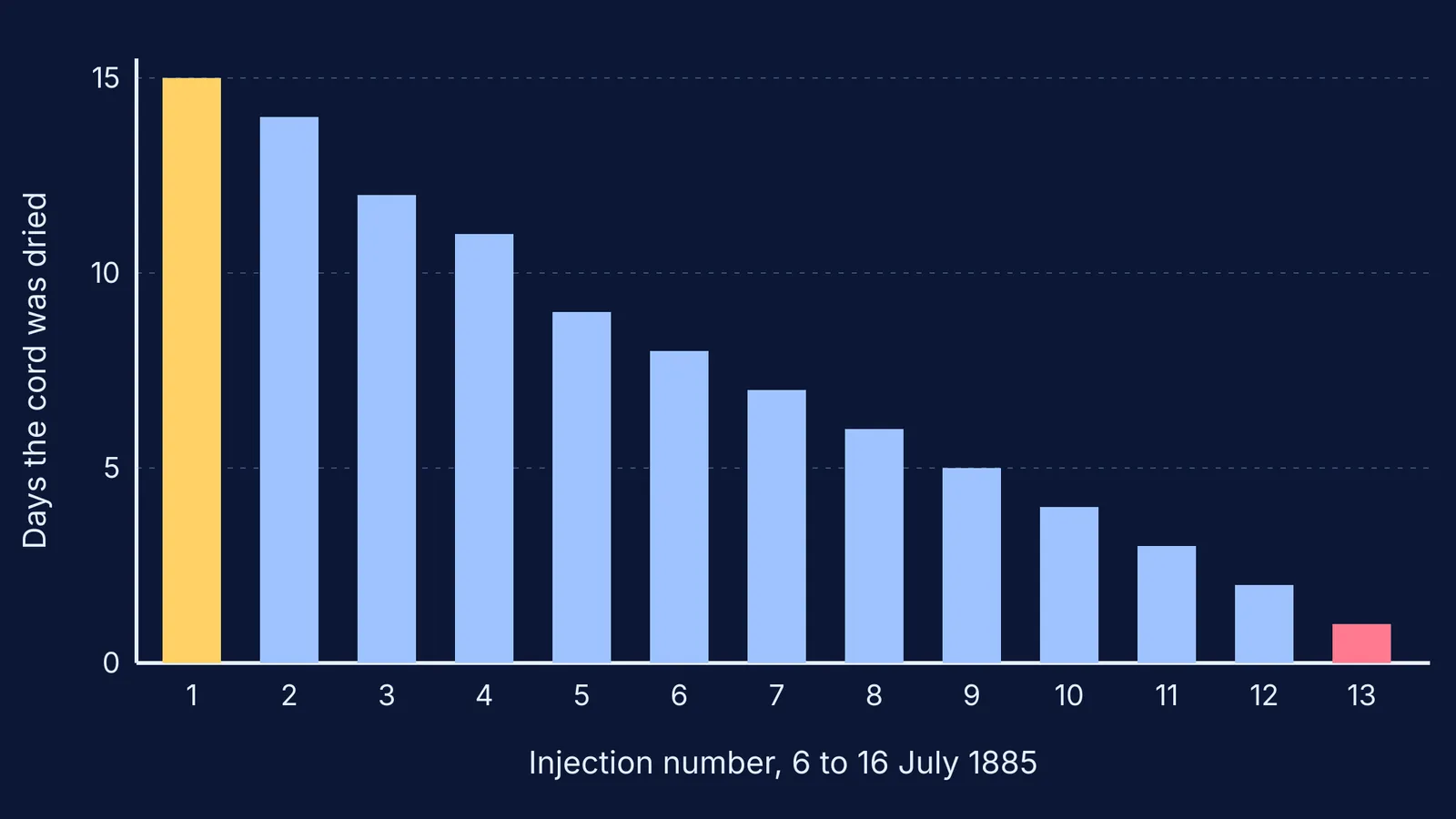
That gave him a dial: the longer a cord dried, the weaker it became. By injecting material from cords of different ages in order, from the longest-dried to the freshest, he could expose the body to rabies gently at first and then more strongly.
Until July 1885 the method had been tried only on animals. The Institut Pasteur's account of the first vaccination says it had been tested successfully in dogs and rabbits, and that Pasteur's colleagues, among them Emile Roux, did not want to give it to a child.
What happened to Joseph Meister?
A physician, Jacques-Joseph Grancher, persuaded Pasteur to go ahead and to let him administer the treatment to the boy, the Institut Pasteur reports.
The schedule survives. A 2014 history in PNAS by Rino Rappuoli (doi:10.1073/pnas.1414226111) records that on the evening of 6 July, with the physicians Vulpian and Grancher, Pasteur inoculated the boy with cord that had been drying for 15 days. Inoculations continued until 16 July with cords air-dried for ever shorter periods: 15, 14, 12, 11, 9, 8, 7, 6, 5, 4, 3, 2 and finally 1 day. That is 13 injections in about ten days, the same total the Institut Pasteur gives, each fresher and stronger than the last.
Meister never developed rabies. Today, the WHO fact sheet explains, treatment can work after a bite because prompt care stops the virus before it reaches the central nervous system. The vaccine gives the immune system a head start in that race. If you want the textbook version, our explainer on active vs passive immunity covers it.
How do you read Pasteur's experiment like a scientist?
History stories can feel like magic. Break this one into parts and it becomes a method you can use in any biology answer:
Question: can a weakened form of rabies protect someone who has already been bitten?
Variable changed: how many days the spinal cord dried, from 15 down to 1.
What was measured: whether the animal, or the boy, developed rabies.
Prior evidence: success in dogs and rabbits before any human.
Limit: one patient is one case. With no comparison group, Meister alone could not prove the method worked. Confidence grew as more bitten people came for treatment, beginning later in 1885 with a 15-year-old shepherd, Jean-Baptiste Jupille, as the Institut Pasteur recounts.
Ethics: his colleagues hesitated because the risk to a child was real. Ask yourself what evidence you would want before saying yes.
Try the same six questions on Edward Jenner's first smallpox vaccination and compare the answers.
If terms like antigen, antibody and immune memory blur together when you revise, the Fermi Concept Library has a lesson for each biology concept and shows where it sits in the map.
What should you do after a dog bite in India today?
Rabies is still a live problem here. India suffers approximately 36% of the world's human rabies deaths transmitted by dogs, the WHO said in 2021 when India launched its plan to end dog-mediated rabies deaths by 2030.
The WHO fact sheet adds two numbers worth knowing: dog bites and scratches cause 99% of human rabies cases, and 40% of deaths are in children under 15. Its everyday guidance is simple:
Wash the wound with water and soap for at least 15 minutes, straight away.
Seek medical attention the same day, even if the bite looks small.
Let the doctor decide on the vaccine course and any immunoglobulin.
Parents can make this a family rule, said out loud before it is ever needed: any bite or scratch from a dog, cat or monkey gets washed, then shown to a doctor, no matter how minor, and nobody gets in trouble for telling.
Want to revise immunity from the start? Fermi's AI tutor can work out what you already know and build a plan for the session, so you begin with a clear next step.