On this page
In July 1942 a 24-year-old from Gujarat went to Benaras to train in general relativity under V. V. Narlikar. He stayed until April 1943, according to a brief biography published in General Relativity and Gravitation. There Prahalad Chunilal Vaidya found an exact solution of Einstein's equations for the gravity outside a star that is shining, and so slowly losing mass.
What did P. C. Vaidya discover in 1943?
Vaidya's paper "The External Field of a Radiating Star in General Relativity" appeared in Current Science, volume 12, page 183, in 1943, according to the editor's note in General Relativity and Gravitation that reprinted it in 1999. The same note records that he was born on 23 March 1918 at Shapoor in Gujarat.
Schwarzschild's solution describes the space around a spherical star but assumes the space outside is empty, as the Indian Association for General Relativity and Gravitation (IAGRG) obituary puts it. A real star fills that space with its own light. Vaidya generalised Schwarzschild's answer to include that outgoing radiation.
He developed it in "The gravitational field of a radiating star", Proceedings of the Indian Academy of Sciences, volume 33, 1951, and in "'Newtonian' Time in General Relativity", Nature, 1953. The GRG associate editor, Andrzej Krasiński, calls the three papers consecutive stages of one derivation and praises the "excellent pedagogical quality" of the 1951 paper.
What is the Vaidya metric?
A metric is the rule that gives the distance between two nearby events in spacetime. If curved spacetime is new to you, start with how Einstein's general relativity showed gravity bends spacetime. In units where G = c = 1, the outgoing Vaidya metric is:
ds² = −(1 − 2M(u)/r) du² − 2 du dr + r²(dθ² + sin²θ dφ²)
Three things to notice:
If M is a constant, this is Schwarzschild's solution, written in different coordinates.
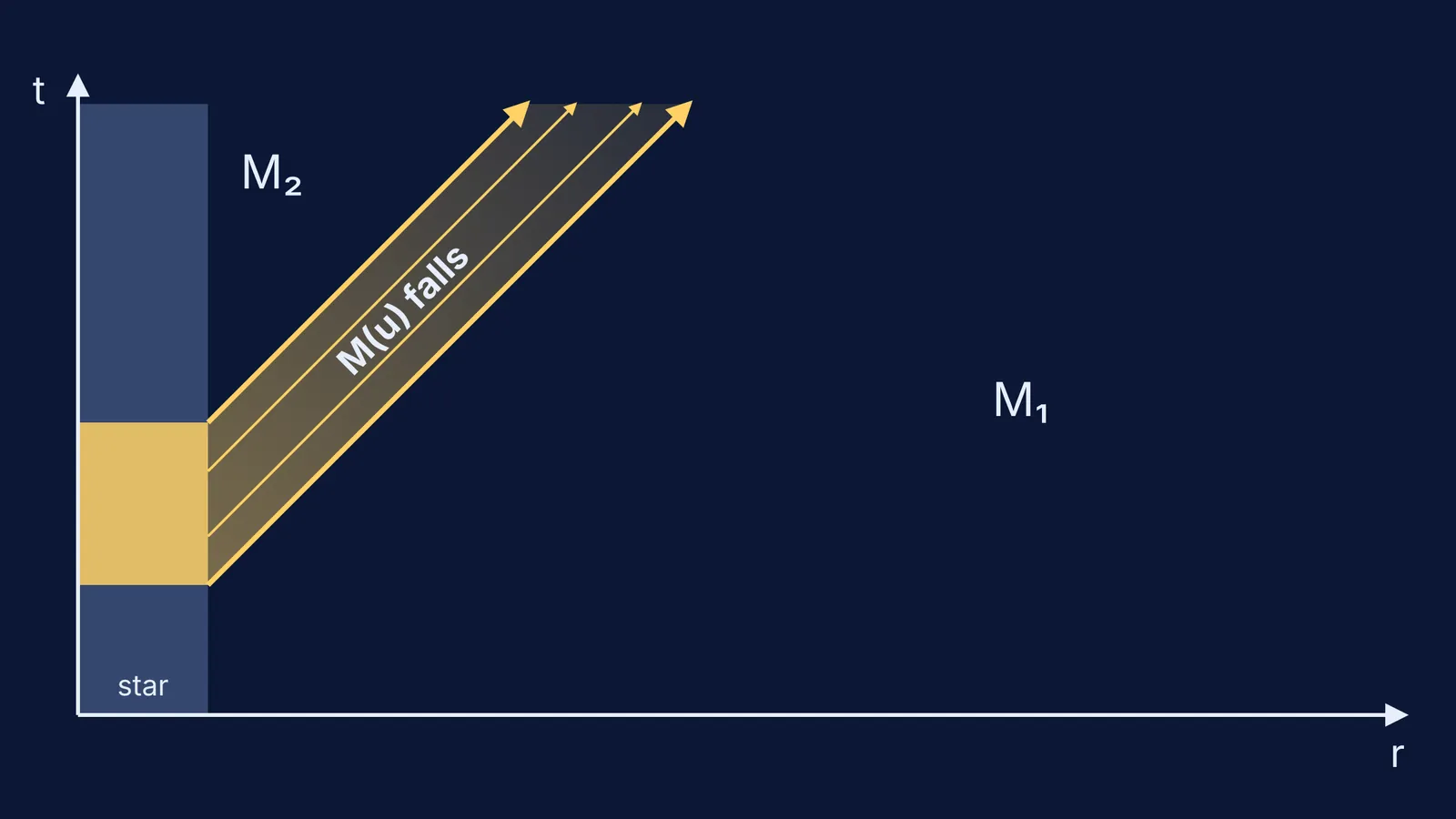
u labels each outgoing shell of light, so a whole shell shares one value of u. The IAGRG obituary credits the metric with pioneering the idea of using light rays as a coordinate frame, the null coordinate.
For a star that radiates, M(u) decreases as u increases. The drop in M is the energy the light carries away.
The "matter" outside the star is what the GRG editor's note calls a null fluid: radiation whose energy flows along light rays.
Why does Vaidya's radiating star metric matter?
The 1999 GRG editor's note says the metric is commonly used in two ways: as a testing ground for the cosmic censorship hypothesis, and as the outside solution for models of objects made of heat-conducting matter.
In 1965 Lindquist, Schwartz and Misner devoted a Physical Review paper, "Vaidya's Radiating Schwarzschild Metric", to its meaning. In 1973 Vaidya and L. K. Patel published a radiating Kerr metric for a star that both spins and shines.
Crossref lists 587 works citing the 1951 paper as of October 2026.
Worked example: how fast is the Sun's M(u) falling?
You need only E = mc². Values are from the NASA Sun fact sheet and NIST's value of G.
The Sun's luminosity is 3.828 × 10²⁶ W.
Mass lost as light each second is L/c² = 3.828 × 10²⁶ ÷ (2.998 × 10⁸)² ≈ 4.26 × 10⁹ kg. NASA lists the same mass conversion rate, 4,260 × 10⁶ kg/s.
In one year (3.156 × 10⁷ s) that is about 1.34 × 10¹⁷ kg.
The Sun's mass is 1.9884 × 10³⁰ kg, so it loses about 6.8 × 10⁻¹⁴ of its mass per year to light.
The term 2GM/c² in the metric, using G = 6.674 × 10⁻¹¹ m³ kg⁻¹ s⁻², is about 2.95 km for the Sun. It shrinks by about 2 × 10⁻¹⁰ m each year.
For the Sun, M(u) barely moves. The metric matters most where radiation carries away a large share of the mass.
Step 5 is the radius where the escape velocity would equal c. For where L comes from, see a star's luminosity from radius and temperature.
Who was P. C. Vaidya beyond the equation?
After Benaras he spent a year and a half with Homi Bhabha at the Tata Institute of Fundamental Research, then left because he could not find accommodation in Mumbai, says the IAGRG obituary. He taught mathematics at Vallabh Vidyanagar and Gujarat University, chaired the Gujarat Public Service Commission and became the university's Vice-Chancellor, still cycling to work.
He called his memoirs "Chalk and Duster", started the Suganitam mathematics magazine and was a founder member of IAGRG. He died on 12 March 2010, aged 92.
If curved spacetime feels abstract, the Fermi Concept Library gives every concept in physics and mathematics its own lesson and its place in the map. For calculations like the one above, the Fermi Problem Library has worked problems with a step-by-step solver that explains the reasoning.