On this page
If you study Class 12 biology, you have met Saheli in one line. The NCERT chapter Reproductive Health asks whether you know that Saheli "was developed by scientists at Central Drug Research Institute (CDRI) in Lucknow", and later calls it a non-steroidal, "once a week" pill with very few side effects. Behind that line is a medicinal chemist, a government request and over two decades of work.
Who was Nitya Anand?
A 2005 tribute in the journal ARKIVOC gives the outline of his life. Nitya Anand was born on 1 January 1925 in Lyallpur, now in Pakistan. He studied chemistry at St. Stephen's College, Delhi, earned a PhD in Bombay in 1948 under K. Venkataraman, and a second PhD at Cambridge under Alexander Todd.
He joined the Medicinal Chemistry Division of the newly opened CDRI in March 1951 and stayed until he retired in 1984. He headed that division from 1963 to 1974 and directed the institute from 1974 to 1984, according to the same tribute. It credits him with more than 400 research papers and about 130 patents. He died on 27 January 2024, aged 99, Sakshi Post reported.
How was centchroman developed at CDRI?
"In the 1960s, the Government of India called on Indian laboratories to develop alternate birth control pills," says a 2019 scoping review in BMJ Open by Rita Kabra and colleagues. The CDRI team took it up and synthesised centchroman in 1967.
The chemistry came out of a way of thinking Anand pushed hard. The ARKIVOC tribute describes how his group designed molecules in which the likely active shape of a lead molecule was "frozen" by building it into a structure with constrained or fixed geometry. The tribute says this gave drugs with more selective and specific action. The group used the idea for fertility regulation through oestrogen receptor modulators, and centchroman (international name ormeloxifene) was one of the molecules that reached the market.
After preclinical work and phase 1 and 2 clinical studies, the Drug Controller General of India approved centchroman as a contraceptive in 1991, and it was on sale from 1992, the BMJ Open review records. It was first sold as Centron by Torrent Pharmaceuticals, and later by HLL Lifecare as Saheli and Choice-7. In April 2016 it entered India's national family planning programme under the name Chhaya.
How is Saheli different from the usual pill?
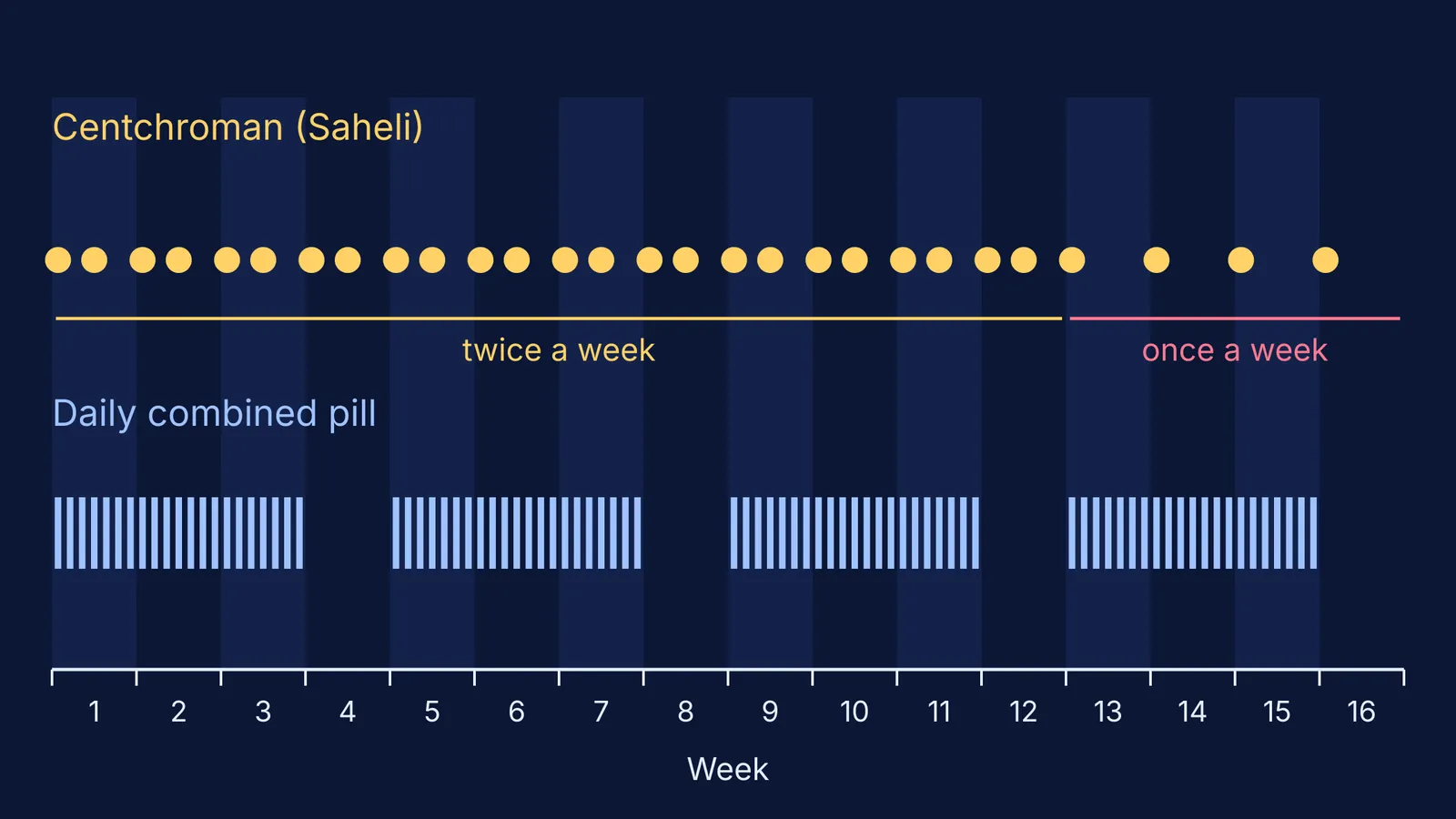
NCERT describes the common pill as small doses of progestogens, or progestogens with oestrogen, taken daily for 21 days, then a 7-day gap, repeated each cycle (NCERT, Reproductive Health). Those are steroid hormones.
Centchroman is not a steroid. It is a selective oestrogen receptor modulator (SERM): a molecule that acts like oestrogen in some tissues and blocks it in others, as the BMJ Open review explains. The same review says that at the doses studied it does not seem to stop ovulation; it works mainly through the cervical mucus and the lining of the uterus, affecting sperm transport and implantation.
The recommended regimen is one 30 mg pill twice a week for 12 weeks, then one 30 mg pill once a week, according to the review.
What does the evidence on centchroman show?
The 2019 review found 33 studies conducted between 1976 and 2017. Eight of them measured how well it prevents pregnancy, in a total of 2,544 women. Reported effectiveness ranged from 96% to 98% in clinical trials and from 93% to 100% in observational studies. The most common side effects were continuous bleeding and cycles longer than 45 days.
The review also flags limits. Roughly half (54.5%) of the studies came from CDRI itself, and the authors concluded there was not enough evidence for global recommendations. That is a useful lesson in reading science: a result is stronger once independent groups repeat it.
This is history and biology, not medical advice. NCERT's chapter says contraceptives should be chosen with qualified medical professionals, so anyone deciding should speak to a doctor or a government health centre.
How do you revise Saheli for a biology exam?
NCERT gives you only a few lines, so the easiest way to remember Saheli is by contrast with the daily pill. Here is a five-point card:
Where: CDRI, Lucknow (NCERT's own wording).
What it is: a non-steroidal oral contraceptive, not a progestogen or oestrogen.
How often: once a week, against daily for 21 days for the usual pill.
How it is described in NCERT: very few side effects and high contraceptive value.
The trap: do not write that Saheli "stops ovulation" as its main action; the review says it acts mainly on the uterine lining and cervical mucus.
Self-test: cover the card and explain in two sentences why a non-steroidal pill is a different kind of method. If the words "oestrogen receptor" or "implantation" feel shaky, the Fermi Concept Library has a lesson for each concept in biology and chemistry and shows its place in the map.
For the rest of the story, read how Gregory Pincus helped make the first birth control pill, how G. P. Talwar worked on an hCG contraceptive vaccine, and revise the female reproductive system diagram that all of these methods act on.