

On this page
In the early 1950s, reproductive biologist Gregory Pincus and his collaborator Min Chueh Chang at the Worcester Foundation for Experimental Biology in Shrewsbury, Massachusetts, investigated a fundamental physiological question: whether hormones could reliably prevent pregnancy by stopping ovulation. Researchers already knew that natural progesterone halts ovulation during pregnancy. However, natural progesterone had severe limitations: it was rapidly degraded by the liver when swallowed, had low oral bioavailability, and was prohibitively expensive to extract.
Why did Gregory Pincus turn to synthetic progestins?
In 1951, birth control advocate Margaret Sanger and philanthropist Katharine McCormick met Pincus and secured independent philanthropic funding to investigate hormonal contraception. At the Worcester Foundation, Chang screened numerous chemical compounds in female rabbits and rats to identify agents that could withstand oral ingestion.
The decisive breakthrough came from steroid chemistry. In Mexico City, chemists Carl Djerassi, Luis Miramontes, and George Rosenkranz synthesized norethindrone (19-nor-17α-ethynyltestosterone) from Mexican yams, as documented in the Journal of the American Chemical Society. Soon after, Frank Colton at G.D. Searle & Company synthesized norethynodrel. By removing the carbon-19 methyl group and adding an ethynyl group at position 17, chemists created 19-nor steroids that resisted hepatic metabolism and remained orally active.
In their 1956 study in Science, Pincus, Chang, and their co-authors reported that oral doses of norethynodrel and norethindrone completely suppressed ovulation in female animals. Once treatment stopped, normal ovulatory cycles and fertility resumed immediately.
How does progestin block the ovulatory hormonal surge?
To understand how synthetic progestins work, you have to trace the hypothalamic-pituitary-ovarian axis studied by endocrinologists in Science. In a typical 28-day ovarian cycle, the hypothalamus secretes gonadotropin-releasing hormone in pulses, stimulating the anterior pituitary gland to release follicle-stimulating hormone (FSH) and luteinizing hormone (LH).
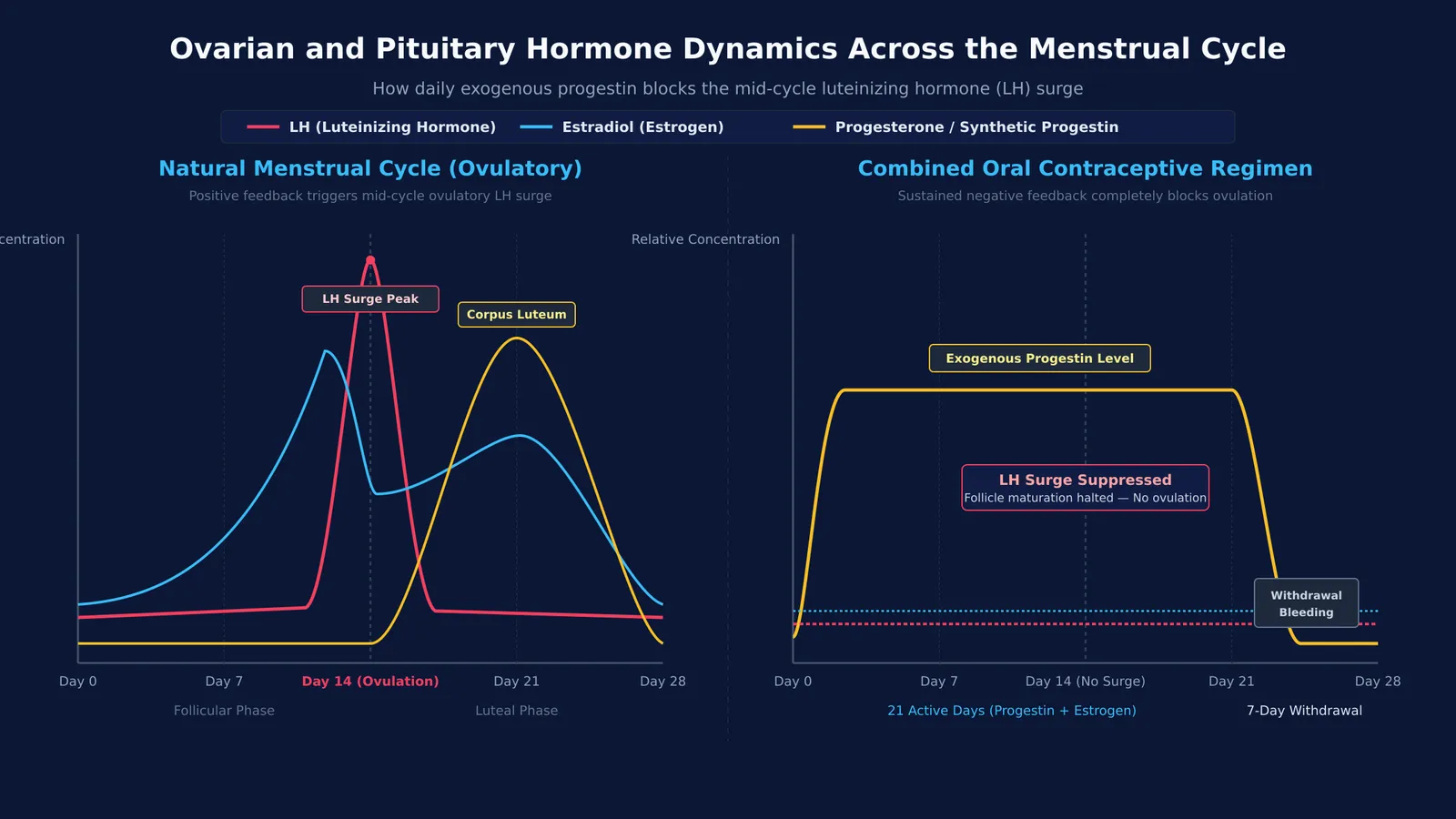
During the first 12 to 14 days of the follicular phase, FSH drives the maturation of ovarian follicles, which secrete increasing amounts of estradiol. When estradiol reaches a critical peak, the endocrine circuit switches to positive feedback, triggering a massive wave of luteinizing hormone known as the LH surge. This surge causes the mature Graafian follicle to rupture and release a secondary oocyte, a mechanism central to human reproductive hormones for NEET.
Daily ingestion of synthetic progestin alters this sequence completely. Sustained blood concentrations of exogenous progestin exert continuous negative feedback on both the hypothalamus and anterior pituitary gland. In clinical research published in Science by gynecologist John Rock, Gregory Pincus, and Celso-Ramon Garcia, daily progestin administration suppressed ovulation, confirmed by suppressed urinary pregnanediol excretion and flat basal body temperatures. Endocrinologists showed this suppression is driven by negative feedback abolishing the mid-cycle LH surge.
Without this surge, ovarian follicles cannot rupture, preventing ovulation. In addition, progestin thickens cervical mucus to block sperm transit and alters the endometrial lining to impede blastocyst implantation. Tracing these simultaneous actions shows how hormonal feedback loops orchestrate both systemic and tissue-specific responses.
What did the clinical trials in Puerto Rico reveal?
Because Massachusetts state laws prohibited contraception, Pincus and Rock partnered with physician Edris Rice-Wray in 1956 to conduct human clinical trials in San Juan and Humacao, Puerto Rico. In their landmark report in the American Journal of Obstetrics and Gynecology90722-1), the team monitored 265 women across 1,712 menstrual cycles taking daily 10 mg tablets of norethynodrel with mestranol.
In the trial data90722-1), the physiological efficacy was absolute: among women who took the tablet for 20 consecutive days each cycle as prescribed, zero pregnancies occurred. Across the full trial, 17 pregnancies occurred, but every conception was traced to missed doses ranging from 3 to 17 forgotten tablets. Prior to the trial, the baseline fertility rate was 67 pregnancies per 100 person-years; with adherence, the rate dropped to zero.
The trials also documented side effects, including nausea, dizziness, and headaches, with Dr. Rice-Wray reporting significant adverse reactions in approximately 17% of participants. Despite these adverse effects, the data confirmed that hormonal ovulation suppression was safe and reversible. On 9 May 1960, the United States Food and Drug Administration approved Enovid 10 mg as the first oral contraceptive pill, as detailed in the Journal of the History of Medicine and Allied Sciences.
Modern oral contraceptives use hormone dosages ten to twenty times lower than early formulations, maintaining high contraceptive efficacy with fewer side effects, as outlined in global guidelines from the World Health Organization.
How do you solve endocrine feedback loop problems?
When preparing for competitive biology examinations or reviewing chemical coordination and hormone pathways, questions on reproductive endocrinology test your ability to predict systemic physiological changes when feedback loops are altered.
You can solve these problems reliably using a four-step framework:
Identify the primary control axis: specify the upstream controller (hypothalamus), the intermediate transducer (anterior pituitary), and the downstream target gland (ovary).
Determine feedback polarity: identify whether a circulating hormone exerts negative feedback (inhibiting upstream secretion) or positive feedback (stimulating a surge at threshold concentrations).
Insert the pharmacological variable: treat an exogenous hormone as a constant non-zero value, which maintains persistent negative feedback regardless of the cycle phase.
Predict organ-level outcomes: deduce which gonadotropin surges are suppressed, whether gamete release occurs, and how target tissues such as cervical mucus or endometrium respond.
When multi-hormone cascades feel difficult to visualize on paper, the Fermi Simulation Lab provides interactive simulations for ideas that are easier to see than to read, allowing you to manipulate hormone levels and observe feedback suppression in real time.
To reinforce how gonadotropins interact across each phase of the cycle, the Fermi Concept Library covers every concept in physics, chemistry, biology, mathematics and computing, each with its own lesson and its place in the map, while the Fermi Problem Library offers worked problems with a step-by-step solver that explains the reasoning rather than printing an answer.


