

On this page
In August 1994, immunologist G. P. Talwar and colleagues at the National Institute of Immunology (NII), New Delhi, published a paper titled "A vaccine that prevents pregnancy in women" in Proceedings of the National Academy of Sciences. Instead of using a hormone pill or a device, it trained the immune system to treat a pregnancy hormone as a target. The vaccine never became a product you can buy. Still, it is a clear example of immunology applied to reproduction, and it was tested in women in India.
Who is G. P. Talwar?
Gursaran Prasad Talwar was born on 2 October 1926 in Hisar and worked at the Pasteur Institute in Paris, according to his Wikipedia biography. He joined AIIMS, New Delhi, as associate professor of biochemistry in 1956 and later headed the department until 1983. He was then the founding director of NII from 1983 to 1994. His work on *Mycobacterium indicus pranii* led to a leprosy vaccine, and he received the Padma Bhushan in 1992.
What is hCG and why make a vaccine against it?
Human chorionic gonadotropin (hCG) is a hormone made by trophoblast cells, the embryo-derived cells that become part of the placenta, as described in a 2009 review by Laurence Cole. Its best-known job is to keep the corpus luteum making progesterone in early pregnancy, which keeps the uterine lining in place. The same review notes that hCG has two subunits, alpha and beta, and that its alpha subunit is identical to the alpha subunit of luteinising hormone (LH).
Antibodies against the shared alpha part could also attack LH, which the body needs for ovulation. So Talwar's team built the vaccine around the beta subunit, the part that makes hCG different. Talwar's group later summed up the logic: because hCG matters for establishing a pregnancy, antibodies that neutralise it should prevent one.
How did the hCG vaccine work?
The body normally does not make antibodies against its own hormones. To get around this, the team linked the hormone to a carrier the immune system already reacts to strongly. In a 1976 PNAS paper, they joined processed beta-hCG to tetanus toxoid. In animals and one human volunteer, the result produced high-affinity anti-hCG antibodies, booster doses produced a rapid recall response, and the antibodies did not cross-react substantially with other hormones.
The version tested in the 1990s went one step further. It paired beta-hCG with the alpha subunit of sheep LH (a "heterospecies dimer") and attached it to both tetanus and diphtheria toxoids, as described in the 1994 PNAS paper.
What did the Indian clinical trials find?
A 1997 report in the American Journal of Reproductive Immunology describes two stages. Safety trials enrolled 47 women who were having tubal ligation. Efficacy trials then enrolled 148 fertile women.
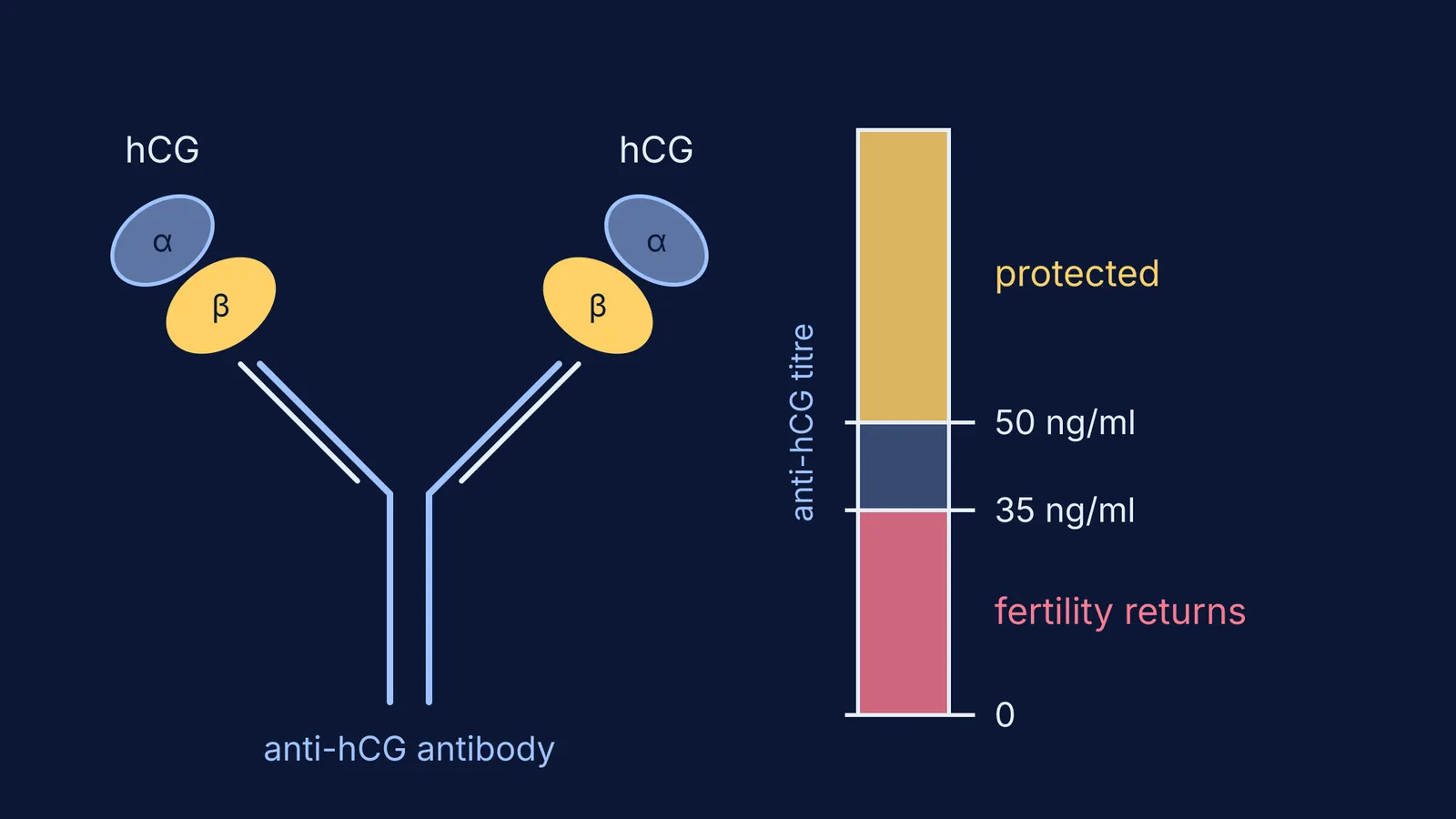
Women with antibody levels above 50 ng/ml had 1 pregnancy in 1,224 cycles (PNAS, 1994).
Antibody levels fell over time, and fertility returned when they dropped below 35 ng/ml (same paper).
Ovulation and menstrual regularity were not disturbed (AJRI, 1997).
Women who later wanted a child conceived after their antibodies declined and gave birth to normal children, the group reported in a 2021 review.
The catch was in that 50 ng/ml line. Protection depended on each woman's own immune response staying above it, and antibodies faded, so booster injections were needed. The same 2021 review describes a newer, genetically engineered version (hCG-beta linked to a bacterial toxin subunit called LTB). With approval from India's Drugs Controller General, a combined phase I/II trial began, but only nine women had received their primary injections when the COVID-19 epidemic arrived.
How do you explain the hCG vaccine in an exam answer?
This topic connects three NEET-UG biology chapters: hormones, reproduction and immunity. Here is a five-link chain where each step follows from the one before.
The vaccine contains beta-hCG joined to a carrier (tetanus or diphtheria toxoid).
The immune system makes antibodies that bind hCG.
If an embryo forms, the hCG it releases is neutralised by those antibodies.
Without hCG, the corpus luteum is not kept going, so progesterone is not sustained.
The uterine lining is not maintained, so pregnancy is not established.
Worked example. Question: "A woman with high anti-hCG antibody levels has a normal LH surge. Does she ovulate?" Answer: yes. The vaccine targets the beta subunit unique to hCG, so LH still works, and the trials found ovulation was not impaired. The block comes after fertilisation, at step 3.
Try the reverse question yourself: why would a vaccine using the whole hCG molecule be a bad idea? Hint: look at the shared alpha subunit.
To revise the hormones in steps 4 and 5, read our guide to human reproduction, the menstrual cycle and its hormones. For where this fits among other birth control methods, see reproductive health for NEET. For antibodies and how vaccines train them, see human health and immunity.
If the corpus luteum or the carrier idea still feels shaky, the Fermi Concept Library covers every concept in biology, each with its own lesson and its place in the map, so you can see how hormones and immunity connect.


