On this page
Before 1962, light-emitting diodes existed, but nobody could see their light. They were made of gallium arsenide, and their light was infrared. Nick Holonyak Jr. changed the material and got red light you could see. That change is a clear example of a physics idea from your syllabus: the band gap of a semiconductor sets the colour of its light.
Who was Nick Holonyak and what did he make in 1962?
Holonyak grew up in Zeigler, a coal-mining town in southern Illinois, according to the IEEE Photonics Society. He was John Bardeen's first doctoral student and finished his PhD at the University of Illinois in 1954, says the University of Illinois obituary.
On 9 October 1962, working at General Electric, Holonyak demonstrated the first visible-light-emitting diode (University of Illinois). He was 33. GE colleagues called the device "the magic one" because its light, unlike that of infrared lasers, was visible (GE press release). He and S. F. Bevacqua reported the work in Applied Physics Letters on 1 December 1962, under the title "Coherent (visible) light emission from Ga(As1-xPx) junctions" (Crossref record, DOI 10.1063/1.1753706).
In a 2012 interview he remembered the reaction at GE: "When I went to show them my LED, all the chemists at GE said, 'You can't do that. If you were a chemist, you'd know that wouldn't work.' I said, 'Well, I just did it, and see, it works!'" (University of Illinois). He called the LED the "ultimate lamp" because "the current itself is the light" (GE). He joined the Illinois faculty in 1963 and died on 18 September 2022, aged 93.
Why did gallium arsenide phosphide give red light?
In an LED, an electron drops from the conduction band into a hole in the valence band. The energy it loses comes out as one photon. That photon's energy is roughly equal to the band gap, the energy gap between the two bands.
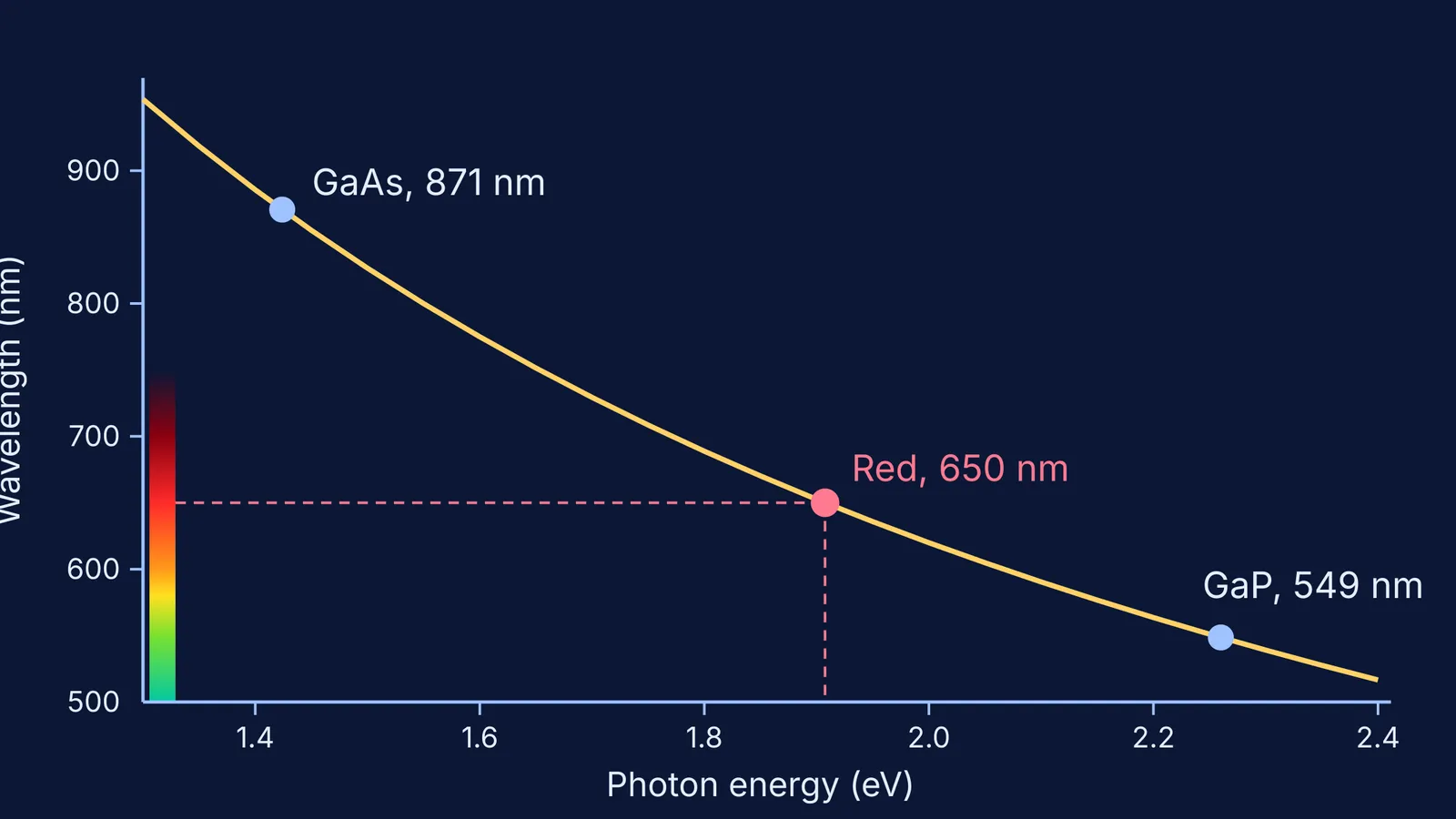
Gallium arsenide has a band gap of 1.424 eV at room temperature (Ioffe Institute semiconductor data, GaAs). Gallium phosphide has a band gap of 2.26 eV (Ioffe Institute, GaP). If you swap some of the arsenic atoms for phosphorus, you get an alloy, GaAs(1-x)P(x), whose band gap lies between the two. Holonyak's idea was to use that alloy as a dial for colour.
There is a limit. According to NPTEL course notes on LEDs/slides/Sec-1/8.html), the alloy has a direct band gap while x is below 0.45, emitting red and infrared light from 630 nm to 870 nm. Above 0.45 the gap becomes indirect: the electron cannot drop down by giving off only a photon, so much less light comes out. The trick was enough phosphorus to reach red, but not so much that the alloy stopped glowing well.
How do you work out an LED's colour from its band gap?
Photon energy is E = hc/λ. NIST gives Planck's constant as 4.135667696 × 10^-15 eV s (NIST CODATA) and the speed of light as 299 792 458 m/s (NIST CODATA). Multiply them and you get hc ≈ 1240 eV nm. That gives a shortcut worth memorising:
λ (in nm) ≈ 1240 ÷ E (in eV)
Try it on the band gaps from the Ioffe Institute:
Gallium arsenide: 1240 ÷ 1.424 ≈ 871 nm. That is infrared, which is why earlier gallium arsenide LEDs gave light you could not see.
Red light at 650 nm: 1240 ÷ 650 ≈ 1.91 eV. That is the band gap you need, wider than GaAs, so you add phosphorus.
Gallium phosphide: 1240 ÷ 2.26 ≈ 549 nm, green. But pure GaP has an indirect gap, so this simple estimate does not tell you how bright it will be.
Step three is where students slip: the formula gives the colour, but only a direct gap tells you the material will glow well.
What should you practise next?
If you are revising semiconductors for boards or JEE Main, use this short check on any LED question:
Write down the band gap in eV and convert it with 1240 ÷ E.
Place the answer on the spectrum: about 700 nm is deep red, about 550 nm is green.
Ask whether the gap is direct or indirect before you decide whether the LED is bright.
In circuit questions, remember why an LED needs a series resistor.
Revise what a hole in a semiconductor is and how it moves, since the light comes from an electron filling one.
Bands and gaps are easier to see than to read. If the picture of electrons falling across a gap still feels abstract, the Fermi Simulation Lab has interactive simulations for ideas like this. If a word such as "valence band" is the real gap in your notes, the Fermi Concept Library gives each physics and chemistry concept its own lesson.
Next, see how Holonyak's red dot grew into the lights at home in why LED bulbs use less electricity than old bulbs.